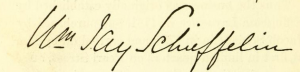
Schieffelin, William Jay (1866–1955)
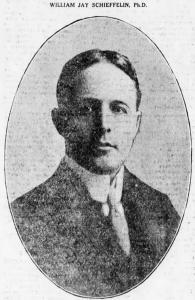
Introduction
William Jay Schieffelin, Republican, Christian, Reformer,
received his Ph.B. from the Columbia School of Mines, phi beta kappa
received his Ph.D. with honors in chemistry from Munich
was president of Schieffelin and Co,
was president of the National Wholesale Druggists Association
was vice-president of the American Pharmaceutical Association
was vestryman of St. George's Church
was manager of the American Bible Society
was president of the American Church Missionary Society
was president of the Laity League
was chairman of the Social Service Committee of the Men and Religion Forward Movement
was president of the American Mission to Lepers
was president of the Huguenot Society of America
was chairman of the Board of Trustees of Hampton Institute
was chairman of the Board of Trustees of Tuskegee
was president of the Armstrong Association
was chairman of the Defense Committee for the Scottsboro Boys
was Colonel of the 369th Harlem regiment
was chairman of the Colored Men’s Department, YMCA
was president of the Citizens Union
was organizer of the Committee of One Thousand that drove Mayor Jimmy Walker from office
was vice president of the Men’s League for Women’s Suffrage
was president of the Serbian Child Welfare Association
was chairman of the Volunteer Christian Committee to Boycott Nazi Germany
etc.
Where to begin?
Education and Formation A great-great-grandson of Chief Justice John Jay, William Jay graduated Phi Beta Kappa from Columbia’s School of Mines and earned a Ph.D. in chemistry (with honors) in Munich—fluent not just in German, but in scientific German. The mix of laboratory rigor and moral urgency became his lifelong signature.
A Gilded-Age Marriage In 1891 he married Maria Louisa Shepard, granddaughter of William H. Vanderbilt. The wedding was a Fifth Avenue spectacle—presidential gifts, a Hunt-designed Parisian townhouse on East 66th Street, summers at Bar Harbor (Islecote House), later Tranquility Farm on today’s Schieffelin Point, and eventually 620 Park Avenue. The Vanderbilt capital and the Schieffelin conscience underwrote a life of comfort yoked to reform.
The Businessman President of Schieffelin & Co., president of the National Wholesale Druggists Association, and vice-president of the American Pharmaceutical Association, he became a prominent public voice on patent medicines and habit-forming drugs. After the 1906 Pure Food and Drugs Act, he praised labeling requirements that exposed cocaine-laced “catarrh cures,” warning that America’s culture of self-medication was the true accelerant. He favored strict control even over cannabis (“not as dangerous as cocaine,” but better classified with it), a stance whose legal shadow lingers.
The Churchman and Social Gospel Advocate A vestryman at St. George’s, he poured energy into the Social Gospel: American Bible Society, American Church Missionary Society, Laity League, the Men and Religion Forward Movement—a program that reframed Christian duty as public action, especially for men. His tone was reformer-brisk rather than pietist-soft. In a speech to Italian Presbyterians about the Men and Religion Forward Movement, William Jay said
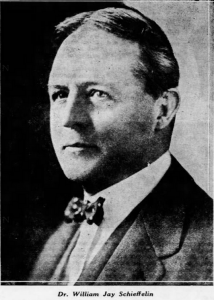
“If we are really going to follow the teachings of Christ and become ‘fishers of men,’ we must go out into the world and mingle in friendly fashion with all those we come in contact with…There are many people already in the Church who don’t believe in playing cards, using tobacco, or going to the theater. But if doing these things is going to enable me to bring people +who now do them into the Church I am going to do them.
‘The men of his country are beginning to realize that they have cared too much about comfort and too little about character in the past. If you are going to join our movement, study the conditions in your district, prevent immorality, stop the bad moving picture shows, co-operate with the officers of the law, and never fail to vote.”
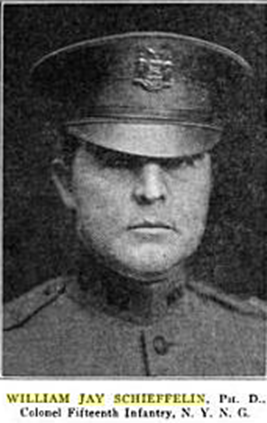
The Soldier A captain and adjutant in the Spanish-American War, in World War I he served as colonel of the 369th Infantry (Harlem Hellfighters)—the first all-Black New York regiment to fight with the AEF (attached to the French). The unit never lost a trench or prisoner; members amassed Croix de Guerre and Légion d’Honneur decorations. Their heroics helped shift public views of Black soldiers.
Two and many were awarded to members of the regiment. The most celebrated man in the 369th was Pvt. , a former Albany, New York, rail station porter, who earned the nickname “Black Death” for his actions in combat in France. In May 1918 Johnson and Pvt. fought off a 24-man German patrol, though both were severely wounded. After they expended their ammunition, Roberts used his rifle as a club and Johnson battled with a . Reports suggest that Johnson killed at least four German soldiers and might have wounded 30 others.
The Lincoln Republican Chair of the boards at Tuskegee and Hampton, president of the Armstrong Association, and later chair of the Scottsboro Defense Committee (1932), he fundraised alongside Booker T. Washington. He spoke bluntly—sometimes too bluntly for modern ears: “The bad Southerner, the poor white trash, complain that they cannot get work owing to the competition of educated colored men...The negro is not economically fitted to be a city dweller. His impulsive nature, for one thing, unfits him to meet the excitement and strain of city life.” But his Christian convictions kept him out of the era’s eugenic cul-de-sacs.
The Political Reformer Civil Service Commissioner (1896), Citizens Union president, and architect of the Committee of One Thousand that helped topple Mayor Jimmy Walker during the Seabury investigations. He backed censorship enforcement more humanely than Comstock—rejecting entrapment, tolerating frank discussions of birth control—and told lay audiences to “mingle in friendly fashion” and vote.
Character and Legacy A tireless, sometimes severe reformer who “put moral energy back into the system.” Not easy to live with, perhaps—but indispensable when public life frays. Maria Louisa died August 18, 1948; William Jay on April 29, 1955. Both rest in the Schieffelin Mausoleum in the uptown Trinity Churchyard.