Tupper, Katherine Boyce (1882–1978)
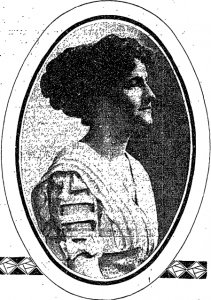
Education and Early Career Katherine graduated from Hollins College in 1902 and then studied drama at the American Academy of Dramatic Arts in New York. She and her sister Allene went on to London, where Katherine attempted a stage career. Her American accent, however, proved a serious obstacle. When she joined a cast, her father cut off her allowance; Allene continued to receive hers and supported them both while Katherine tried to lose her accent. She played small parts, but soon became ill from exhaustion. Back in Baltimore she was advised to rest in the Adirondacks, where she met again her childhood friend Clifton Stevenson Brown, who fell in love with her and proposed. She initially refused, determined to continue acting, but recurring illness and partial paralysis convinced her to abandon the stage.
Marriage to Clifton Stevenson Brown On September 30, 1911, Katherine married the Baltimore attorney and champion tennis player Clifton Stevenson Brown at her parents’ home, 34 Gramercy Park, New York. They settled in Baltimore at 1015 North Calvert Street and had three children: Molly, Clifton Jr., and Allen. Katherine had some independent means and purchased a summer cottage on Fire Island.
On June 4, 1928, she called her husband’s office to report that the final papers for the cottage purchase had arrived—but there was no answer. That same day, Louis Berman, a disgruntled client, shot Brown in his office in the Calvert Building. Brown had represented Berman in settling his father’s estate and sued him for an unpaid legal fee. Berman ambushed Brown, shooting him five times; he died minutes later at Mercy Hospital. Katherine was left a widow with three children aged thirteen, eleven, and nine.
Berman’s trial in September 1928 drew wide attention. His own psychiatric experts testified that he was sane; when their statements undermined his defense, his attorney tried to discredit them. Berman was convicted of first-degree murder and sentenced to life imprisonment. In prison he filed hundreds of habeas corpus petitions, arguing his psychiatric examination had been too brief, and taught other inmates to do the same. His antics finally prompted the Maryland legislature to pass a law forbidding endless repetition of previously settled legal claims.
Widowhood and New Beginnings After her husband’s murder, Katherine stayed for eight months with her sister in Connecticut, then traveled with her daughter Molly to Hawaii, living for several months in a cottage in Waikiki. On her return trip she stopped in Columbus, Georgia, to visit Mrs. William Blanchard, Molly’s godmother. At a small dinner at the home of Mrs. Blanchard’s friend, she met Lt. Col. George C. Marshall.
George C. Marshall, Widower.
While a cadet at VMI, George Marshall met his future wife, Elizabeth (“Lily”) Carter Coles. “She was a very lovely looking woman,” said Marshall. “I guess you might call her a beauty.” Lily lived with her mother in a house just off of the campus. She was “the finest amateur pianist” Marshall had ever heard, and her music and charm so captivated him that he routinely “ran the block” to see her. These visits were against school regulations and would be dismissal offenses if discovered. Because Marshall was the senior military officer of his class, he gambled that he was above suspicion. Moreover, he was in love. The young couple were married on February 11, 1902, in a simple Episcopal ceremony inside the bride's home. The marriage was an extraordinarily happy one for twenty-five years.
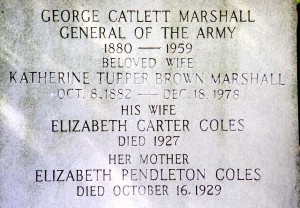
Lily died in 1927 of a heart condition that had prevented her from having children.
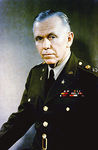
Meeting George C. Marshall Katherine later described their meeting: “When he first arrived the Colonel was standing by the fireplace. My first impression was of a tall, slender man with sandy hair and deep-set eyes. He refused the cocktails when they were served and this attracted my interest, for it was in prohibition times when the main topic of conversation was, ‘How do you make your gin?’ I said, ‘You are a rather unusual Army officer, aren’t you. I have never known one to refuse a cocktail before.’ He asked agreeably how many I knew. ‘Not many,’ I confessed.”
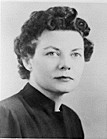
Katherine as a widow.
G****eorge as Widower
Their courtship continued quietly. Katherine recalled his dry wit—his pretending to be lost while deliberately avoiding the street where her hosts lived—and his steady reserve. Her children quickly came to like him. Allen, age twelve, wrote Marshall a letter: “I hope you will come to Fire Island. Don’t be nervous, it is OK with me. (Signed) A friend in need is a friend indeed.”
Marriage to General George C. Marshall They were married on October 2, 1930, in the chapel of Emmanuel Episcopal Church in Baltimore. The best man was General John J. Pershing, under whom Marshall had served as aide-de-camp. Pershing, too, had known tragedy: his wife and three daughters had died in a fire at the Presidio in 1915.
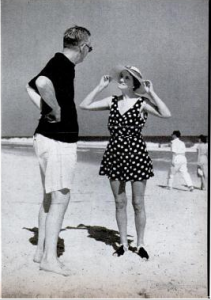
Life with Marshall Katherine shared the hardships of an underfunded peacetime army in the 1930s, moving from post to post and maintaining a modest household on limited means. In 1938, she and her daughter Molly were at their Fire Island cottage (left) when the great New England hurricane struck. Their house survived, but they had to wade through waist-deep water to safety.
During the Second World War she endured the burdens of being the wife of the Army Chief of Staff. She faced shortages, cared for a household at Leesburg, Virginia, and worried for her sons—both in uniform. After Pearl Harbor she feared for her country’s survival; later she feared for her children’s lives. When she tried raising chickens to offset food shortages, the effort proved so traumatic that she resolved never again to complain about butcher prices.
War and Later Life Her son Allen Tupper Brown, serving as a tank officer in France, was killed in action in 1944. Katherine appeared that year in Life magazine, her hair now white from strain. She stood beside her husband through the war, postwar reconstruction, and his later diplomatic service. Their home in Leesburg, Virginia, called Dodona Manor, became their refuge in retirement.
Author and Memoirist Katherine published Together: Annals of an Army Wife (New York: Tupper and Love, 1946), a vivid memoir of her years with Marshall and her reflections on duty, loss, and devotion.
Final Years George C. Marshall died in 1959. Katherine lived quietly at Leesburg until her death in 1978 at age ninety-six. She was buried beside her husband at Arlington National Cemetery.
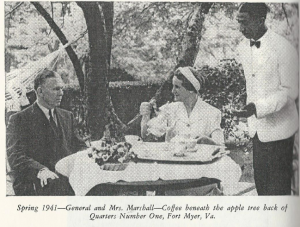
The Marshalls in Spring 1941
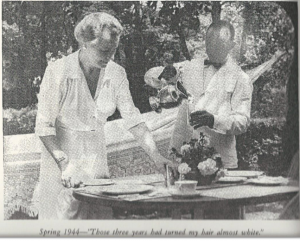
Katherine in Spring 1944. She said the war had turned her hair white.
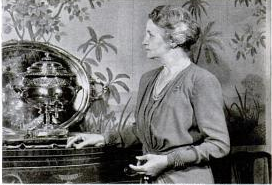
Katherine in Life Magazine, 1966
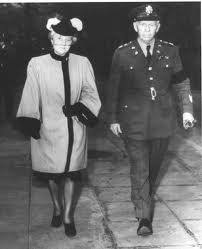
The Marshalls in April 1945
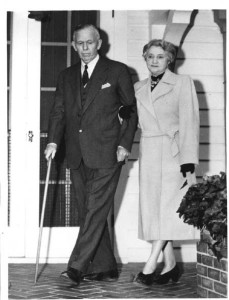
The Marshalls in 1949
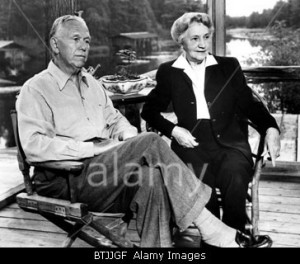
The Marshalls in retirement, 1950

Dodona, the Marshalls’ house in Leesburg, Virginia
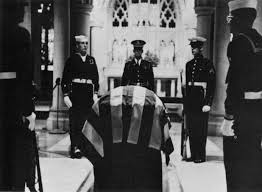
George Marshall’s funeral, 1959
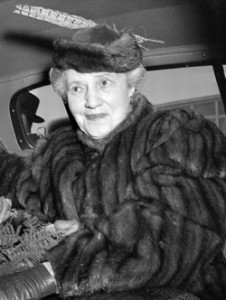
Katherine lived to be 96.
Katherine at 96.
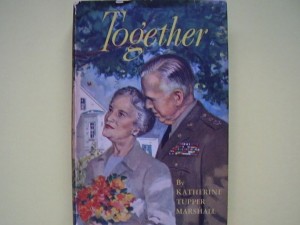
Together: Annals of an Army Wife
By Katherine Tupper Marshall (New York: Tupper and Love, 1946)
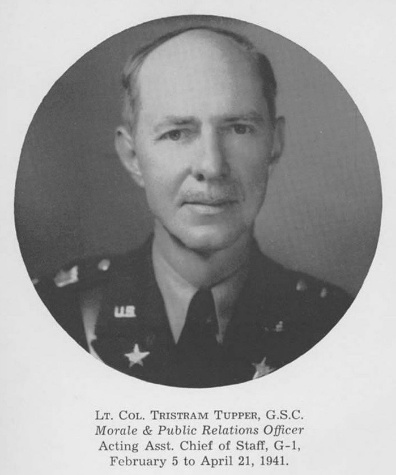
Tupper, Tristram, Brig. Gen. (1885–1954)
Brigadier General
Parents: Rev. Henry Allen Tupper Jr. (1856–1927) and Marie Louise Pender (1859–1921). Married: (1) Ruth Reynolds (1891–1971); (2) Clara Caroline Tarbell (1885–1966), niece of the journalist Ida Tarbell; (3) Marion Cecile Ferrill (1908–1982). Children: With Ruth Reynolds: Ruth Reynolds Tupper (1911–1985) and possibly Edward Allen Reynolds (1913– ); with Clara Tarbell: Caroline Tarbell Tupper (1920–2024) and Tristram Tupper Jr. (1926–1999).
Kinship: Second cousin twice removed of the post–World War II Smith generation.
Education and Early Life Tristram attended Phillips Academy, Andover, and graduated from New York Law School in 1912. He tried his hand at several occupations, none of them, as he later admitted, very successfully. In July 1917 he married Clara Caroline Tarbell, the niece of the famous muckraking writer Ida Tarbell.
Military Service in the First World War In 1916 Tristram enlisted as a private in the Army. He first served on the Mexican border and then went to France with the 7th Regiment, the “Silk-Stocking Regiment,” composed largely of the young men of New York society. As the 107th Infantry Regiment it sailed with General John Francis O’Ryan’s 27th Division, fought in France, and helped to break the Hindenburg Line. A line in the Social Register offered little protection from German shells.
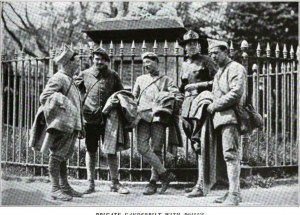
Private Vanderbilt and new French friends The Fallen of the 107th
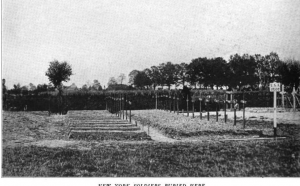
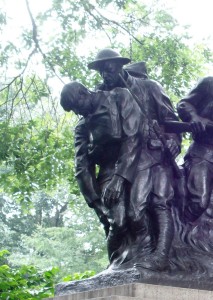
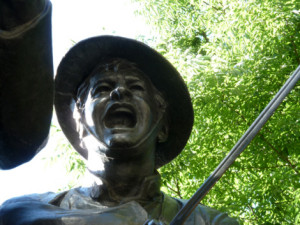
The monument to the 7th. It portrays the fierceness of battle and the results of battle.
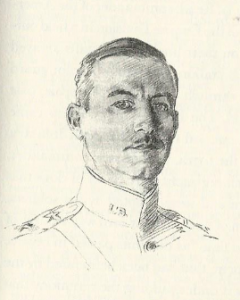
Tristram served as Adjutant General to General O’Ryan (left), commander of the 27th Division. He witnessed the devastation of the Western Front at Ypres, where the trenches were “nothing but torn places in the earth surface where soldiers might escape enemy observation if they lay flat on the ground and did not move.”
General O’Ryan, by John Singer Sargent (left)
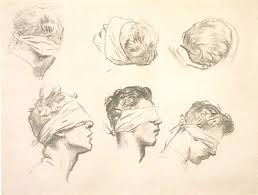
John Singer Sargent and “Sargent’s Studio of Shellfire” In August 1918 Tristram met the painter John Singer Sargent, who had been attached to O’Ryan’s command near Vierstraat Bridge at Ypres while making studies for his painting Gassed. Sargent and Tupper met first when the artist was sketching General O’Ryan and later again in the trenches. Tupper described these encounters in his article “Sargent’s Studio of Shellfire,” published in The New York Times, March 23, 1919.
He wrote that “this valley might truthfully be called the valley of the shadow of death. The maps showed neat rows of trenches. But there were no trenches—nothing worthy of the name—merely shell holes and torn places in the earth surface where soldiers might escape enemy observation through the day if they lay flat on the ground and did not move.”
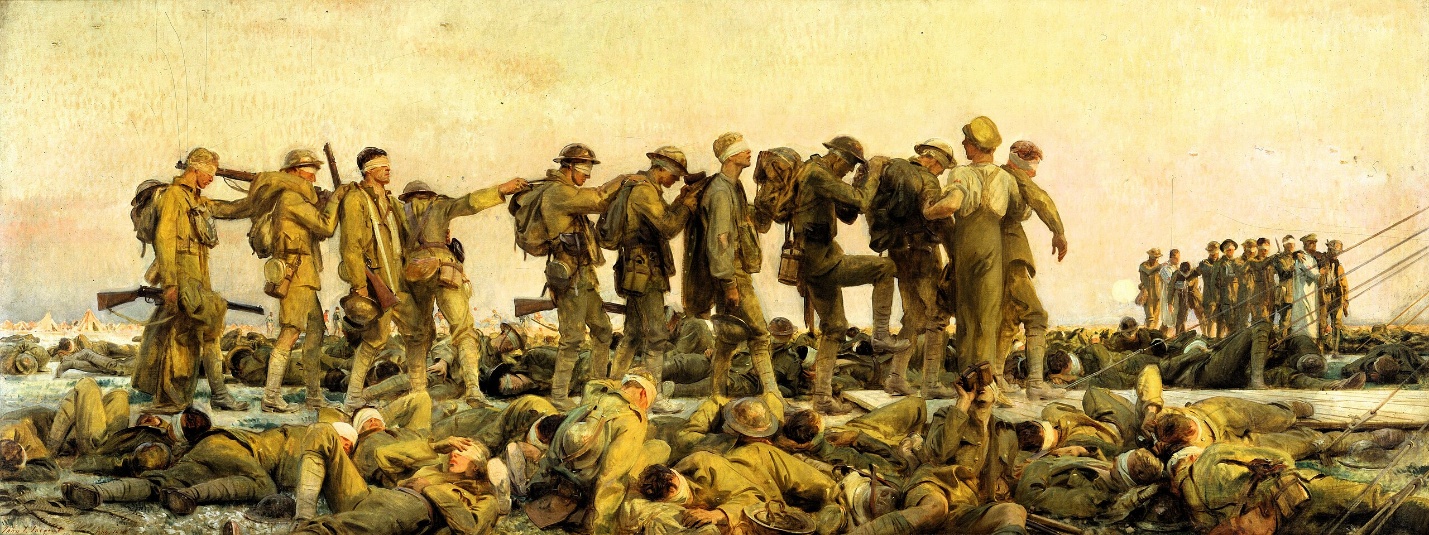
Tupper described seeing Sargent on the battlefield with his umbrella, canvas, and paints, watching the fighting but not painting. “The reason was obvious—all the paintings of all the great galleries of the world can give no adequate impression of war. It is indescribable. You may read all the books in the libraries, you may look at all the paintings of the masters, and you will not get anything akin to the feeling caused by the sight of a man stumbling forward, wounded, with the dream of life fading from his eyes.”
Paul Fussell in The Great War and Modern Memory describes how soldiers drowned slowly in the mud, and how the landscape was haunted by its name: The Valley of the Passion.
Later Tristram saw Sargent on the battlefield, searching for a dugout in which a soldier had drawn a picture. Then he saw him on a hill, watching the battle in which the Americans were pushing back the Germans at Vierstratt, Sargent had his umbrella and canvas and paints. But Sargent was not painting.
Tupper explained why: “The reason was obvious – all the paintings of all the great galleries of the world can give no adequate impression of war. It is indescribable. You may read all the books in the libraries, you may look at all the paintings of the masters, and you will not get anything akin to the feeling caused by the sight of a man stumbling forward, wounded, with the dream of life fading from his eyes.
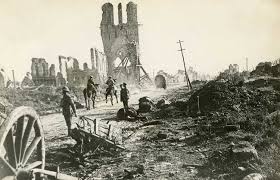
Their last meeting was at Ypres (right), “where not a house had a roof and not a room four walls—a ruin more complete than Pompeii.” Sargent, painting amid the rubble of the cathedral, pointed to a pigeon that had returned to the shattered tower and said, “It’s in the heart of every living thing. The thing that has brought the pigeon back to the cathedral tower where it used to live will bring men back to these ruined towns and cities. They will build again. Home has an irresistible power. Men and beast always return.”
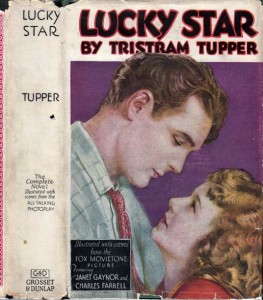
Postwar Career as Writer After the war, Tupper devoted himself to writing fiction, journalism, and screenplays. For fifteen years he wrote scenarios for Fox, Republic, and Universal Pictures, moving between New York and Hollywood. His stories appeared regularly in The Saturday Evening Post, The American Magazine, and other national publications.

Selected works include: “Adventuring,” The Saturday Evening Post, Jan. 27, Feb. 3, Feb. 10, 1923. “Four Brothers,” The Saturday Evening Post, Apr. 7, 1928. “The Language of the Angels,” The Saturday Evening Post, Jun. 3, Jun. 10, 1922. “The Magnolia Grove,” The Saturday Evening Post, Aug. 3, 1935. “The Man Who Knew Nothing on Earth,” The World’s Greatest Stories, Apr. 1929. “The Man Who Swam the Pacific,” The American Magazine, Jul. 1937. “Prelude to Summer,” The American Magazine, Aug. 1936. “The River,” The Saturday Evening Post, Nov. 26, Dec. 3, Dec. 10, 1927. “A Storm at the Crossroads,” The Saturday Evening Post, Jun. 16, 1923. “Three Episodes in the Life of Timothy Osborn,” The Saturday Evening Post, Apr. 9, 1927. “Too Old to Be Spanked,” The Saturday Evening Post, Nov. 2, 1946. “When the Band’s Not Playing,” The Mother’s Magazine, Sept. 1917.
Hollywood and the Screen In Hollywood Tupper’s war experience and narrative skill made him a valuable scenario writer during the transition from silent films to talkies. He worked on adaptations and original stories that combined action with moral or psychological tension. Among his screenwriting credits or story contributions are: The Fighting Rookie (1934, Columbia Pictures) – story contributor. The Last Trail (1933, Fox Film Corporation) – adapted from his short story “The Last Trail.” The Lady Who Dared (1931, Warner Bros.) – story contributor. The Golden Hoard (unproduced screenplay, 1938). Hell’s Angels (1930, Howard Hughes Productions) – uncredited dialogue contributions drawn from his war reportage.
He also collaborated on early treatments for war films later developed by others, including The Eagle and the Hawk (1933).

During the 1930s he maintained a parallel career in magazine fiction, writing character-driven adventure and domestic stories for popular publications, and lectured occasionally on the portrayal of war in literature and film.
Army Public Relations and the Second World War From 1939 to 1941 Tristram served as Public Relations Officer at Fort McClellan, Alabama, where he met Marion Cecile Ferrill, chief nurse of the post hospital. When the Second World War began, General George C. Marshall, his brother-in-law, arranged an appointment for him as a Brigadier General in charge of war correspondents in the Mediterranean Theater.
Journalist Ed Kennedy described him in Ed Kennedy’s War: “During the last days of Algiers a new general had arrived to take command of public relations in the Mediterranean Theater. He was the mouse-like Brigadier General Tristram Tupper from Hollywood, a scenario-writing brother-in-law of General George Marshall. Although his job naturally called for contact with correspondents, he went into concealment… Word spread that there was no General Tupper. After we were established in Italy he made a few furtive appearances… When he assumed personal supervision—as press arrangements for the invasion of southern France were made—the result had almost every correspondent howling.”
Later Years and Publishing Career Tristram and Clara Tarbell Tupper separated in 1935; she divorced him in 1947 on grounds of desertion and infidelity. He married Marion Ferrill, who later founded “Marion Tupper’s Moonglade Preserves.”
After retiring from the Army in October 1945, he established the publishing firm Tupper and Love with Arthur Love. Their greatest commercial success was the publication of his sister’s book Together: Annals of an Army Wife (1946), Katherine Tupper Marshall’s memoir of her life with General George C. Marshall.
Death Tristram Tupper died in 1954. He left behind a varied legacy as a soldier, writer, and sometime Hollywood figure—a man who, as one critic wrote, “moved restlessly between the battlefield and the studio, always searching for the story that would make sense of both.”