Brown, Allan Tupper (1916–1944)
**
Parents: Clifton Stevenson Brown (1880–1928) and Katherine Boyce Tupper (1882–1978). Spouse: Margaret Goodman “Madge” Shedden (1916–2006). Children: Allen Tupper Brown Jr. (1941–). Kinship: Third cousin once removed of the post–World War II Smith generation.
Early Life
Allan Tupper Brown was born in Baltimore in 1916, the younger son of Clifton Stevenson Brown, a Maryland judge, and Katherine Boyce Tupper, who after her husband’s tragic murder in 1928 would later marry George C. Marshall, the future Chief of Staff of the U.S. Army and architect of the Marshall Plan.
When Allan was twelve, his father was killed by a disgruntled litigant. The loss marked the family deeply. In her memoir, Katherine recalled the first meeting between her sons and Colonel Marshall:
“The next summer I told my sons that I had asked Colonel Marshall to visit us at Fire Island as I wanted him to know them. Clifton said, ‘If it makes you happier, Mother, it is all right with me.’ But Allen, then twelve, said, ‘I don’t know about that—we are happy enough as we are.’ Early the next morning he came to my room. ‘It is all right, Mother, about your asking Colonel Marshall.’ That summer George told me that Allen had written him a most amusing letter: ‘I hope you will come to Fire Island. Don’t be nervous—it is OK with me. (Signed) A friend in need is a friend indeed. Allen Brown.’ And they were friends until the end.”
Education and Early Career
Allen attended Gilman School in Baltimore, then Woodberry Forest, and later the University of Virginia. After graduation he joined the promotion department of The New York Times in 1936. He married Margaret Goodman “Madge” Shedden, of Westchester County, New York, and they had one son, Allen Tupper Brown Jr. (born 1941). The family lived in a farmhouse near Poughkeepsie.
Military Service
In November 1942, Brown enlisted in the Armored Force of the U.S. Army and entered Officer Candidate School at Fort Knox, graduating as a Second Lieutenant in June 1943. Before shipping out for North Africa that August, he spent a final evening at the family home Dodona in Leesburg, Virginia, with his brothers Clifton and James Winn, both already in uniform. His mother later recalled a characteristic exchange:
“Jim, a Regular Army officer, and Clifton were a bit down in the mouth that Allen, the youngest and last in the service, was to be the first to get to the front. As we approached, Allen was saying, ‘Why shouldn’t I go over first? I’m a tanker, and the tanks lead the fight.’ Clifton broke in with, ‘Where would the tanks be without the Antiaircraft?’ and Jim came back, ‘Who clears the way for the tankers?—the Field Artillery.’”
That night, Katherine provided a farewell dinner of Allen’s favorite dishes. In a small ceremony afterward, he nailed a horseshoe above the garage door for good luck—at first upside down, until protests from the family led him to reverse it “so the luck would not run out.”
Italy and Anzio
Second Lieutenant Brown served with distinction in the 1st Armored Division, taking part in the Italian campaign. General Marshall, though deeply reluctant to use his position for personal influence, agreed to Allen’s request for combat assignment. “I feel quite differently about intervening when it is a move to the front rather than the opposite,” he wrote—allowing his stepson to go into action.
Allen fought at Monte Cassino and later commanded a Sherman tank platoon at the Anzio beachhead, one of the war’s most perilous fronts. From Italy he wrote home cheerfully: “I feel sorry for any German in Italy. The horseshoe has held my luck. I shall take it down this Christmas and keep it for the rest of my life.”
Death in Action
On May 29, 1944, near Campoleone, while leading his platoon in an assault west of Velletri, Allen stood up in his turret to survey the terrain with his field glasses and was killed instantly by a sniper’s bullet—some reports say by a grenade. He was twenty-eight years old.
His brother Clifton Brown, also serving in Italy, arrived at the scene only hours later. He collected Allen’s effects and attended the field funeral on Decoration Day, gathering wildflowers to place on the grave “for Madge and Mother.”
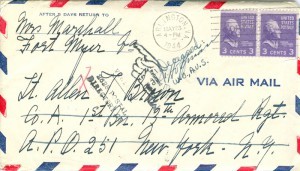
Here is the last letter that his mother wrote to Allen. It is marked “return to sender.”
Aftermath and Remembrance
When news reached Washington, General Marshall went home from his office to tell Katherine in person. Hundreds of condolence letters arrived; he answered them all himself, sparing her the task. One note that comforted her read:
“Your son will always be young and unafraid; he will never have to grow old, he will never know such grief as yours.”
In June 1944, while in Italy, General Marshall visited Allen’s grave at the Anzio Military Cemetery and later returned there with Katherine during his 1948 visit to Rome and audience with Pope Pius XII.
Allen’s mother found among his old belongings a black Woodberry Forest sweater and a box of childhood medals, including a small gold football inscribed with his name. These mementos remained her most cherished possessions.
Reflections and Legacy
In July 1937, seven years before his death, the twenty-one-year-old Allen had written a letter to The New York Times:
“When a man becomes of importance to the world, is it necessary for him to forget the common decencies of life? Should a man become so great that, encountering opposition to a cause that is of greatest interest, his feelings should be so contorted as to let him dwarf the death of a friend and supporter beside an issue of political importance? Should any man become so great that into his personality creeps a stubbornness and a touch of ego that unbends to nothing—not even to death? How great is a great man?”
His words foreshadow the integrity and moral clarity with which he lived and died.
Allen’s wife Madge endured a double wartime loss—her own brother, Lt. Robert L. Shedden, was killed on a bombing mission over Europe in 1943. She later married John White Pendleton (1908–1971), a VMI graduate and Rhodes Scholar.
Allan Tupper Brown rests in the Sicily–Rome American Cemetery at Anzio, remembered by his family and country as a brave, idealistic young officer who died leading his men in battle.