Tupper, Henry Allen Jr., Rev. (1856–1927)
Baptist Minister
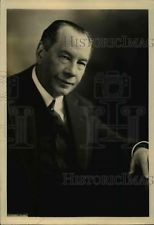
Parents: Henry Allen Tupper (1828–1902) and Nancy Johnston Boyce (1828–1888). Married: Marie Louise Pender (1859–1921), daughter of William Pender and Martha King, on August 5, 1879; after her death, married Debbie J. Crabbe (1857–1925), widow of the comptroller of the city of Philadelphia. Children: Allene Pender Tupper (1879–1931), Katherine Boyce Tupper (1882–1979), and Tristram Tupper (1886–1954). Kinship: First cousin three times removed of the post–World War II Smith generation.
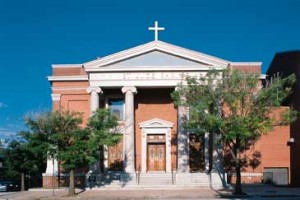
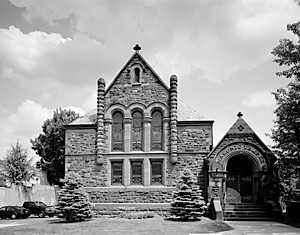
Education and Early Ministry Henry was born in Washington, Georgia, where his father was a Baptist minister, and he followed in his father’s footsteps. He was educated at Charleston College, the University of Virginia, and the Southern Baptist Theological Seminary, which his uncle, James Petigru Boyce, had founded. He served as pastor of the Broadway Baptist Church in Louisville, Kentucky, where all his children were born, and later as pastor of the Seventh Baptist Church in Baltimore; its building at Paca and Saratoga Streets is now St. Jude’s Shrine, a Catholic church (right).
World Travels and Writings In 1896 he traveled around the world, publishing Around the World with Eyes Wide Open; The Wonders of the World Pictured by the Pen and Pencil (1898).
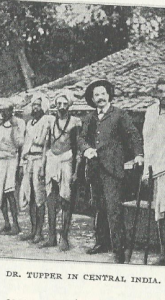
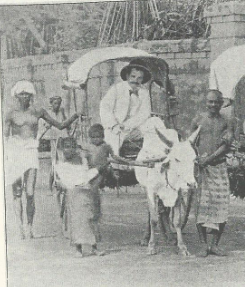
Tupper in Ceylon (left)
Tupper in India (right)
The most serious part of his travelogue concerned Armenia, and he later expanded this into a separate book, Armenia: Its Present Crisis and Past History. Describing Turkish atrocities against the Armenians, he wrote of Christians herded into churches, doused with gasoline, and set afire: “Had it not been for the intervention of the authorities, after the set time of one, two, or three days, the entire Christian population would have been exterminated. And the bloody work was stopped, not because the Moslems did not want to make a clean sweep of the Christians and pillage all their goods, but because those who inspired the slaughter thought that one, two or three days of killing was about as much as Europe would stand at one time.” He continued: “Nor let it be supposed that the Turks as such hate the Armenians as such. The Armenians have been for centuries the most submissive and profitable subjects; and they would still be most loyal, if, instead of the increasingly oppressive policy of the Sultan Abdul Hamid, their lives and honor and property had been even tolerably protected. All this, many Turks know very well, and regret the cruel and utterly impolitic course of the present sovereign. The Turk, as a man, has many excellent qualities. It is his religion which at certain times makes a devil of him. It is the very essence of Mohammedanism that the Giaour has no right to live save in subjection.”
A Baptist, Henry praised the Armenians for their steadfast loyalty to Christianity: “For more than a thousand years, the Armenians have been subjected to the bitterest persecutions, and during these centuries they have willingly chosen death with terrible torture, rather than prove false to their faith.” He lamented that the apathy of the European powers meant that nothing would be done for the Armenians and proposed that the entire Armenian nation be allowed to emigrate to Canada and the United States. His fears proved prophetic when the Turks, seeing that the Armenians had no friends, murdered more than a million of them during the First World War. As Adolf Hitler later asked, “Wer redet heute noch von der Vernichtung der Armenier?” (“Who today speaks of the annihilation of the Armenians?”).
Pastorates in Montclair and Brooklyn Henry left Baltimore to become pastor of First Baptist Church in Montclair, New Jersey (1897–1900), apparently a prosperous congregation. He then gave up that position to lead the Fifteenth Street Baptist Church in Brooklyn, a poor parish. Having some independent means, he lived at 34 Gramercy Square in Manhattan and announced that he would no longer accept a salary from his church.
Mission to Mexico After the presidency of Porfirio Díaz, Mexico descended into civil war between Federalists and Constitutionalists. The International Peace Forum, a Protestant organization with former president William Howard Taft as honorary head, asked Henry to go to Mexico to investigate and mediate between the factions, likely because of his family’s long missionary connection with Mexico. In Mexico he met Venustiano Carranza, whom he found “an educated, cultivated man.” Henry and his daughter Allene were often in danger; once, when their train was attacked, they took refuge in a theater in Mexico City. Allene, who lived there as a correspondent for eleven months, described being trapped in a cinema during a firefight, emerging hours later to find corpses in the streets.
Carranza flattered Henry, professed a commitment to education and religious liberty, and insisted on paying his travel expenses, which Henry accepted only after consulting Carranza’s attorney. Carranza sought an end to the American arms embargo, while Pancho Villa was raiding across the border and Mexican refugees poured into Texas. Henry’s father had been corresponding secretary of missions for the Southern Baptists and had helped found Baptist schools in Saltillo; Henry’s sister Mary Caldwell had taught there, and he recalled with sadness that horses had been stabled in the very room where she once taught.
Henry’s efforts brought him before the hostile Senate Committee on Foreign Affairs. Although Cardinal Gibbons thanked him for his work, Jesuits in America accused him of taking Protestant bribes from the Constitutionalists—an accusation he refuted with his careful financial records. “There are some people in the world who never get their eyes above dirt,” he said. “It is money, money, money all the time.” Senator Albert Fall later reminded him that the 1917 Mexican constitution had forbidden foreign-born clergy from serving in Mexico or religious institutions from running schools. Henry admitted he had been deceived: “The more and more I studied Mexico, the more mysterious Mexico became. After I first paid my visit there I lectured on Mexico. The second time I paid a visit there I stopped lecturing on Mexico because I saw many angles to the situation.”
Later Ministry and Public Work In 1918 Henry became pastor of First Baptist Church on Sixteenth Street in Washington, D.C., later attended by President Jimmy Carter. In 1922, Secretary of Labor James J. Davis sent him to the Middle East to investigate immigration questions. Traveling by the Orient Express from Paris to Istanbul, Henry urged restrictions on “undesirable elements,” protection of immigrants from exploitation, and help toward citizenship. He also demanded that the Turks be expelled from Europe and that America insist they end the persecution of Christians and minorities.
Final Years After the death of his wife in 1921, Henry married Debbie J. Crabbe, widow of the comptroller of the city of Philadelphia. He suffered a stroke and died on September 29, 1927, at 1015 North Calvert Street in Baltimore, the home of his daughter Katherine Boyce Tupper (Mrs. Clifford Brown).