Lawrence, William Van Duzer (1842–1927)
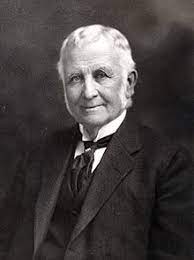
Early Life and Family Background William Van Duzer Lawrence was born in Elmira, New York, on February 28, 1842. His parents possessed a pioneering spirit and moved west to Michigan during his youth, where he grew up. At the age of nineteen he returned to New York City. He was commonly known as “Van” in both his business and social circles.
Early Career in Pharmaceuticals After returning to New York, Lawrence worked for five years in the drug store of S. R. Van Duzer & Co. Through savings from his employment, he moved to Canada and became a representative for several pharmaceutical companies, including the firm Perry Davis & Son of Providence, Rhode Island, manufacturers of the patent medicine known as Pain-Killer.
Pain-Killer and Patent Medicines Perry Davis’s Pain-Killer, first patented in 1845, was among the earliest nationally advertised remedies marketed specifically for the relief of pain rather than for a particular ailment. It became widely distributed, including through missionary channels abroad. Its formulation, based principally on opiates and ethyl alcohol, reflected the common medical practices of mid-nineteenth-century patent medicines. One period advertisement declared it “the great family remedy for internal and external pain,” and another assured customers that “no household should be without a bottle at hand.”
Lawrence gained increasing responsibility within the firm. In 1888, by then a partner in the renamed Davis & Lawrence Company, he returned to New York City. He and his family resided in the mansion he commissioned at 969 Fifth Avenue and summered at Kelp Rock (see Houses and Estates).
Related Ventures In addition to his role in Davis & Lawrence, he established and operated the Fellows Medical Manufacturing Company while retaining the presidency of Davis & Lawrence. The company also issued household and nursing manuals, such as Nursing the Sick, later cited in Culinary Landmarks: A Bibliography of Canadian Cookbooks 1825–1949.
Family and Social Life in New York Sarah Lawrence took an active interest in charitable work. She became prominently involved in the New York Exchange for Woman’s Work, a philanthropic retail outlet providing a means of support for women in need through the sale of their handiwork. The New York Tribune described it as “one of the most practically helpful institutions in the city.”
As their children grew, the Lawrence family remained socially active. Announcements in the early twentieth century recorded the engagements and marriages of their children, including the engagement of Arthur to L. Virginia Heppe of Philadelphia in 1902 and the marriage of Dudley Bates Lawrence to Katherine Clitherall Birch in Birmingham, Alabama, in 1905. In 1908, William and Sarah Lawrence accompanied Mrs. George B. Custer, widow of General Custer, on a three-month motor tour of France, Italy, Germany, and Austria.
Real Estate Development and the Creation of Lawrence Park In the 1890s, Lawrence began shifting his primary focus from pharmaceuticals to real estate. In 1890 he purchased the 86-acre Prescott Farm in what would become Bronxville, New York. His concept was to create a planned suburban community of architect-designed homes. He commissioned architect William A. Bates to design a series of speculative cottages in a variety of picturesque styles, including Colonial Revival, Tudor Revival, and Queen Anne Shingle-style. The first houses were completed in 1891.
As the homes sold, Lawrence had Bates renovate the original mansion on the property into an inn, the Manor House. The community, named Lawrence Park, quickly developed a reputation for attracting artistic and literary residents and was described by 1896 as “an exclusive literary and artistic development.” By 1916 he had begun work on his own estate there, Westlands (see Houses and Estates).
Bronxville’s Exclusivity Lawrence Park and the surrounding Bronxville community cultivated a socially selective environment. An advertisement in House and Garden in 1925 stated, “Restrictions? Yes! Bronxville has been carefully guarded in its development… The index of desirability has always been character, culture, and the ability to fit easily and naturally into the social scheme.” Later observers noted that social and religious exclusivity was a defining feature of early twentieth-century Bronxville, a characteristic that drew both admiration and criticism in retrospective accounts.
A landmark local institution from this era was the Gramatan Hotel, which Lawrence developed atop Sunset Hill. From 1905 until 1972, it became a celebrated gathering place for prominent figures of stage and society, hosting guests such as Greta Garbo, the Barrymores, Gloria Swanson, and Theodore Dreiser.
Founding of Sarah Lawrence College Sarah Elizabeth Lawrence died on May 9, 1926. In her memory, William founded Sarah Lawrence College on his Bronxville estate, Westlands. Its academic design emphasized close faculty mentorship and individualized programs of study. In a letter to his children, he explained that colleges begin modestly but grow over time and “will live on undoubtedly for centuries to come, perpetuating the names of their founders while even our presidents and the greatest men of our country are forgotten.”
Founding of Lawrence Hospital Lawrence also founded Lawrence Hospital after one of his sons fell critically ill and required transport to New York City for treatment. Desiring accessible medical care for his community, he established a local hospital in Bronxville. It later became part of the New York-Presbyterian network.
Later Years and Death William Van Duzer Lawrence remained active in business and civic affairs into his later years. He died in Bronxville on November 23, 1927.
Advertising and Publicity Lawrence was an inventive and prolific advertising promoter. His pharmaceutical ventures used distinctive and memorable advertising campaigns, including brochures, almanacs, booklets, and striking illustrated newspaper ads. One promotion styled Pain-Killer as “the great remedy of the age,” while another assured families that “from the nursery to the sick-room, it brings comfort and relief.” His marketing techniques helped establish Davis & Lawrence as one of the best-known patent-medicine enterprises of the period.