Kelp Rock, also Beacon Rock
Architects
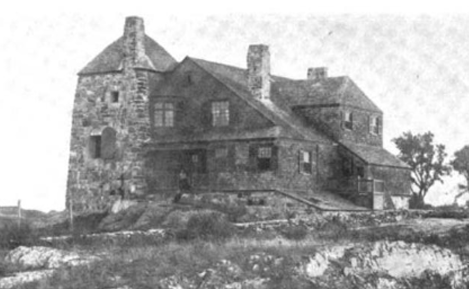
Edmund M. Wheelwright (1854–1912) was a Boston architect educated at Harvard, MIT, and the École des Beaux-Arts in Paris. After early work with Peabody & Stearns and McKim, Mead & White, he developed a practice that combined academic training with picturesque design. His 1883 house for Edmund Clarence Stedman (Kelp Rock) is a notable early Shingle Style work, distinguished by rugged stone construction, irregular massing, and a dramatic coastal siting. Wheelwright later served as Boston City Architect and designed many major public buildings, though Kelp Rock remains one of his most imaginative domestic commissions.
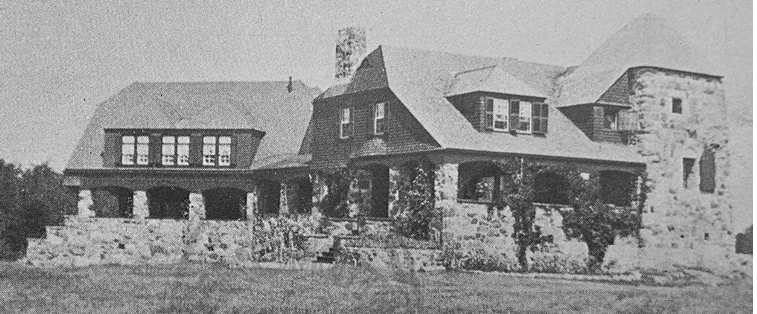
William A. Bates (1853–1922) was a New York architect best known for suburban and resort houses and for his writings on domestic architecture. From 1896 to 1905 he oversaw the enlargement of Kelp Rock for William Van Duzer Lawrence, nearly doubling the house while preserving its Shingle Style character. Bates echoed Wheelwright’s arched stone porticos, shingled surfaces, and asymmetrical massing, transforming the cottage into a substantial Gilded Age summer estate without stylistic rupture.
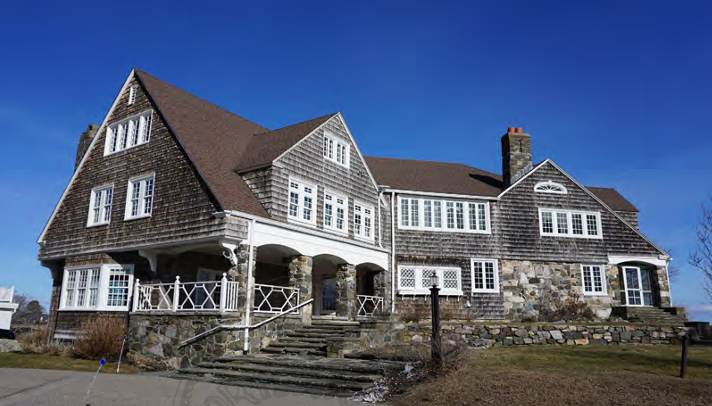
William L. White (1885–1971) was a New Hampshire architect trained at Harvard and in the offices of Olmsted Brothers, Cram & Ferguson, and Mowll & Rand. Beginning around 1930, he specialized in modernizing older houses to suit contemporary tastes. His c.1931 redesign removed the stone tower and regularized rooflines and dormers, imposing a Colonial Revival order on the earlier Shingle Style composition. The resulting house, renamed Beacon Rock, reflects White’s characteristic emphasis on formality and architectural coherence.
Architectural Description
The house at 149 Wild Rose Lane is a layered seaside residence reflecting three principal building campaigns: the original 1883 Shingle Style cottage by Edmund M. Wheelwright; the c.1896–1905 expansion for William Van Duzer Lawrence; and the c.1931 Colonial Revival transformation by William L. White.
Phase I (1883). The original house, built for Edmund Clarence Stedman and known as Kelp Rock, was a compact 1½-story Shingle Style cottage dramatically sited on rocky ledges overlooking Portsmouth Harbor. Wheelwright’s design combined a high stone base, arched stone loggia, shingled upper walls, and a distinctive two-story stone tower at the northeast corner. Irregular rooflines with clipped gables and dormers reinforced the picturesque character, while the plan centered on a combined hall–living room with the study located in the tower.
Phase II (c.1896–1905). After acquiring the property in 1896, William Van Duzer Lawrence nearly doubled the house in size under the direction of architect William A. Bates. A substantial 2½-story westward addition expanded the house into a full-scale summer estate. Bates retained the Shingle Style vocabulary—arched stone porticos, shingled walls, and irregular massing—allowing the enlarged structure to remain visually continuous with Wheelwright’s original cottage.
Phase III (c.1931). In the early 1930s, architect William L. White undertook a comprehensive redesign that imposed a Colonial Revival order on the earlier picturesque composition. The stone tower was removed, clipped and jerkinhead roofs were replaced with steep gables, and dormers were simplified and regularized. While much of the original rugged character was subdued, first-floor stonework and portions of the arched porticos were retained, preserving elements of the earlier phases beneath the Colonial Revival overlay.
Present Appearance. Today the house is a 2½-story stone-and-shingle residence in which the eastern core of the 1883 cottage, the westward Lawrence-era addition, and the unifying 1930s Colonial Revival treatment remain legible. Although later alterations softened the original Shingle Style boldness, the building clearly illustrates the evolution of a late nineteenth-century artistic retreat into a formal twentieth-century seaside estate.
History
The house at 149 Wild Rose Lane, New Castle, New Hampshire, was built in 1883 as a seaside summer cottage for Edmund Clarence Stedman (1833–1908), one of the most influential American literary critics of the late nineteenth century. Designed by Boston architect Edmund M. Wheelwright, the house—known as Kelp Rock—became a well-known gathering place within the Little Harbor summer colony, attracting writers and intellectuals drawn to the New Hampshire seacoast. Widely published in architectural and popular journals, the house gained early recognition for its dramatic siting and unconventional design.
In 1896, following financial difficulties, Stedman sold the property to William Van Duzer Lawrence (1842–1927), whose ownership marked the most consequential phase in the estate’s development, transformed the former literary retreat into a substantial Gilded Age summer estate. Over the next nine years he nearly doubled the size of the house, acquired additional land, and invested heavily in renovations that adapted the property for large-scale social use while retaining its Shingle Style character.
Lawrence sold the property in 1905, but the enlarged house he created defined its subsequent scale and function. In the early 1930s, a major redesign by architect William L. White altered the exterior, removing the distinctive stone tower and imposing a more formal Colonial Revival character. Following this transformation, the property came to be known as Beacon Rock.