Lawrence House at 969 Fifth Avenue
Architect
Richard Morris Hunt (1827–1895), the preeminent Gilded Age architect, designed the residence. Hunt, trained at the École des Beaux-Arts in Paris, introduced French Renaissance and château-inspired styles to American domestic architecture, earning commissions from titans like the Vanderbilts (e.g., their Marble House and Biltmore), Astors, and other ultra-wealthy clients. He co-founded the American Institute of Architects and established the first architectural school in the U.S. at his Tenth Street Studio Building. For Lawrence, Hunt applied his mastery of the François I (French Renaissance Revival) mode, blending ornate asymmetry, rich detailing, and dramatic verticality ideal for a corner site—evoking Loire Valley châteaux like Chenonceau or Blois while adapting to New York's urban context.
Architectural Description
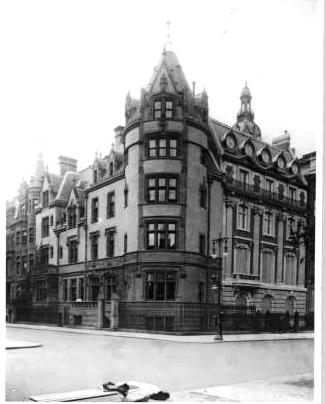
The five-story mansion was a picturesque French Renaissance fantasy executed in beige brick with brownstone trim, often called a "gingerbread confection" for its elaborate, whimsical ornamentation and intricate facade work. Hunt emphasized the corner prominence with a massive circular tower anchoring the Fifth Avenue and 78th Street intersection, creating a bold, commanding silhouette visible across from Central Park. The design featured high mansard-like roof elements, rich sculptural details, and vertical drama that rose impressively above the avenue. The main entrance was on East 78th Street via a grand stone stoop, while the prestigious address remained 969 Fifth Avenue. It epitomized the eclectic, ostentatious residential style favored by New York's elite in the late 1880s.
Although the formal entrance was placed on East 78th Street and approached by a substantial stone dog-legged stoop, the house claimed the more prestigious address of No. 969 Fifth Avenue.
History
Lawrence built the mansion as his primary Manhattan residence during Fifth Avenue's golden era of private palaces. He and Sarah Bates Lawrence (whom he married in 1867; she died in 1926) raised their family there. The family occupied it for decades, but high property taxes (as noted in family accounts) eventually prompted Lawrence to move to Westlands, his house in Bronxville. . It sold in December 1918 for about $1.5 million.
Plans were soon announced to demolish the mansion and erect a luxury apartment hotel on the site. On May 4, 1919, The Sun reported that the proposed structure would be among the most luxurious of its kind ever built, designed by George and Edward Blum.
The proposal provoked intense opposition from civic and preservationist groups, most notably the Fifth Avenue Association, which argued that apartment houses constituted an “invasion” that would destroy the character of the last intact stretch of Millionaires’ Row. Fifth Avenue, they asserted, was a matter of national pride whose appearance concerned all New Yorkers. The opposition succeeded temporarily, and the project was halted.
Although the apartment project was blocked, the Lawrence mansion did not return to use as a private residence. The property passed rapidly through multiple owners. In 1921, William Van Duzer Lawrence himself repurchased the house out of foreclosure for approximately $200,000, but this proved only a temporary measure. In January 1923, the building was sold again, reportedly for $210,000, reflecting the sharply diminished market for large private mansions on Fifth Avenue.
Demolished in 1937 by developer Kensington Estates, Inc., to clear the site for modern high-rise use. Architect Irving Margon designed the replacement: a slender 16-story apartment building completed around that era (with elements dating to 1926–1937 transitions), now 969 Fifth Avenue—a cooperative featuring a dark-brown brick facade, stone base, 12 luxury apartments. This reflected the broader mid-20th-century trend of replacing Gilded Age mansions with apartments.