Davis & Lawrence Company
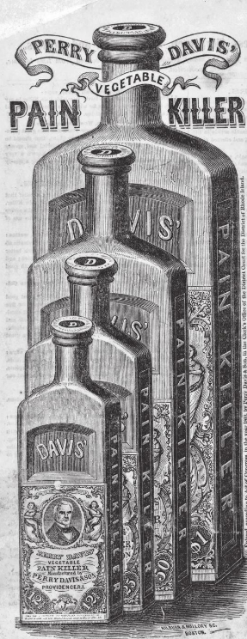
The Davis & Lawrence Company (often styled as Davis & Lawrence Co.) was a prominent 19th-century patent medicine firm, best known for manufacturing and distributing Perry Davis' Vegetable Pain Killer (commonly called Perry Davis Pain Killer or simply Pain Killer).
Origins with Perry Davis
Perry Davis (1791–1862), a Rhode Island entrepreneur from Providence, published a book Nursing the Sick, which achieved mention in Culinary Landmarks: A Bibliography of Canadian Cookbooks 1825–1949. This was not, however, the foundation of his
success.
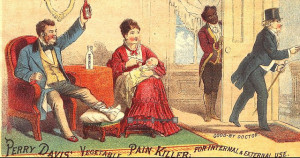
In 1849, Perry Davis, suffering from severe pain himself, Davis created a "vegetable elixir" formula — primarily a high-alcohol base (around 89-90% ethanol) mixed with opium (opiates), herbs, and other ingredients. He introduced it as Perry Davis' Vegetable Pain-Killer, patented in 1845. It was marketed as a versatile remedy for virtually any pain (internal or external), including ailments like cholera, dysentery, toothaches, bruises, sprains, and more — revolutionary at the time for promising broad "pain relief" rather than targeting specific diseases.
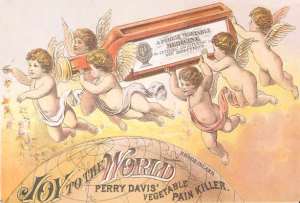
Davis and his son Edmund (Perry Davis & Son) built the business in Providence, RI, turning it into one of the era's early global patent medicines through aggressive advertising, including almanacs, testimonials, and international distribution. It became a household name, with millions of bottles sold over decades, and helped popularize modern brand marketing tactics in the patent medicine industry.
T****ransition to Davis & Lawrence Company
By the later 19th century, the business expanded into Canada. William Van Duzer Lawrence (1842–1927), a New York-born entrepreneur, became involved after moving to Montreal. He joined the wholesale drug operations tied to Perry Davis' product, initially through Perry Davis & Son's Canadian interests.
Around the 1880s, it was reorganized as the Davis & Lawrence Company, with operations based in Montreal, Canada. Lawrence rose quickly, becoming a partner and managing the Canadian side. The firm continued producing and marketing the Pain Killer (labeled under Davis & Lawrence Co. in many surviving bottles and artifacts), along with other remedies. It was a key player in the North American patent medicine trade, publishing almanacs and distributing widely.
Lawrence's involvement proved highly profitable — the company paid strong dividends (often over 20% on capital), contributing significantly to his personal fortune.
Later Developments and Legacy
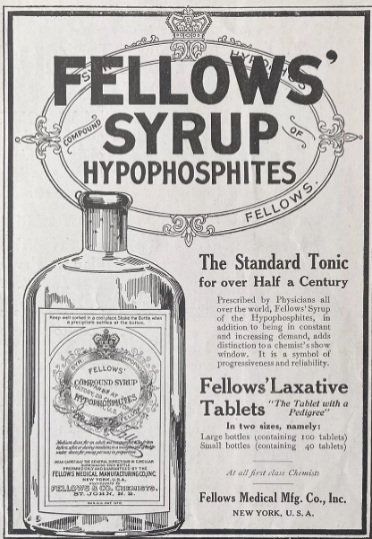
In 1888, Lawrence left the Montreal operation to return to New York City, where he took over and managed another patent medicine firm he had helped organize: Fellows Medical Manufacturing Company (known for Fellows' Syrup of Hypophosphites, which included ingredients like strychnine). His wealth from Davis & Lawrence and Fellows funded major philanthropic and real estate ventures, including developing Lawrence Park in Bronxville, New York, founding Lawrence Hospital, and establishing Sarah Lawrence College in 1926 (named after his wife).
The Davis & Lawrence Company itself continued into the early 20th century (with family members like A.W. Lawrence involved as president by the 1920s–1930s), though like many patent medicine firms, it faced declining relevance after regulations tightened (e.g., the 1906 Pure Food and Drug Act in the US exposed addictive ingredients like opium and high alcohol content). The Pain Killer's heyday was in the mid-to-late 1800s, when it was a blockbuster "global brand" in the unregulated era of patent medicines.
Today, surviving bottles and labels from Davis & Lawrence Co. appear in museum collections (e.g., Smithsonian, various historical pharmacy exhibits), serving as artifacts of 19th-century medicine, marketing, and the opioid/alcohol-based “cure-all” phenomenon.