Stone House
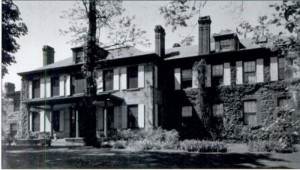
Architectural Description
The house was a substantial early-nineteenth-century stone residence, rectangular in massing, two stories in height, and capped by a low hipped roof with multiple interior chimneys. Contemporary photographs and later postcards show a restrained, symmetrical façade with evenly spaced windows and shutters, consistent with late Federal or early Greek Revival domestic architecture on Long Island. Ivy later covered large portions of the stone walls, and porches and minor additions were made over time. In the late nineteenth century, a large wing containing a dining room was added to accommodate extended family gatherings.
History
The Stone House was erected in 1822 on approximately forty-eight to forty-nine acres of land commanding views across Little Neck Bay. It was built by Isaac Stansbury of Flushing for Judge Effingham Lawrence,
Effingham Lawrence (1779–1850) served as a judge in Queens County. His social and professional standing made the Stone House both a family seat and a place of hospitality.
Judge Lawrence bequeathed the Stone House to his daughter, Lydia Lawrence. She resided there until her death in 1879, maintaining the property as the family’s principal Bayside residence. Upon her death, the house passed to her son, Colonel Frederick Newbold Lawrence (1834–1916), the child of her marriage to her cousin Edwin Newbold Lawrence. During Frederick Lawrence’s ownership, the house reached its greatest scale, with the addition of a large dining wing reportedly capable of seating eighty guests, reflecting the Lawrence family’s tradition of large family gatherings and social entertaining.
After the death of Colonel Frederick Newbold Lawrence in 1916, the Stone House was left unoccupied. In 1924 it was sold to Emma Foster, who later left the property to her niece, Clara Kouvenhoven. By the mid-twentieth century the surrounding acreage had been subdivided, and the house stood as a relic of an earlier rural Bayside.
The Stone House was demolished in 1956.