Lawrence, Frederick Newbold (1834–1916)
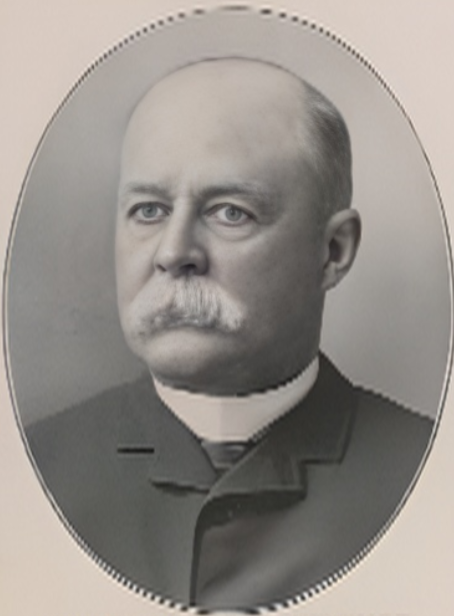
Early Life and Education Frederick Newbold Lawrence was born in 1834 into the New York branch of the Lawrence family. His father died when he was a child, and he was raised within a close network of Lawrence relatives. He graduated from Columbia College in 1854.
Civil War Service During the Civil War he served with distinction in the Union Army and attained the rank of colonel. His military title continued to be used by friends and the press throughout his life.
Career in Finance and Public Life After the war, Lawrence entered the financial world and became a prominent figure on Wall Street. He served twice as president of the New York Stock Exchange, in 1882 and 1883. In 1882, as president, he was called to testify regarding the expulsion of a broker accused of dishonest practices. The presiding judge—inevitably, in New York of that era—was another member of the family, Judge Lawrence.
In 1888, during a visit to New York by President Grover Cleveland, Lawrence delivered the official welcome and spoke in praise of Cleveland’s administration.
Interests and Social Life Frederick Newbold Lawrence was a well-known figure in New York society and maintained a town house at 18 West 53rd Street, as well as an apartment at the Croisic. He was particularly associated with the sport of trotting horses, a popular pastime among New York gentlemen at the turn of the century. In May 1900 he achieved notice when Carlyle Carne, a trotter driven by Col. Lawrence—described in the press as “the veteran road rider”—defeated Cobwebs, driven by Nathan Straus, before a crowd of some 2,500 to 3,000 spectators.
Descriptions of such races had something of the tone of the society columns: the horses’ equipment, lineage, and price were discussed with the same relish as gowns and jewels. Carlyle Carne, a flea-bitten grey gelding of more than sixteen hands, foaled in 1891 in Portland, Oregon, and purchased by Lawrence in 1899 for $1,375 (approximately $40,000 in 2024 dollars), was spoken of much as a society reporter might describe a debutante’s dress. In November 1900, deciding to retire temporarily from driving, Lawrence sold Carlyle Carne at auction; the buyer was his son-in-law, Foxhall Keene.
Trotting as a Gilded Age Gentleman’s Sport In the last decades of the nineteenth century, trotting was a favored recreation among affluent New York gentlemen. The sport combined breeding, speed, skill in handling the reins, and a keen sense of style. The Harlem River Speedway became a social stage where families such as the Lorillards, Vanderbilts, and Keenes displayed their horses just as they displayed their fashions. For many, it served the same social function as the opera, the ballroom, or the Newport season: one was seen, one competed, and one belonged. Lawrence moved comfortably within this milieu, and his reputation as a capable “road rider” gave him a certain distinction among sporting men of his era.
His Daughter’s Marriage to Foxhall Keene His daughter, Elizabeth Boyce Lawrence, married the celebrated sportsman Foxhall Parker Keene in 1894. Keene, one of the most prominent amateur athletes of the age—famed for polo, racing, and coaching—was a striking figure in international sporting circles. The marriage, however, proved unhappy. Elizabeth eventually left Keene and returned to her father’s household. Although she resumed the Lawrence name and protection, the marriage was not dissolved, and she predeceased her father in 1906.
Later Years and Death In March 1908 the New York Times reported that Lawrence had suffered a serious accident in his apartment at the Croisic, where he was found unconscious beneath a fallen cheval mirror. Pneumonia developed, and his condition was grave, but he ultimately recovered. His physician attributed his survival to his “twenty-year course of vegetarianism,” then an unusual practice.
Frederick Newbold Lawrence died in 1916, having lived through a period of enormous change in American social and economic life, to which he contributed both through public service and his long association with the New York Stock Exchange.