Los Vientos
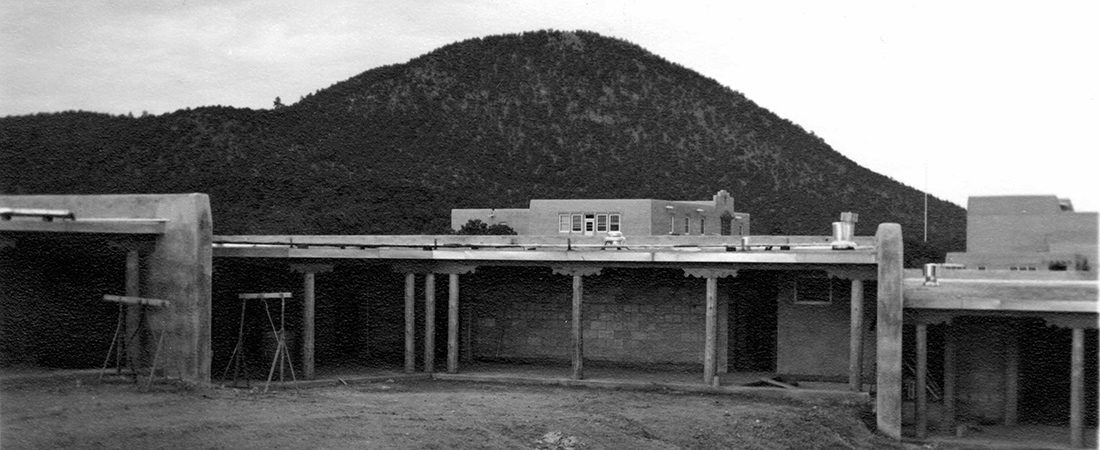
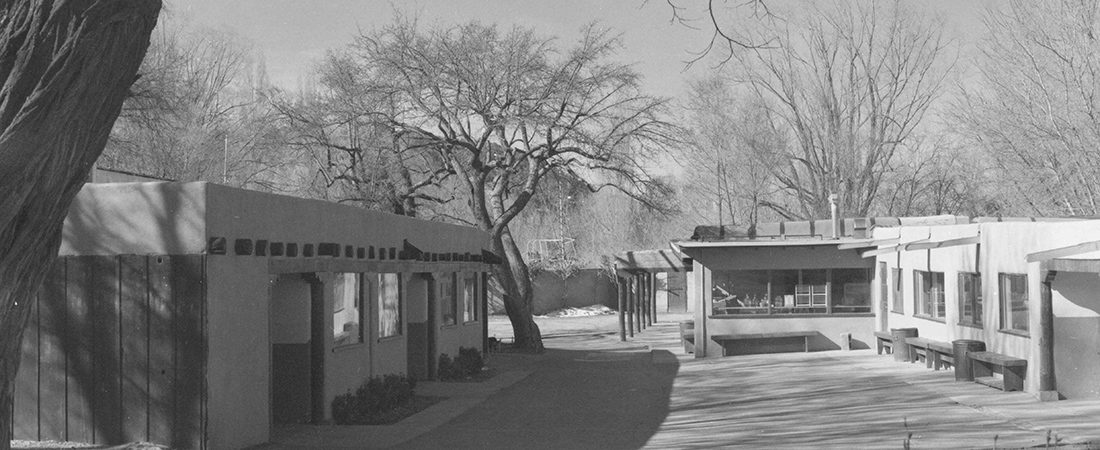
Location: Upper Canyon Road, Santa Fe**, New Mexico**
Built: 1926 with later additions by John Gaw Meem.
Architectural Character Los Vientos was originally a ranch-style residence influenced by Santa Fe’s adobe and Pueblo Revival traditions, consistent with Upper Canyon Road’s informal, site-responsive architecture. Early descriptions suggest a low, rambling structure adapted to terrain and climate, with terraces and outdoor spaces integrated into daily life. Precise architectural documentation is limited, but family testimony emphasizes its unpretentious, organic character rather than formal architectural display.
Later Alterations
As the family’s needs changed, Los Vientos underwent significant remodeling. Architect John Gaw Meem, a close family friend and a leading figure in Santa Fe architecture, was engaged with the intention of preserving the original adobe character. Family recollections indicate that this goal was compromised by later decisions to add a second story, a glass-brick greenhouse, and a white stucco exterior. These alterations substantially altered the building’s appearance, and the original architectural charm of Los Vientos was regarded within the family as having been permanently lost.
Landscape and Grounds The property included terraces, orchards, and a water feature that evolved into a swimming pool. Family accounts describe the physical labor involved in shaping the grounds, including enlarging an existing duck pond with teams of horses. At one point, the Santa Fe River was diverted through the pool and returned to its bed, allowing for winter freezing and improvised curling on the ice. The grounds supported a lively menagerie of animals—ducks, geese, and other creatures—reflecting the property’s ranch-like, experimental atmosphere.
Name and Origin Los Vientos—Spanish for “the winds”—was a deliberately playful name. It functioned as a near-translation and Spanish pun on The Breeses, echoing the naming tradition established by James Lawrence Breese’s Gilded Age house The Breezes in Tuxedo Park, New York. According to family recollection, the Spanish name was suggested by local Hispanic neighbors shortly after the family settled on the property.
History
James Lawrence Breese Jr. first encountered Santa Fe during an aviation journey, when strong headwinds forced his tri-motored Ford aircraft to land in the area. Captivated by the landscape, climate, and culture, he later acquired land on Upper Canyon Road and established Los Vientos as a permanent base. He lived there while he invented the Breese Burner.
His daughter reminisced:
My father gathered his children and their friends together on the promise of a swimming pool if we all helped. It was hard work under the hot sun, carrying those heavy rocks. I still have a photograph of Andres behind a team of horses hitched to a plow digging out and enlarging the existing duck pond on the terrace below the house. That first summer, the only pool that came to be was still used exclusively by geese and ducks. I especially remember the geese who weren't very friendly to little girls. Later, of course, a real swimming pool did materialize. A friend who was around in these days writes that Dad diverted the Santa Fe River through the pool and back into the river bed. In winter, the pool sometimes froze; and some of the older children went out curling with broomsticks and skates.
Artist Randall Davey, who lived and kept his studio about a mile up Canyon Road from us (now a notable Audubon museum property), often came to Los Vientos to swim. He and Dad thought it would be a "bully" idea to install two trapezes, one at either end of the oblong pool. Each trapeze was reached by a ladder, topped by a small platform. Once on the platform, the next step was to throw out a grappling hook and pull in the trapeze. Somebody on the opposite platform would hurl out his trapeze, while at the same time the person going over would time leaving his platform to swing out so there could be a midair transfer leap from one trapeze to the other above the pool. Davey loved to show his trapeze artistry by including a somersault before grasping the on-coming trapeze, while, of course, all onlookers clapped enthusiastically. There was always a beginner who confidently let go with both hands and, because of poor timing, missed the on-coming trapeze completely, plunging into the water amidst howls of laughter from the sidelines. We smaller children soon figured a sure-fire way to make it across, avoiding the disgrace of missing and falling in. The trick was to get hold of the on-coming trapeze with one hand before letting go of the other trapeze. This method was looked down upon, however, and dubbed "monkey style".
Speaking of monkeys, we acquired a real monkey quite soon after moving into Los Vientos. My parents were telling a house guest of a remarkable drugstore on the plaza run by Martin Gardesky. He had the reputation of getting anything a customer wanted, no matter how bizarre the order. Our friend made a bet with Dad that Mr. Gardesky couldn't get us a monkey. He lost the bet; and Chango, "monkey" in Spanish, joined the growing menagerie. He was the special pet of my sister NC, who would go everywhere with him riding on her shoulders, hanging on tenaciously to her long braids. Chango caused havoc around the house, and I can remember my mother in tears when a favorite pueblo pot was broken. On one occasion, we all got up from the dining room table to greet a guest at the front door and returned to the dining room to find Chango sitting smack in the middle of what had been a beautiful bowl of Pink Floating Island pudding. He was eating with much gusto, as he flung pieces of egg white around the table. One summer, Chango became apathetic, lost his appetite and got so weak that we children kept him in a little doll buggy. The vet could not determine the cause of his sickness, but when he finally died an autopsy revealed arsenic in his system. He had eaten apples from one of our trees, which had in those days been sprayed with arsenic.
When Los Vientos needed additions and remodeling, Meem, an old friend of our family, was called in. He wanted to preserve the character of the original old adobe, which he would have done expertly, but my stepmother insisted on his making changes that included a second story, an attached greenhouse of glass brick, and an exterior of white stucco. The original charm of Los Vientos was lost forever.