Breeses, The
Architect: Robert Henderson Robertson.
Architect
Robert Henderson Robertson (April 29, 1849 – June 3, 1919) was a prominent American architect based in New York City, celebrated for his versatile designs spanning Gilded Age residences, churches, institutional buildings, and pioneering early steel-frame skyscrapers. Born in Philadelphia to Scottish parents, he was educated partly in Scotland before graduating from Rutgers College in 1869. After early partnerships (including with William Appleton Potter), he established his own practice and became known for robust, often Romanesque-inspired brownstone work in the 1880s, as well as later contributions to tall commercial structures in Manhattan. Among his notable commissions was The Breezes (1887), the Tudor Revival mansion in Tuxedo Park for James Lawrence Breese, showcasing his skill in elegant country estates amid the era's elite enclaves.
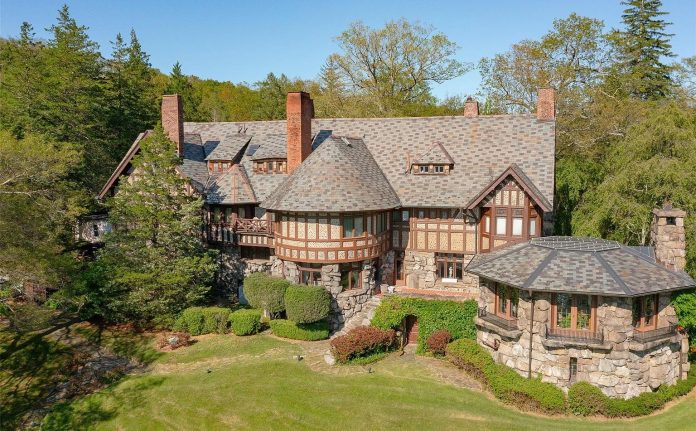
Architectural Description The Breezes is a large Tudor Revival mansion commanding one of the most dramatic sites in Tuxedo Park. The house features steeply pitched gables, varied rooflines, prominent chimneys, and richly textured exterior surfaces characteristic of the style. The building encompasses approximately 10,687 square feet and historically included nine bedrooms and numerous public rooms arranged to maximize views of Tuxedo Lake. The property boasts more than 600 feet of lake frontage, among the longest in the community. Interior features traditionally associated with the house include multiple fireplaces, elaborate period millwork, Tiffany windows, and crystal chandeliers, many of which have been carefully preserved or restored.
Interior Description
The interior of The Breezes is one of the most complete and evocative survivals of late nineteenth-century Gilded Age domestic architecture in Tuxedo Park. While the furnishings visible in the 2020 photographs are modern and not original to the house, the architectural fabric itself—plan, finishes, and decorative woodwork—remains largely intact and defines the character of the interiors.
The principal entrance opens into a large, double-height hall conceived as both a reception space and a social center. This hall is richly paneled in warm, dark-stained wood, with deeply molded panels, pilasters, and carved newel posts reflecting Robertson’s Tudor Revival vocabulary. Exposed structural beams cross the ceiling, emphasizing the horizontal articulation of the space and reinforcing its medieval English inspiration. Leaded and stained-glass windows admit filtered light, contributing color and pattern rather than panoramic views.
A broad, ceremonial staircase rises from the hall, its balustrade and stair posts elaborately carved with foliate and geometric motifs. The stair hall functions visually as a great hall in the English country-house tradition, signaling status and hospitality rather than mere circulation. Crystal chandeliers and wall sconces—some likely later replacements—hang from the beamed ceilings and illuminate the extensive woodwork.
Public rooms radiate from the central hall. The main living rooms are lined with full-height wood paneling and centered on large fireplaces with carved mantels, stone or tiled surrounds, and decorative overmantels. These fireplaces serve as architectural anchors, around which rooms are symmetrically composed. Ceilings vary by room, ranging from beamed and coffered to plaster with ornamental medallions, suggesting a deliberate hierarchy of spaces.
The dining room is among the most formal interiors, distinguished by a long axial arrangement, a monumental fireplace, and continuous wall paneling. Tall windows are dressed with elaborate surrounds, and the ceiling treatment reinforces the room’s ceremonial function within the house. Adjacent service and circulation spaces indicate the original separation between public display areas and domestic work areas typical of elite Gilded Age houses.
Several more intimate sitting rooms and libraries exhibit lighter finishes or painted paneling, particularly in upper or secondary spaces, softening the otherwise robust Tudor character. Upper-floor rooms retain decorative fireplaces, paneled walls, and carefully proportioned openings, indicating that architectural richness extended throughout the house rather than being confined to the principal floor.
Throughout the interior, the emphasis is on craftsmanship rather than ostentation: hand-carved woodwork, carefully proportioned rooms, and a coherent stylistic program. Although the movable contents have changed over time, the surviving architectural elements convey the original intent of The Breezes as a sophisticated country house—at once theatrical, masculine, and socially performative—designed to reflect both the personality of James Lawrence Breese and the elite, image-conscious culture of early Tuxedo Park.
History The Breezes was constructed during the formative years of Tuxedo Park, the exclusive gated community founded in the 1880s by Pierre Lorillard as a rural retreat for New York’s social and financial elite. Houses in the enclave were commissioned from leading architects and reflected both wealth and social ambition. The Breezes stands among the earliest and most prominent of these Gilded Age country houses. Eloise Lawrence Breese also maintained a presence in Tuxedo Park, where she owned Nundao, a nearby cottage designed by McKim, Mead & White.
James Lawrence Breese was a civil engineer trained at Rensselaer Polytechnic Institute, a stockbroker who co-founded the firm of Breese & Smith, and a well-known social figure. He was also an amateur photographer and a close associate of architect Stanford White of McKim, Mead & White. Breese developed a reputation for flamboyant behavior and high-living antics that eventually clashed with the conservative social norms of Tuxedo Park society. By about 1900, he left the community and relocated to Southampton, Long Island, where he established The Orchard, a grand Colonial Revival summer estate designed and expanded by McKim, Mead & White.
After Breese’s departure, The Breezes passed through a succession of owners, including Charles Frederick Hoffman Jr. in the early twentieth century and, by about 1910, members of the Foster family. Unlike many large Gilded Age estates elsewhere, the house has remained standing and in use as a private residence. In recent years it has appeared periodically on the market, often described in listings as one of the architectural masterworks of Tuxedo Park, prized for its scale, craftsmanship, and unparalleled lakefront setting.
Top of Form