Lawrence, Jonathan (1737–1812)
Major, New York Provincial Militia
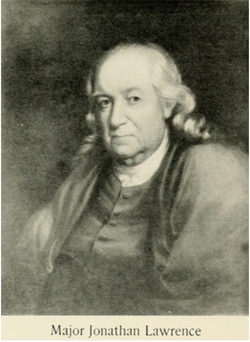
Parents: John Lawrence (1685–1765) and Patience Sackett (1701–1772).
Spouse: (1) 1766, Judith Fish (1749–1767). (2) 1768, Ruth Riker (1746–1818), of the Riker family for whom Rikers Island is named.
Children: Jonathan Lawrence (1767–1850), merchant (m. Elizabeth Rogers); Judith Lawrence (1769–1827), m. John Ireland; Margaret Lawrence (1771–1851); Samuel Lawrence (1773–1837), U.S. Representative (m. Elizabeth Ireland); Andrew Lawrence (1775–1806), died abroad of “African fever”; Richard M. Lawrence (1778–1856), merchant and insurance executive; Abraham Riker Lawrence (1780–1863), early president of the New York & Harlem Railroad; Joseph Lawrence (1783–1817); John Lawrence Lawrence (1785–1849), diplomat; N.Y. State Senator (m. Sarah Augusta Smith); William Thomas Lawrence (1788–1859), merchant (m. Margaret Sophia Muller). Kinship: Third cousin seven times removed of the post–World War II Smith generation.
Early Life and Mercantile Career
Jonathan Lawrence was born in 1737 into a prominent Long Island and New York mercantile family. As a young man he traveled to Europe and the West Indies in the employ of his elder brother, John Lawrence, gaining commercial experience at a time when New York’s overseas trade was rapidly expanding. He later joined the firm of Watson, Murray & Lawrence, one of the significant mercantile houses of pre-Revolutionary New York. By the early 1770s, after the death of his brothers John and Nathaniel (the latter dying unmarried in the West Indies), he inherited their estates and retired from commerce at around the age of thirty-four. He purchased from his sister and brother-in-law, Anna Lawrence and William Sackett, a property at Hell Gate (Hurlgate), originally part of the Sackett family estate.
Revolutionary Era and Military Service
In 1772, during the final years of royal authority in New York, Lawrence was appointed captain in the provincial militia. After the outbreak of the American Revolution, the New York Provincial Congress reorganized the militia in 1775, and Lawrence was appointed major of the Queens and Suffolk County brigade under Brigadier General Nathaniel Woodhull. In August 1776, on the eve of the Battle of Long Island, the brigade was ordered to drive livestock eastward to prevent it from falling into British hands—an operation intended to deprive the advancing British army of provisions. Woodhull was subsequently captured by British forces, wounded, and died days later from mistreatment and infection. Because the livestock-removal mission preceded these events, later accounts sometimes linked Lawrence to the tragedy. Contemporary records, however, show that Major Lawrence had been ordered north to Harlem to seek reinforcements from General George Washington and was not responsible for the circumstances of Woodhull’s capture or death. His service in this period reflects the complex and shifting military demands placed on local officers during the chaotic early months of the war.
Political Leadership in Revolutionary New York
Lawrence played an important role in the civil government that emerged as royal authority collapsed. He served as a member of the 1st, 3rd, and 4th New York Provincial Congresses between 1775 and 1777. The Provincial Congress served as the de facto government of New York during the Revolution and drafted the first New York State Constitution. When that constitution came into force, Lawrence entered the New York State Senate, representing the Southern District in the 1st through 6th Legislatures (1777–1783). He was twice elected to the powerful Council of Appointment, in 1778 and 1782. The Council had sweeping authority to appoint nearly all civil and military officials in the state and was one of the most influential bodies in New York government in the late 18th century. Lawrence later served as chairman of the committee supporting the re-election of Governor George Clinton, who was a central figure in Revolutionary and early national politics and later served as Vice President under both Thomas Jefferson and James Madison.
Later Life and the Cayuta Lake Settlement
After the war, Major Lawrence acquired a tract of approximately six square miles surrounding Cayuta Lake, part of what became known as the Watkins and Flint Purchase in central New York. This was among many post-Revolutionary land investments undertaken by New York families as settlement moved westward. Three of his sons—Samuel, Joseph, and William—relocated to the area and established residences there. Samuel’s home became known as the Lawrence Homestead; William built an estate on the east side of the lake, called “Lawrence Villa,” later known as “White Gates.” The Lawrence presence contributed to the early development of that region of the state.
Connections to Prominent New York Families
Through the marriages of his children and grandchildren, Major Lawrence’s line became connected to several leading New York families. These included the Rikers, Irelands, Floyds, Pells, Duanes, Livingstons, Hamiltons, and Waynes. These marriages linked the Lawrence family with figures such as William Floyd, signer of the Declaration of Independence, and families prominent in politics, the military, and civic life in the early Republic. A fuller account of the Ireland descendants is given under Ireland Family.
Death
Major Jonathan Lawrence died in New York City on September 4, 1812.