Hurlgate
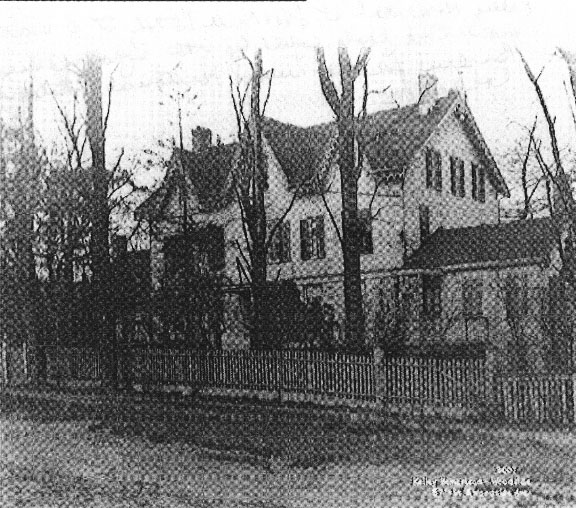
“Hurl Gate" (or "Hurlgate") was an old name for the nearby ferry road and east-west route (today's Woodside Avenue and parts of 58th Street), derived from the Dutch "Hellegat," which referred to the turbulent strait in the East River known as Hell Gate. The mansion was situated along this Hurl Gate Road, giving it a prominent position in the area formerly part of Newtown (now Elmhurst and Woodside).
Architectural Description
The mansion was a elite colonial-style home facing south at the foot of Betts Avenue (now 58th Street) along Hurl Gate Road. Features included:
A front door in two sections with a grand brass knocker.
A 12-foot-wide front hall.
A grand parlor (17x17 feet) with a fireplace flanked by glass cases in imitation sea scallop shells.
A back room with a corner fireplace and closets.
Additional rooms and a kitchen with a spacious fireplace.
Exterior amenities: a well in front, barn and cider house in back, surrounding woodlawn, sheep folds, and a nearby slave cemetery.
It eventually expanded to 25 rooms by the 19th century.
History
The history of the estate begins with the Sackett family, a lineage of Puritan origin that settled in New England in the early seventeenth century. The family was founded in America by Simon Sackett, who arrived from England and settled in Cambridge, Massachusetts, in 1628. Upon his death, his two sons, Simon and John, carried the family line forward. Simon left a single son, Joseph Sackett, who was adopted by his maternal uncle, Daniel Bloomfield, and brought to Newtown, Queens, then part of the Dutch and later English settlements on western Long Island.
Joseph Sackett (1656–1719) emerged as a prominent figure in Newtown, serving as a church member, road commissioner, assessor, and militia captain. Through three marriages—his first to Elizabeth Betts, daughter of Captain Richard Betts—he became closely allied with the town’s leading families and acquired substantial landholdings. In his will of 1719, Joseph divided his Newtown properties among his children. Two of his sons, William and John, inherited extensive tracts in the area that later became Woodside, including parcels bounded by roads leading toward Hell Gate.
John Sackett inherited two large lots totaling approximately 115 acres, separated by Hurl Gate Ferry Road (now Woodside Avenue). The northern tract extended westward to the Moore property near present-day Broadway and bordered his brother William’s land to the east, while the southern tract reached toward the Betts property south of today’s 47th Avenue. John Sackett died in 1768.
His son William Sackett (1731–1802) married his first cousin, Anna Lawrence, their common grandfather being Joseph Sackett. The marriage linked the Sacketts to the Lawrence family, one of the most prominent families in Newtown and Hell Gate. William continued farming the estate and expanded the original farmhouse into a substantial manor house. The property became known locally for its cider press, which produced cider from Newtown pippin apples renowned throughout the region.
The estate figured prominently in colonial and Revolutionary-era events. During the French and Indian War, French officers were billeted at the house, for which the family received weekly compensation. During the Revolutionary War, Hessian officers occupied the manor for much of the conflict, forcing William Sackett—whose sympathies were patriotic—to leave the property. A Hessian sword later discovered in the rafters was donated to the Long Island Historical Society. Nearby, a deserter named Michael Hagan was executed and buried on the grounds.
William Sackett died in 1802, leaving the farm to his son John Sackett, who died in 1819. In 1826, John’s heirs sold the 115-acre estate for $11,000 to John A. Kelly (1792–1833) and his sister-in-law, Catherine B. (Friedle) Buddy. Kelly, of German descent, initially used the property as a rural retreat. After his death, his widow, Anna Maria Friedle Kelly, remarried Caleb Tappan Howell, and the family took up permanent residence on the estate in the early 1840s.
Beginning in the 1860s, portions of the former Sackett estate were sold to developer Benjamin Hitchcock, initiating the residential development of Woodside. The neighborhood’s name derived from John A. Kelly’s newspaper essays titled Letters from Woodside. After Anna Maria Howell’s death in 1882, the mansion was rented, declined in condition, and was sold in 1895 to St. Sebastian’s Roman Catholic Church. The house was demolished in 1896, and church and school buildings were erected on the site. No physical remnants of the Sackett manor house survive.