Kennedy, Julian (1852-1932)
World’s Foremost Metallurgical Engineer
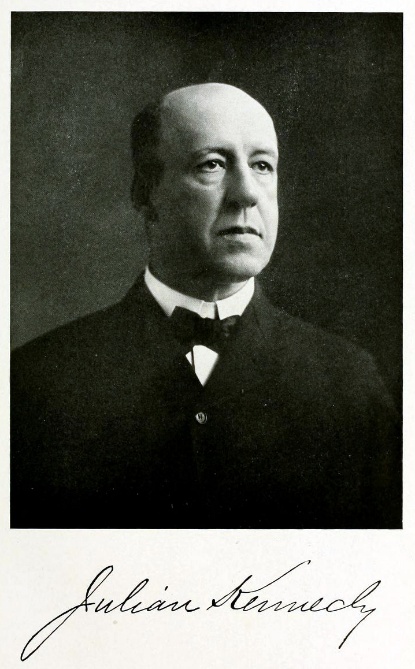
Parents: Thomas Walker Kennedy (1824-1896) and Margaret Truesdale (1824-1907).
Married: Jane Eliza Brenneman (1852-1930) Children: Lucy Belle Kennedy (1880-1962); Joseph Walker Kenendy (1884-1950); Julian Kennedy (1886-1955); Hugh Truesdale Kennedy (1888-1889); Eliza Jane Kennedy (1889-1964); Thomas Walker Kennedy (1894-1922). Kinship: Great-grandfather of the post-World War II Smith genration.
Early Life and Formation
Julian Kennedy was born on 15 March 1852 in Poland, Ohio, to Thomas Walker Kennedy and Margaret (Truesdale) Kennedy. His father, Thomas, was himself an engineer and furnace designer; Kennedy’s early exposure to blast-furnace practice came within this domestic environment.
He went to the Sheffield School of Science at Yale. After he graduated in 1875, he stayed to take graduate courses and to teach physics courses. He was also a champion sculler. He was stroke of the Yale Four-oared Crew at the Centennial in Philadelphia in 1876, won the single scull at Lake Saltonstall in 185, and the intercollegiate single scull race at Saratoga in the summer of 1876.
The WASP elites of America were concerned about the lack of masculinity and the neurasthenia of the upper classes. But Julian was an example of vigorous American masculinity. His physical attributes were measured and publicized:
“Julian Kennedy is the giant of the crew…. He is six feet tall, weighs 164, is forty-one inches around the chest, fourteen-inch biceps and twelve and a half forearm. He is a Western farm boy from Struthers, O,, florid and robust, with light hair and a quick eye.”
Kennedy married Jane Eliza (“Jennie”) Brenneman in 1878, with whom he had daughters Lucy and Eliza, both later prominent in Pittsburgh civic and suffrage movements.^
Superintendent and Chief Engineer
Kennedy’s first significant appointments were in bridge and steel works in the 1870s. By 1879 he was superintendent at Morse Bridge Works in Youngstown, Ohio, where he gained experience in heavy fabrication. In 1883 he moved to Pittsburgh, where he entered the Carnegie system at a moment of rapid consolidation and modernization.
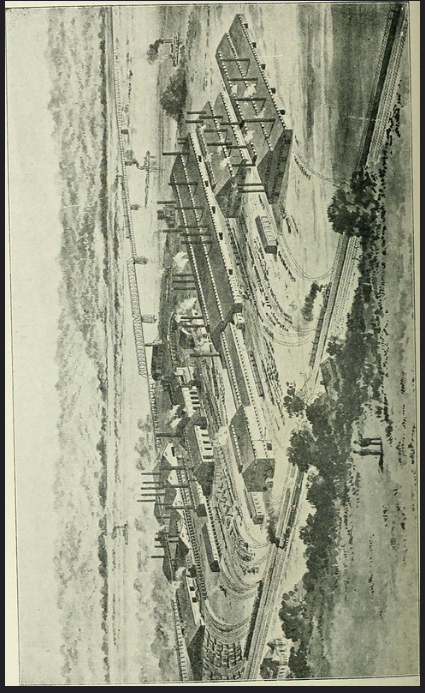
From 1885 to 1888, Kennedy served as general superintendent at the Homestead Works, then the centerpiece of Andrew Carnegie’s empire. At Homestead he participated in the planning and design of new open-hearth and armor-plate mills. As historians of the Carnegie company note, “Julian Kennedy drew up plans for an armor plate mill” during this period, work that directly fed into the United States’ naval rearmament program of the late 1880s and 1890s. Instead of making steel ingots and bars, which had to be sold as mere raw material, the Homestead works began to produce beams, girders, and all manner of structural shapes. At that start there was no strong demand for such things, but then America began building skyscrapers, and vast wealth flowed into Carnegie’s pockets. His role placed him among the select group of Carnegie “lieutenants” who bridged process knowledge and strategic industrial expansion.
Consulting Engineer
Julian did not find Carnegie’s style agreeable (see The Carnegie Boys: The Lieutenants of Andrew Carnegie that Changed America, Quentin R. Skrabec, Jr., 2012). Julian set himself up as a consulting engineer, worked at Allegheny Steel Works and Latrobe Steel Works, and soon became known as the best metallurgical engineer in the world.
He had scores of patents for devices and processes to improve iron and steel production, but his genius seems to have been in his ability to see the whole process as a single system, rather than as disparate machines, and to maximize the output of iron and steel while minimizing the input of ore and energy. That is, he was making the system as efficient as possible, a theme we will see in other family members.
Kennedy was deeply engaged in the professional networks of Pittsburgh engineers. He became an active member of the Engineers’ Society of Western Pennsylvania (ESWP), an organization that served as a clearinghouse for industrial practice in the nation’s steel capital. In 1907–08, he presented a paper entitled “Some Modifications in Blast Furnace Construction”, which appeared in the Proceedings of the society.
The paper dealt with improvements in furnace shells, stove connections, and refractory linings. Kennedy emphasized the “systemic” nature of furnace design: every modification to the stoves, gas mains, or charging equipment had cascading consequences for efficiency. His emphasis on plant-wide integration aligned him with contemporaries who increasingly treated the steel works as a holistic, interdependent organism rather than a collection of discrete machines.
In 1892, Frick and Julian toured the Homestead works after the violent strike, presumably to see what damage had been done to the equipment. Rumors circulated that Julian was being offered the superintendency of the plant, because he was acceptable to the workers. Whether or not this happened, Julian did not become superintendent again but pursued his consulting business.
Patents and Inventions
Kennedy’s technical contributions are best measured through his prolific patenting activity. Between the 1880s and 1910s, he secured dozens of U.S. patents focusing on hot-blast stoves, flue structures, charging mechanisms, and furnace valves.
A representative example is his 1903 application for a hot-blast stove (granted in 1904), which refined the cyclic process of heating and delivering air to the furnace. He aimed to increase thermal efficiency by improving gas flow within the stove’s checkerwork.
In 1916, Kennedy patented a flue structure for hot-blast stoves, introducing innovations in refractory design and gas distribution channels.^9 That same year, he secured a patent for a charging-bell apparatus, an attempt to regulate burden materials at the furnace top while maintaining internal pressure.
These inventions addressed two perennial problems in ironmaking: first, how to maximize heat recovery and minimize refractory damage in stoves; and second, how to maintain reliable, sealed, and controlled charging at the furnace top. Even incremental improvements in these domains could yield substantial savings in coke consumption or improvements in furnace output. Kennedy’s devices, therefore, were not merely mechanical curiosities but essential contributions to the economic competitiveness of large-scale steelmaking.
Professional Societies and Publications
Kennedy was deeply engaged in the professional networks of Pittsburgh engineers. He became an active member of the Engineers’ Society of Western Pennsylvania (ESWP), an organization that served as a clearinghouse for industrial practice in the nation’s steel capital. In 1907–08, he presented a paper entitled “Some Modifications in Blast Furnace Construction”, which appeared in the Proceedings of the society.
The paper dealt with improvements in furnace shells, stove connections, and refractory linings. Kennedy emphasized the “systemic” nature of furnace design: every modification to the stoves, gas mains, or charging equipment had cascading consequences for efficiency. His emphasis on plant-wide integration aligned him with contemporaries who increasingly treated the steel works as a holistic, interdependent organism rather than a collection of discrete machines.^12
The ESWP platform allowed Kennedy to situate himself among Pittsburgh’s technical elite—figures like Benjamin Thaw, William Metcalf, and the younger Charles Schwab—thus reinforcing both his professional credibility and civic stature.
Recognition and the ASME Medal
By the 1920s, Kennedy was recognized as one of Pittsburgh’s “eminent engineers.” In 1928, the American Society of Mechanical Engineers (ASME) awarded him the ASME Medal, citing his “eminently distinguished engineering achievement.”^13 The roll of medalists places him in the company of Wilfred Lewis (1927), W. L. R. Emmet (1930), Albert Kingsbury (1931), and Willis Carrier (1934).
This recognition, bestowed at the end of his career, acknowledged not only his inventions but also his international consulting. Kennedy had become known for designing entire works, integrating hot-blast stoves, charging mechanisms, and material-handling systems into coherent plants. The ASME award thus represented a codification of his reputation as an engineer who linked invention, plant design, and global diffusion of American practice.
International Consulting
Britain
By the early 1900s, Kennedy’s consulting firm, Julian Kennedy, Sahlin & Co., was active in Britain. He supervised refitting projects that adapted American design principles—larger furnaces, higher-pressure blast systems, and mechanical burden handling—to British works.^14 His ability to transfer these “American lines” of operation earned him contracts in an industrial environment increasingly conscious of U.S. competition.
Russia
In 1893 Russian princes visited Pittsburgh to meet Julian, and in 1896 Julian went to St. Petersburg and in 1897 to Mariupol. His nephew Harry Kennedy was the on-site supervisor. Julian seems to have been concerned with worker safety, and overbuilt his works to protect workers, and also, as it turned out, to protect Ukrainian soldiers from Russian artillery. The steel works at Mariupol withstood a siege for months in 2022, and finally the defenders evacuated.
India and the Tata Steel Works
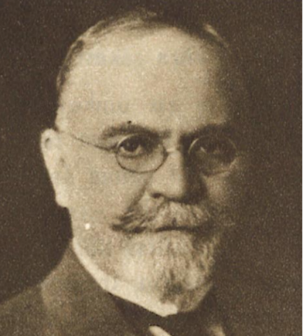
Kennedy’s most consequential foreign work came through his connection with Jamsetji Nusserwanji Tata, the Indian industrialist who envisioned a modern steel industry in India. During Tata’s 1902 visit to the United States, he consulted Kennedy in Pittsburgh about his plans. Kennedy advised Tata to begin with a thorough geological and market survey and recommended Charles Page Perin, a New York consulting engineer, to lead the investigations.
By 1907, Kennedy’s firm, in partnership with the Swedish-born engineer Axel Sahlin, was appointed construction engineer for the new Tata Iron and Steel Company (TISCO) at Jamshedpur. Sahlin had supervised the steel mill at Sparrows Point in Maryand. But Julian also went to India, and came back with trunks of Indian tsochkes, which have circulated in the family for over a century.
Kennedy, Sahlin & Co. designed the blast furnaces, hot-blast stoves, and open-hearth facilities, embedding U.S. technical practice in the new works. Contemporary sources credit Kennedy’s designs with giving the plant a competitive edge by ensuring high capacity, reliable stoves, and mechanized charging systems.
The Tatas, a Parsee family in India, had made a fortune in cotton goods, They hired Julian, who designed both the works and the model town for its workers. “Founder Jamsetji Tata’s vision was simple: his men should have access to everything they would ever need. And so, American Julian Kennedy was brought in to design Jamshedpur — on the basis of Tata’s blueprint — around its people. Marketplaces were set up in every cluster, large homes were made for employees, wide roads were laid out and lined with shady trees. Parks, stadiums, hospitals, and community centres were created, and a special zone was earmarked for the important officials.”
TISCO’s success made Jamshedpur the industrial heart of modern India. Kennedy’s role was not solitary—Perin, Sahlin, and later German firms also contributed—but his Pittsburgh office provided the crucial system-level expertise that enabled Tata’s dream to materialize. The project demonstrates how American engineering expertise was globalized in the pre–World War I era.
Family and Civic Context
Having made an international reputation and a great deal of money, Julian moved from the family house on Forbes Ave, to mansion he built at 5400 Forbes Ave.. He also supported his wife Eliza and her sister Lucy in their campaign for women’s suffrage and civic reform.
He criticized the police court system in Pittsburgh: “He charged that foreigners and people without funds who come before the police magistrates received little or no consideration and that the police court records show that an average of one minute is all that is allocated to each case.”
In 1908 Kennedy joined H.J. Heinz in the political reform movement to break the political machine of Major William Magee, exposing graft, bribes, and payoffs. In 1910 he gave an address in Exposition Hall on “The Spread of Vice in Pittsburgh” (mainly prostitution, gambling, and saloons). He ridiculed the light sentences given to those engaged in “the white slave trade.” He denounced “ worthless politicians who never made an honest living and never could make a success of any decent occupation “ nut “fattened off the degradation of the poor women.”
In 1911 U.S. Senators were still elected by state legislatures. Reform Republicans and Democrats formed a Keystone Party and put forward Kennedy’s name. But the machine Republican won: George T. Oliver (Republican, incumbent) – 181 votes, Julian Kennedy (listed in the official tally as Democratic but supported by Keystone/independent Republicans) – 25 votes.
His reform movement was connected to his advocacy of women’s suffrage (Compare Josiah van Orsdel). Kennedy told campaigners for women’s suffrage that “Pennsylvania is the tailender in civic virtues” and “that if women were given the vote workhouses, penitentiaries, asylums and poor houses will be but a memory on a few years.”
Engineers designed the mills that produced armaments. During the First World War Kennedy addressed a group of them and reminded them that “this flourishing business is due to the misery of our brethren across the seas. And while business is stimulated by the war in Europe, I don’t believe that there is a gentleman here who would not cause the war to stop this minute if he could, regardless of any possible profits on the business in which he is interested.”
He left the Presbyterian church of his childhood and joined the First Unitarian Church of Pittsburgh. Indeed, one of his sons Thomas Kennedy married the daughter of the minster there. On Layman’s Sunday at that church, Julian preached a sermon, “Community Efficiency.” (What else?) He and his wife supported Unitarian national initiatives.
Kennedy’s influence extended beyond industry into the civic sphere. His wife, Jennie Breneman Kennedy, and daughters Lucy Kennedy Miller and Eliza Kennedy Smith became leading suffragists in Pittsburgh. Lucy served as the first president of the Pennsylvania League of Women Voters, while Eliza was a prominent organizer of the Women’s International League for Peace and Freedom.
Thus, the Kennedy household illustrates how engineering elites intersected with Progressive Era reform. While Julian engineered steel mills, his family engineered civic movements for women’s political participation. The Kennedys exemplify the interweaving of technical and social modernization in early twentieth-century Pittsburgh.
Final Years and Death
Kennedy remained active into the 1920s, continuing to patent innovations and serve as a consultant. His ASME Medal in 1928 crowned a half-century of engineering achievement. He died in Pittsburgh on 28 May 1932 at the age of 80, and was buried at Homewood Cemetery. Contemporary obituaries praised him as Pittsburgh’s “most eminent engineer,” a recognition that placed him alongside the great organizers of the steel industry.^
Kennedy the Engineer
Julian Kennedy’s life illuminates three themes in engineering history:
Incremental but Crucial Invention: His patents for stoves, valves, and charging devices exemplify the relentless pursuit of efficiency in industrial systems.
Systems Integration: Kennedy viewed the steelworks as an interdependent system, not merely a collection of machines. This approach foreshadowed modern systems engineering.
Global Transfer of Expertise: His role in Tata’s Jamshedpur works shows how American industrial practice was transplanted abroad, shaping industrial modernity outside the West.
Kennedy thus deserves remembrance not only as a Pittsburgh engineer but also as a figure in the global history of technology.
Kennedy the Reformer
Kennedy’s departure from the Presbyterian church of his youth did not signify any abandonment of traditional moral norms. His decision to join the Unitarian church placed him within a theologically liberal denomination, but “liberal” in that period referred chiefly to doctrine—particularly questions about the Trinity—and not to personal conduct or social ethics. Late nineteenth-century American Unitarianism often combined rationalist theology with a disciplined, Victorian sense of private virtue, sobriety, and civic obligation. Whatever Kennedy concluded about the nature of Christ or the creeds of his childhood, he retained a moral code remarkably similar to the Presbyterianism in which he was raised.
Within this framework, Kennedy subscribed to the common Progressive belief that societal vice was a public evil that could and should be curtailed by law. Reformers of his generation typically understood vice in the older Protestant civic sense: prostitution, habitual drunkenness, gambling, corruption, and commercialized dishonesty. These were not simply personal failings but sources of urban disorder, threats to public health, burdens on working families, and gateways to political corruption. Kennedy’s support for efforts to suppress vice placed him in the mainstream of middle-class Progressive moral reform, a movement that sought to use municipal ordinances, licensing restrictions, and police regulation to protect the public, especially the poor, from exploitation.
It is also important to recall that early Progressivism was deeply intertwined with moral reform. Before the movement became associated with professionalized administration and technocratic expertise, it was animated by evangelical and post-evangelical impulses toward social purity, temperance, honesty in public life, and the defense of the home. Kennedy’s outlook belongs to this earlier phase of Progressivism, with its conviction that modern industrial cities needed moral as well as physical order.
Finally, moral reform at this time was closely linked to the cause of women’s suffrage. Reformers believed that women, understood as the moral guardians of the household, would bring a higher moral sensibility to the electorate. Suffrage was promoted not only as a political right but also as an instrument for purifying public life and restraining the forces of vice. Kennedy’s sympathy for women’s suffrage, and his support for the reform commitments of his wife and daughters, reflects this convergence of traditional morality, Progressive idealism, and the belief that women’s political participation would strengthen civic life.
In this way Kennedy exemplified a characteristic pattern of his generation: theologically liberal, morally conservative, socially reformist, and convinced that law and civic activism could shape a more orderly and virtuous modern society.