Kennedy, Reid (1864–1953)
Burgess, Banker, and Strike Leader
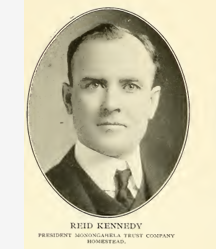
Parents: David Stewart Kennedy (1834–1898) and Nancy Wills Kelly (1837–1921). Married: Martha E. West (1865–1946). Children: None recorded. Kinship: First cousin three times removed of the post–World War II Smith generation.
Early Life and Education: The son of a United Presbyterian minister, Reid went to Illinois in 1878 and worked as a farmhand and later as a steelworker in Homestead to earn money for college. He entered Westminster College in 1885 and graduated in 1889. Both his parents were alumni of that college, and his grandfather had donated one of its early buildings.
Career and the Homestead Strike: Reid moved to Homestead to work as a roller in the armor plate mills of the Carnegie Steel Company. During the Homestead Strike of 1892 he was one of thirty-three members of the Advisory Committee of the Amalgamated Association. All were indicted on charges of aggravated riot, conspiracy, and treason against the Commonwealth of Pennsylvania for allegedly forming “a government within a government.”
The prosecution collapsed because the Pennsylvania treason statute required actual armed insurrection, and juries and judges refused to equate strike organization with rebellion. Many viewed the charges as a ploy to crush the union. No convictions followed.
Public Service: After the strike Reid organized a building-supply company and then turned to real-estate development in West Homestead Borough. A staunch Republican, he served as Burgess of Homestead (later Mayor) from 1897 to 1900, performing both administrative and judicial duties. In 1898, at the opening of the Carnegie Library in Homestead, he met Andrew Carnegie and Henry Clay Frick and gave the final address—reported, curiously, in The Dunfermline Journal and Advertiser for the West of Fife.
Judicial Anecdote: Among his cases was the famous “Goat Affair”:
Burgess Reid Kennedy of Homestead had a goat up before him on a charge of disorderly conduct. On the docket he was listed as “William, alias Billy Goat,” accused by citizens of West Street of being a nuisance. After a chaotic arrest that left two boys dragged downhill, Kennedy resolved the case by ordering the owner to confine the goat and keep him out of town.
Law Enforcement and Civic Activity: Reid organized raids against speakeasies, poker clubs, and “coat-and-pants” gambling houses; dismantled hobo encampments; tried to halt an illegal prizefight that ended fatally; and once rescued laborers overcome by gas in a street excavation. In 1905 he ran unsuccessfully for County Treasurer on a fusion ticket.
Financial and Civic Leadership: In 1901 Reid became the first president of the Monongahela Trust Company of Homestead, serving until 1942. He was also treasurer of the Orient Coke Company, of which Julian Kennedy was president, with O. W. Kenney and S. A. Kennedy as associates. He represented Julian Kennedy in several business negotiations and served as chairman of the finance committee for Homestead Hospital, laying its cornerstone in 1922. He later chaired the 1926 capital campaign for Westminster College.
He was a member of the Duquesne Club, Longue Vue Club, Oakmont Country Club, and the Bankers Association of Pittsburgh.
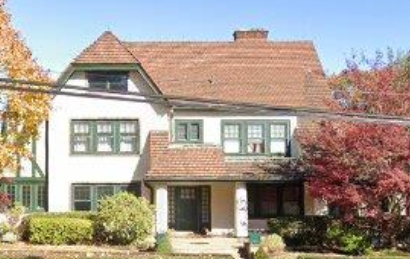
Residences and Personal Life: In 1918 architect Paul W. Irwin designed a residence for him at 6553 Beacon Street, Squirrel Hill, Pittsburgh. The Kennedys wintered in Orlando, Florida, at the Amherst Apartments. Mrs. Kennedy was active socially, and Reid was an accomplished golfer whose holes-in-one were occasionally reported in the press. Their absences from Pennsylvania, widely noted in society columns, unfortunately invited burglary: the Homestead home was looted in 1918, and the Squirrel Hill residence suffered similar break-ins in 1942 and 1950.