Kennedy, Eliza Jane (1889–1964)
Suffragist and Civic Reformer
Parents: Julian Kennedy (1842–1932) and Jane Eliza Brenneman (1852–1930). Married: Raymond Templeton Smith (1888–1967). Children: Raymond Templeton Smith (1919–2007) and Kennedy Smith (1922–1996). Kinship: Grandmother of the post–World War II Smith generation.
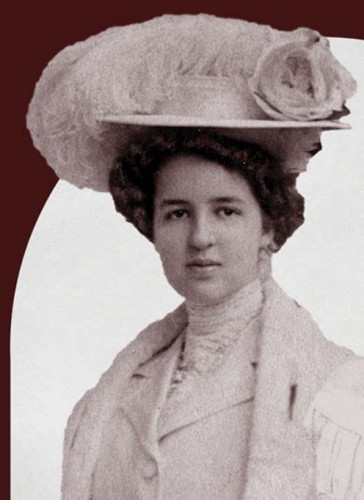
Early Life and Education Eliza Jane Kennedy was born December 11, 1889, in Latrobe, Pennsylvania, the daughter of the prominent engineer Julian Kennedy and the suffragist and reformer Jane Eliza Brenneman Kennedy. In 1892 the family moved to Pittsburgh, where Eliza was raised in an atmosphere of public service and reform. She graduated from Winchester Thurston School in 1908 and from Vassar College in 1912 with a degree in economics and political science.
In 1907 she served as maid of honor at the wedding of her sister Lucy Kennedy to John Oliver Miller, an event held at the family home on Forbes Street in Pittsburgh. In 1915 she became engaged to Raymond Templeton Smith, a Cornell graduate and executive vice president of the Pittsburgh Coal Company. At her engagement party, her sister Lucy, president of the Equal Franchise Federation of Pittsburgh, called upon several guests to speak on women’s suffrage. Eliza married R. Templeton Smith later that year.
Suffrage and Civic Reform Born into a family already committed to reform, Eliza joined her mother, Jennie E. Kennedy, and her sister, Lucy Kennedy Miller, in attending suffrage training sessions organized by Carrie Chapman Catt. The three women became active advocates for equal rights and female enfranchisement in Pennsylvania.
Eliza Kennedy Smith worked alongside Lucy Kennedy Miller, Jennie Bradley Roessing, Mary E. Bakewell, Hannah J. Patterson, and Mary Flinn Lawrence in organizing the Allegheny County Equal Rights Association. This organization evolved into the Equal Franchise Federation of Western Pennsylvania and, after the ratification of the Nineteenth Amendment in 1920, became the Allegheny County League of Women Voters. Eliza was elected president of the League in 1924 and held that position until her death in 1964.
Public Integrity and Government Oversight In the 1930s Eliza and Lucy Kennedy Miller began investigating municipal corruption in Pittsburgh. Their work led to the indictment and conviction of Mayor Charles H. Kline on forty-eight counts of malfeasance. Eliza became widely known as “a relentless, tenacious watchdog of the city’s purse strings,” attending more budget hearings than any other citizen of her generation. She monitored the city’s use of funds, exposed abuses such as padded garbage collection weights, and demanded merit-based appointments in city departments.
During the 1940s she led the campaign to modernize the city’s police communications system after a series of unsolved murders revealed deficiencies in coordination and forensic capacity. Her advocacy resulted in the opening of a new centralized communications center in 1950.
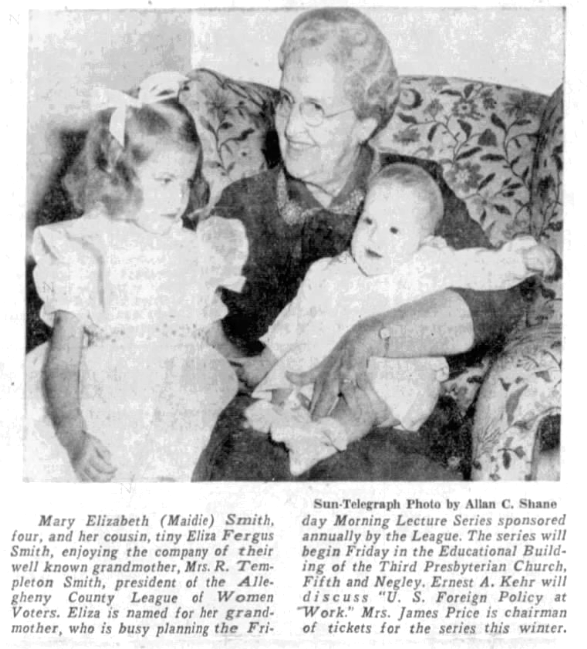
Political Engagement and Later Years A lifelong Republican, Eliza remained politically active into her seventies. In 1964 she and her granddaughter Eliza Smith appeared in The Pittsburgh Press with Admiral Ben Moreell as supporters of Senator Barry Goldwater’s presidential campaign. She and Moreell sought election as delegates to the Republican National Convention, pledging to support Goldwater on every ballot.
She and her husband maintained their home at 1336 Shady Avenue in Pittsburgh’s Squirrel Hill neighborhood.
Illness and Death Diagnosed with carcinoma of the sigmoid colon in 1963, Eliza endured declining health over the following year as the cancer metastasized. She died at home on October 23, 1964, aged seventy-four. Funeral services were arranged by H. Samson Inc., and she was buried in Homewood Cemetery. Her son Kennedy Smith served as informant on her death certificate.
Legacy Upon her death, The Pittsburgh Press and Post-Gazette honored her as one of the city’s most effective private citizens. On June 10, 1965, Congressman James G. Fulton entered a tribute to her into the Congressional Record, praising her as “one of our most honored citizens in the city of Pittsburgh … whose tireless efforts over the years gave so much toward improving the civic life and governmental structure of Pittsburgh.”
Her granddaughter, Eliza Smith Brown, later chronicled her life and work in She Devils at the Door (Carnegie Mellon University Press, 2023), which portrays the Kennedy sisters as emblematic of a generation of civic reformers who combined social conscience with administrative skill and moral determination.