Caldwell, James Henry, Sr. (1793–1863)
The Actor
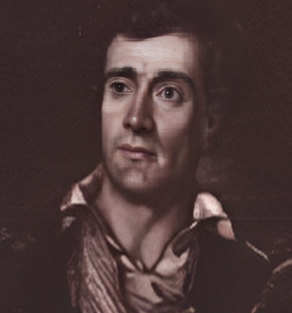
Parents: Edward Henry Caldwell (1759–1802) and Margaret Bolton (1769–1857). Married: (1) Maria Carter Hall Wormeley (1790–1859); (2) Josephine Rowe (1829–1857). Other Relationships: Jane Placide (1804–1835); Margaret Abrams (1816–1848). Children: With Maria Carter Hall Wormley: William Shakespeare Caldwell (1821–1874), Sophia Caldwell (1824–1872); with Josephine Rowe: Harry Stroud Caldwell (1855-1860); with Margaret Abrams: James Henry Caldwell Jr. (1839–1870), Edward Holland Caldwell (1844–1872.
Kinship: Third great-grandfather of the post–World War II Smith generation.
Early Life and Theatrical Beginnings
James Henry Caldwell was born in England in 1793, the son of Edward Henry Caldwell and Margaret Bolton. One newspaper claimed that his father was an umbrella maker, though this may have been a slur rather than fact. As a child actor in England, Caldwell began performing at an early age and came to the United States in 1816 with a Shakespearean troupe.
In 1819, while managing a small theater in Fredericksburg, Virginia, he met Maria Carter Hall Wormeley, a member of the First Families of Virginia and a niece of King Carter. Their marriage that year produced two children. Although they later separated, they remained on civil terms and were not divorced until 1850.
Relationships and Family
Caldwell’s personal life was notably complex, involving several women over the course of his life:
Maria Carter Hall Wormeley (1790–1859) — His first wife, widow of Warner Lewis Wormeley (1785–1815). Their children were William Shakespeare Caldwell and Sophia Caldwell.
Jane Placide (1804–1835) — A New York–born actress and businesswoman, she collaborated with Caldwell in numerous theatrical ventures. The precise nature of their relationship remains uncertain, though they were close professional and possibly personal partners.
Margaret Abrams (1816–1848) — Caldwell’s mistress, with whom he had two illegitimate sons later legitimized by an act of the Louisiana Legislature: James Henry Caldwell Jr. and Edward Holland Caldwell.
Josephine Rowe (1829–1857) — An actress from a theatrical family, whom Caldwell married in 1850 when he was fifty-seven and she was twenty-one. They had one child, Harry Stroud Caldwell.
Career and Achievements
Caldwell became the leading actor, theater manager, and impresario in the antebellum South. His charisma and managerial skill transformed the cultural life of New Orleans and other Southern cities. His theatrical enterprises led to a series of civic and commercial ventures that secured both his wealth and reputation.
He built theaters in New Orleans, Cincinnati, Mobile, and St. Louis, and even operated a public bath and spa in New Orleans. While performing in Baltimore’s Holliday Street Theatre, Caldwell encountered gas lighting—a technology that inspired his most profitable innovation.
By 1833, he had obtained contracts to light the streets of New Orleans, Mobile, and Cincinnati with gas. This business became the foundation of the Caldwell family fortune and directed his descendants toward careers in engineering and commerce.
Public Office and Political Views
Caldwell parlayed his prominence into political influence. He served as member and recorder of the Second Municipality Council of New Orleans, alderman and president of the Board of Aldermen, and as a representative in the Louisiana legislature.
His politics were staunchly Southern and pro-slavery, as illustrated in a 1835 resolution he sponsored condemning Northern abolitionists. It included such phrases as:
“We have every reliance upon our northern brethren that they will prostrate these vile disturbers of our public peace…these disseminators of dreams in the face of our great rights and truth…these distributors of vile and rash lies and visionary trash.”
Later Life and Death
With the onset of the Civil War, Caldwell left New Orleans in 1862, living for a time in Cincinnati and then in New York City. In failing health, he died there on September 11, 1863. Funeral services were held at St. Patrick’s Cathedral on September 14, and his body was transported to New Orleans for a second service at the Dead Church on Rampart Street. He was buried in Fireman’s Cemetery.
Legacy
James Henry Caldwell was a pioneering figure in the development of American theater and civic enterprise in the South. His entrepreneurial ventures—particularly the introduction of gas lighting—ensured both his fortune and the prominence of his descendants. Despite the turbulence of his personal life, he remains a central figure in the cultural history of nineteenth-century New Orleans.