Caldwell, James Henry (1865–1931)
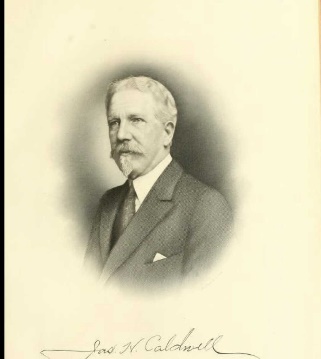
Early Life and Education
James Henry Caldwell, the eldest son of Edward Holland Caldwell and Caroline Amelia Shields Caldwell, was born in Mobile, Alabama, on March 21, 1865. He grew up amid the wealth and prominence that his grandfather, the actor and industrial pioneer James Henry Caldwell (1793–1863), had established through the gas lighting enterprises of the family. His father, Edward Holland Caldwell, managed the Mobile Gas Light and Coke Company until his premature death in 1872, leaving Caroline a young widow with three children.
James received his early education in private schools in Maryland and New York City, environments that reflected both the refinement and the ambition of his family. In 1882, at the age of seventeen, he entered the Rensselaer Polytechnic Institute in Troy, New York—then the leading engineering school in the United States—and graduated with the Bachelor of Science degree in 1886.
Engineering Career and Early Business Work
Following graduation, Caldwell returned to Mobile, where he applied his training as a civil engineer with the Mobile Gas Light Company, helping design and oversee the construction of an electricity-generating plant. His aptitude for both engineering and management soon led him to higher positions: by 1888 he was vice-president, and later president, of both the Mobile Gas Light and Coke Company and the Mobile Electric Light Company—two of the key properties held by the Caldwell estate.
Move to New York and Industrial Leadership
In 1887–1888, after several years of professional success in Mobile, Caldwell undertook extensive travels in the United States and Europe, broadening his technical and business perspective. In 1888 he joined the Ludlow Valve Manufacturing Company of Troy, New York, a firm specializing in the production of industrial valves and hydrants. His rise within the company was rapid. In 1892 he was elected vice-president, and in 1893 also assumed the duties of general manager. By 1909 he became president of the company, a position he held until his death. Under his leadership, Ludlow Valve expanded into one of the premier manufacturers in its field, known for precision engineering and for supplying major municipal water and gas systems throughout the United States.
Banking, Corporate, and Financial Roles
Caldwell’s interests extended well beyond manufacturing. He was one of the organizers of the Troy Trust Company and served as its first president for eight years. He later became vice-president and trustee of the Troy Savings Bank, and a director of the National State Bank of Troy. He served as president of the Commercial Telephone Company until its absorption into the American Telephone and Telegraph Company, and was also president of the Van Rensselaer Hotel Company, treasurer of the Rensselaer Improvement Company, and trustee of the Troy Gas Company.
His reputation for managerial efficiency and civic-mindedness made him a sought-after board member and adviser. At the time of his death, he was a director of several other corporations across the northeastern United States.
Civic, Educational, and Philanthropic Activities
Caldwell was deeply engaged in civic and charitable life in Troy. He served as president of both the Troy Public Library and the Troy Chamber of Commerce, and was vice-president and trustee of Rensselaer Polytechnic Institute, maintaining a lifelong devotion to his alma mater. He was one of the founders, as well as president and trustee, of the Samaritan Hospital in Troy, a charitable institution serving the industrial and working population of the city. He also served as trustee of the Day Home Nursery, reflecting his interest in social welfare and public health.
Professional and Social Affiliations
Caldwell’s professional affiliations reflected his national stature within the engineering community. He was a member of the American Society of Mechanical Engineers, the American Water Works Association, the American Gas Institute, the Illinois Gas Association, and the National Founders’ Association. His intellectual curiosity led him also into scientific societies such as the American Geographical Society, the National Geographic Society, and the American Museum of Natural History.
He maintained an active social life through a number of clubs: the University, Engineers, Machinery, and Recess Clubs of New York City, and the Troy Club and Elks of Troy. His fraternity at Rensselaer was Delta Phi.
Religious Life and Personal Character
Caldwell was an Episcopalian, serving as senior warden of St. Paul’s Church in Troy. Contemporaries described him as energetic, urbane, and methodical—a man of integrity who combined technical mastery with civic conscience. His career linked the industrial vigor of the late nineteenth century with the civic reform movements of the early twentieth.
Caldwell, John Christie (1893–1923)
Parents: James Henry Caldwell (1865–1931) and Marguerite Josephine Christie (1865–1919). Married: Helen Greatsinger Farrell (1898–1970).
Children: None recorded. Kinship: First cousin twice removed of the post–World War II Smith generation.
Early Life and Education
John Christie Caldwell was born in Troy, New York, on April 3, 1893, the only son of James Henry and Marguerite Josephine Christie Caldwell. He grew up in one of Troy’s most prominent families, his father being president of the Ludlow Valve Manufacturing Company and a civic leader in both business and philanthropy. The Caldwells occupied a position of considerable distinction in Troy society, with ties to New York and New England industrial circles.
He was educated first at the Troy Academy, a preparatory institution founded by members of the city’s professional elite, and later at St. Mark’s School in Southborough, Massachusetts, one of the leading Episcopal boarding schools of the day. He entered Rensselaer Polytechnic Institute, his father’s alma mater, where he studied chemical engineering and graduated in 1916 with a Bachelor of Science degree.
Early Career and Military Service
After graduation, Caldwell accepted a position with the Robert W. Hunt Company in Chicago, an engineering and inspection firm specializing in materials testing and industrial quality control. His work there reflected both his technical training and the expanding importance of engineering expertise in early twentieth-century industry.
In 1917, following the entry of the United States into the First World War, Caldwell enlisted in the United States Marine Corps. While training at Parris Island, his leadership and technical ability led to his transfer to the U.S. Army Corps of Engineers, where he accepted a commission as second lieutenant. He was stationed first at Fort Myer, Virginia, and later sent to Cambridge, Massachusetts, for training at the Army’s new flying school under the Signal Corps Aviation Section. His aptitude as an instructor resulted in a transfer to Miami, Florida, where he was appointed commandant of cadets in the aviation program. He was honorably discharged in February 1918.
Professional Life
After the war, Caldwell returned to Troy and joined the Ludlow Valve Manufacturing Company as purchasing agent and assistant to his father. The firm, one of the largest valve and hydrant manufacturers in the United States, had expanded its wartime production and was an important supplier to municipal and industrial clients nationwide. Caldwell’s position placed him in line for a significant role in the company’s management, and he was viewed as his father’s natural successor.
Illness and Death
In the early 1920s his health began to decline, and it was reported that he suffered from tuberculosis or another respiratory illness. Seeking a milder climate, he traveled to Augusta, Georgia, and took rooms at the Hotel Bon Air Vanderbilt, a luxury winter resort frequented by northern industrialists.
On the night of February 18, 1923, while smoking in bed, he accidentally ignited the bedclothes. The fire spread rapidly, and he was fatally burned. His death was widely reported in Troy and Albany newspapers, which emphasized the tragic loss of a young man of promise from one of the city’s leading families.
Legacy
Although his life was brief, John Christie Caldwell represented the third generation of Caldwells who combined engineering accomplishment with civic standing. Educated in the best schools and active in both industry and military service, he exemplified the family’s tradition of technical innovation and public responsibility. He was buried in Troy, New York, near his parents and other members of the Caldwell family. His widow, Helen Greatsinger Farrell Caldwell, survived him by many years.