Breese, Frances Tileston “Tanty” (1893–1985)

Early Life and Relationship with Father
Frances Tileston “Tanty” Breese had a colorful and unconventional life—an unsurprising outcome given her father’s reputation for exuberance and eccentricity. As an infant she moved with her family to The Breeses in Tuxedo Park, but they did not remain long; her father had scandalized the local country club by starting a craze for tobogganing down its grand staircase on silver tea trays.
At five, Tanty moved with her family to The Orchards, a fifty-acre estate in Southampton surrounded by gardens. Raised by a French governess, she spoke French more fluently than English. Her relationship with her father was complex; he was both her champion and a source of disillusionment. He delayed sending her to school until she was ten but gave her an early education in mechanics. She later recalled, “Of me, he was known to say, ‘Frances is the best of my boys,’ and he liked to show me off. As soon as I was tall enough to sit behind the wheel of a car, he put me in the driver’s seat and taught me to shift gears and manipulate the hand throttle.”
However, her father’s flagrant philandering and financial volatility strained their bond. Frances penned a poem about him that, while playful on the surface, revealed a daughter’s cynical awareness of her father’s indiscretions
A Poem for Her Father
Tanty, his youngest child
How well do I remember
The year of ninety-three
when Father and my Mother
Had just created Me.
T’was from my painted iron crib
while blowing bubbles in my bib
I used to look with wonder on
The costumes that my Pa would don.
For fancy dress at every party
Was much the vogue if you were “arty”
In the eighties and the nineties
And the naughty nineteen oughties
Then later, when a little tot,
(You may believe I was, or not)
I used to watch and have much fun
When Jimmy made his horses run.
For trotting then was much the fad
And moving slow was not for Dad.
Give him action, give him speed,
He likes them fast… yes Sir, indeed.
In horses, women, games and sport
Slow movers never were his sort.
(Of course all this is merely heresay,
But rumors sometimes reach the nursray.)
So, by the time I could count ten
I’d heard a thing or two. For instance when
A little fairy flitting by
Told me the tale about the Pie.
She said no crows came out that night.
Instead, a vision of delight;
A fancy from the brain of him
Who all my friends call Uncle Jim.
But in the fear that I might tell
Too much, it would be well
Only to mention with a word
Some of the things that I have heard.
About his prowess and his skill;
The birds he’s shot, the fish he’s killed,
The boats he’s sailed, the cars he’s driven,
And his immense success with women.
So if you lesser men are spurned
Because as yet you haven’t learned
To charm the birds from off the trees,
You’d best tune in on Jimmy Breese.
Education and Adolescence
When Tanty was about twelve, her father’s fortunes—soaring and collapsing with market fluctuations—fell sharply. The family sold their Manhattan townhouse, leased The Orchards to tenants, and moved to a run-down Maryland farm. Her father embraced farming with typical gusto, donning overalls and learning to drive a tractor. For Frances, the change was lonely and disorienting. With little money for tuition, she attended a Baltimore day school, making an exhausting daily commute, and later an all-boys school where she felt isolated. Her dogs and the freedom to drive on country roads were her chief comforts.
By the time she was sixteen, her father had recouped enough wealth to send her to school in Paris. Before leaving, she proved her driving prowess. “A memorable occasion for me,” she wrote, “was the day in my fifteenth year that my father and I had set out from New York for eastern Long Island in our six-cylinder Pierce Arrow.” Once across the Queensboro Bridge, he allowed her to take the wheel. “I was filled with pride when my father opened his newspaper to look at the stock market reports instead of watching my driving.”
She was the model for the BLM (Breese-Lawrence-Moulton) sports car poster (left); her brother Sydney Breese was involved in that business. After her stay in Paris, she bought herself a Hupmobile.
Coming Out and Early Adulthood
After returning from Paris, Tanty had a modest coming out, but it included excitement and notoriety. She and a friend performed a “snake dance” at a charity benefit, consulting the modern dancer Ruth St. Denis about their costumes and painting their arms green to complement their reptile-skin ensembles.
Her volunteer work with the Junior League brought her into contact with New York’s less privileged classes. She taught dancing at settlement houses and visited foster homes for the Children’s Aid Society, where she observed poverty firsthand.
Marriage and War Years
At the end of her second winter in New York, Tanty in a moment of weakness behaved conventionally. She became engaged to Lawrence McKeever Miller, a young man from a family long associated with Tuxedo Park and Southampton. Her father approved, pleased to have a son-in-law conversant with finance.
During World War I, she trained with the Red Cross, drilled at the Armory, and learned typing and automobile repair. When her husband returned from France, she was, as she wrote, “a different woman”—a transformation typical of her generation’s wartime experience.
Later Life and Artistic Pursuits
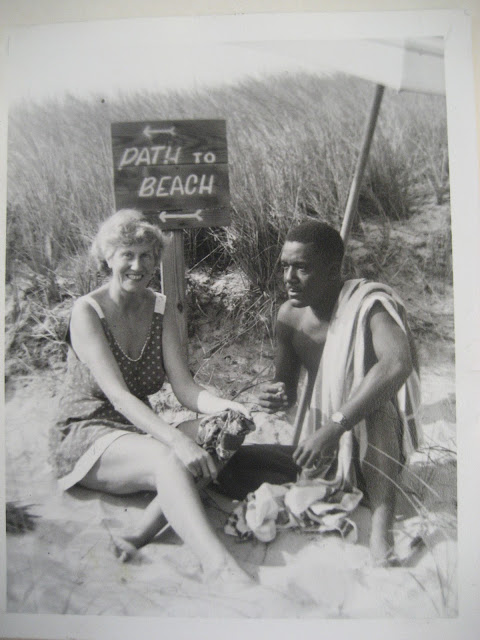
After the war, the Millers lived in Hewlett, Long Island, though Tanty found suburban life frustrating. She cherished summers at Southampton, and after her father remarried Grace Lucille Momand, a woman near Tanty’s own age, she and her husband rented their own house.
Encouraged by artist Rachel Hartley to paint, she began to work seriously, but her husband disapproved, and she gave up the pursuit. A nervous breakdown preceded their eventual divorce in 1930.
She built a modern house in Bridgehampton known as The Sandbox and began painting again. Later she moved to Haiti, where she married a Haitian artist, Arsene Marius (right). They relocated to Mexico but eventually divorced.
Returning to Long Island in 1957, she devoted herself to art, design, and dance. In 1939 she designed the carpet for the United States Building at the Chicago World’s Fair, an acknowledgment of her modernist sensibility.
Final Years
Frances Tileston Breese Miller spent her later years at The Sandbox, painting and entertaining friends in the free-spirited manner that had always defined her. She died there on June 19, 1985, at the age of ninety-one. Her beloved house was later sold and demolished.
Adapted from “High Style in the Gilded Age: Frances Breese Miller” by Mary Cummings.