Boyce, Ker (1787–1854)
Early Life and Character
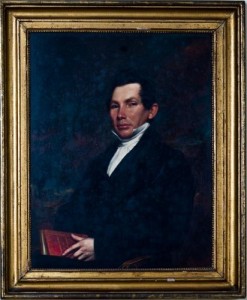
Ker Boyce was born in the upland district of Newberry, South Carolina, in 1787, of Scotch-Irish Presbyterian ancestry. His early life revealed both energy and humor; he was described as “mirthful and mischievous.” From modest beginnings, he rose through intelligence and perseverance to become one of the wealthiest and most influential men in the antebellum South.
During the War of 1812, with maritime trade blocked by the British navy, Boyce began an overland commerce route with Philadelphia, carrying southern goods northward and bringing back manufactured products. In 1817 he moved to Charleston, then the principal commercial center of the South Atlantic states, and established himself as a commission merchant and lender to planters. He weathered the financial panic of 1825, showing the business acumen that would later make him one of South Carolina’s foremost financiers.
Marriage and Religious Influence
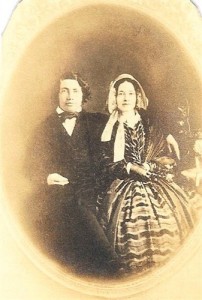
Boyce married first Nancy Johnston, and after her death in 1823 married her sister, Amanda Caroline Johnston. Because such a marriage was barred by Presbyterian discipline, it was solemnized by Baptists, who saw no theological impediment. Ker himself never joined the Baptist church but remained sympathetic; Amanda, after hearing a moving sermon by the young preacher Basil Manly Sr. on the death of his child, was converted and became a devout Baptist. Her conversion would deeply affect their son, James Petigru Boyce, who became a leading Baptist theologian.
Ker and Amanda
Commerce and Industry in Charleston
By the 1830s Ker Boyce was one of the most powerful figures in Charleston’s economy. He served as president of the Bank of Charleston and helped found several other enterprises that advanced the industrial and financial modernization of South Carolina. In 1836 he purchased and revitalized a failing sugar company, renaming it the Charleston Sugar Refining Company. He also presided over the South Carolina Paper Manufacturing Company and held directorships in the South Carolina Railroad, the South Carolina Insurance Company, and the Charleston Gaslight Company.
Boyce invested heavily in manufacturing and infrastructure, holding shares in more than twenty companies and serving as president of the Charleston Chamber of Commerce. In that role he toasted the retirement of the British consul in 1845 with the sentiment: “Commerce—the parent of civilization, the nursery of arts, the bond of universal peace.”
Industrial Development and Social Vision
Boyce was among the first Charleston leaders to support industrial diversification. He purchased 9,000 acres near Aiken and became an early investor in William Gregg’s Graniteville manufacturing venture, built partly on Boyce’s land. Gregg, influenced by Northern industrial models, argued that South Carolina must transform its economy from exporting raw cotton to producing finished goods. Boyce’s financial support reflected both philanthropic concern and pragmatic vision: he saw industrialization as a means to employ impoverished whites and retain Southern capital within the state.
Gregg’s plan to employ poor white laborers rather than slaves was controversial among Charleston’s planter elite, but Boyce recognized the long-term advantage of creating a balanced economy not wholly dependent on plantation agriculture. Graniteville thus became one of the South’s first industrial communities, foreshadowing the postwar “New South” ideal.
Public Life and Politics
A Unionist Democrat by conviction, Boyce opposed the early movement toward secession. He served in both the South Carolina House and Senate and corresponded with national leaders, including John C. Calhoun. In an 1848 letter to Calhoun, he lamented Northern hostility toward the South: “They have no respect for us and their only object is to see the Negroes cut our throats.” Yet he expressed confidence in Zachary Taylor as president, “as he must be sound on the Main Question [i.e., slavery]. His being a Southern man and a slaveholder give assurances beyond doubt.”
Philanthropy and Death
At his death in 1854, Boyce left an estate valued at approximately two million dollars (equivalent to about $57 million in modern currency). His will reflected both his wealth and his social conscience: he gave $10,000 for a house for the poor in Graniteville, $20,000 to the Charleston Orphan House, and $30,000 to the College of Charleston for scholarships for needy students. The remainder was placed under the trusteeship of his son, James Petigru Boyce.
He was buried in Magnolia Cemetery, Charleston, among the city’s most prominent citizens.
Legacy
Ker Boyce’s life embodied the transition of the South Carolina economy from mercantile to industrial capitalism. Though a defender of slavery, he also promoted local enterprise, social philanthropy, and education. His descendants—especially his son James Petigru Boyce—carried forward his combination of intellect, piety, and civic vision.
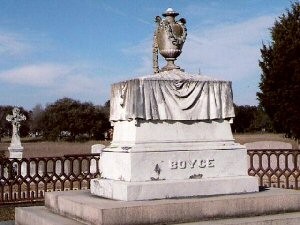
Ker Boyce’s monument