Bowne House
Architectural Description
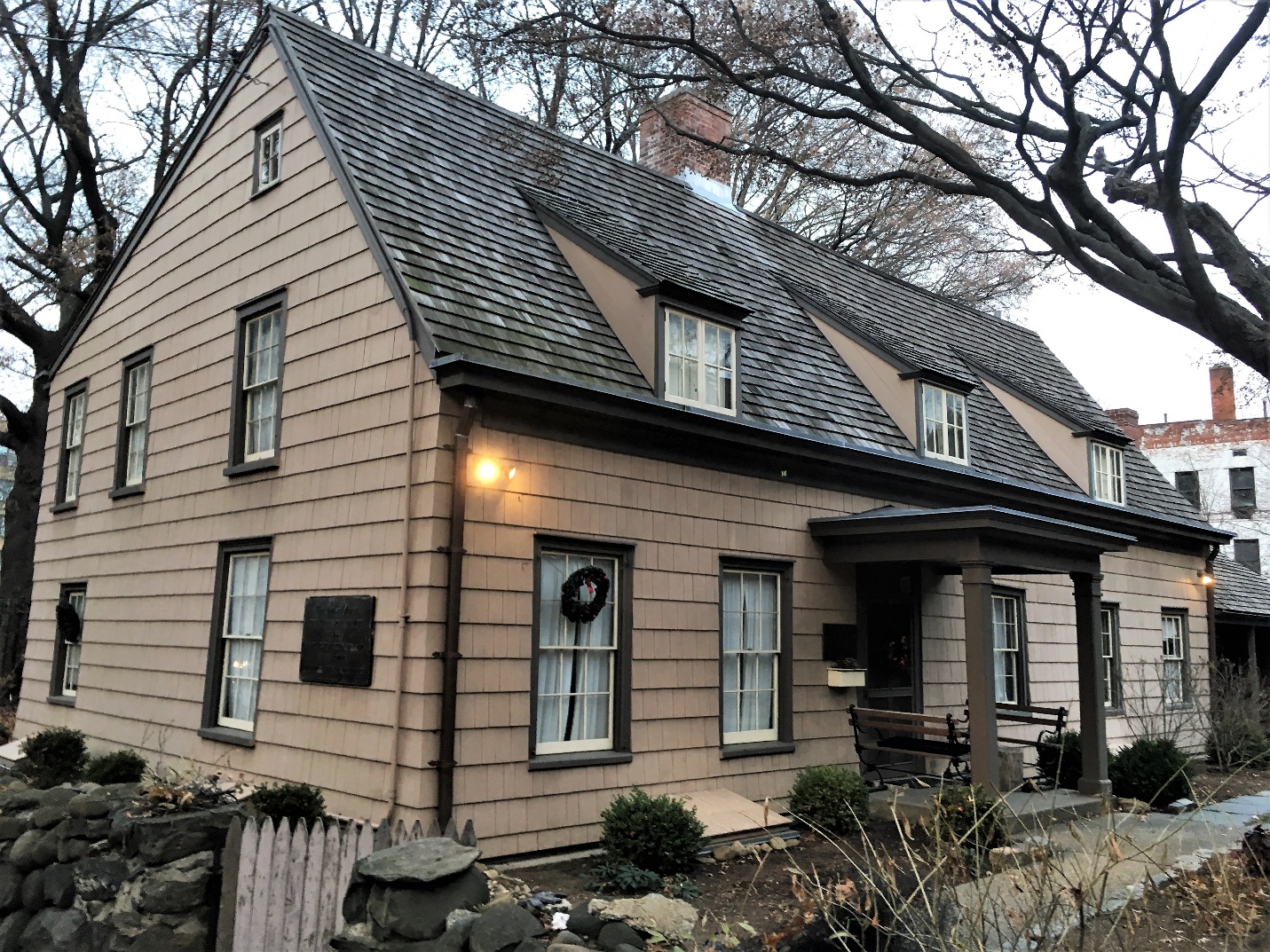
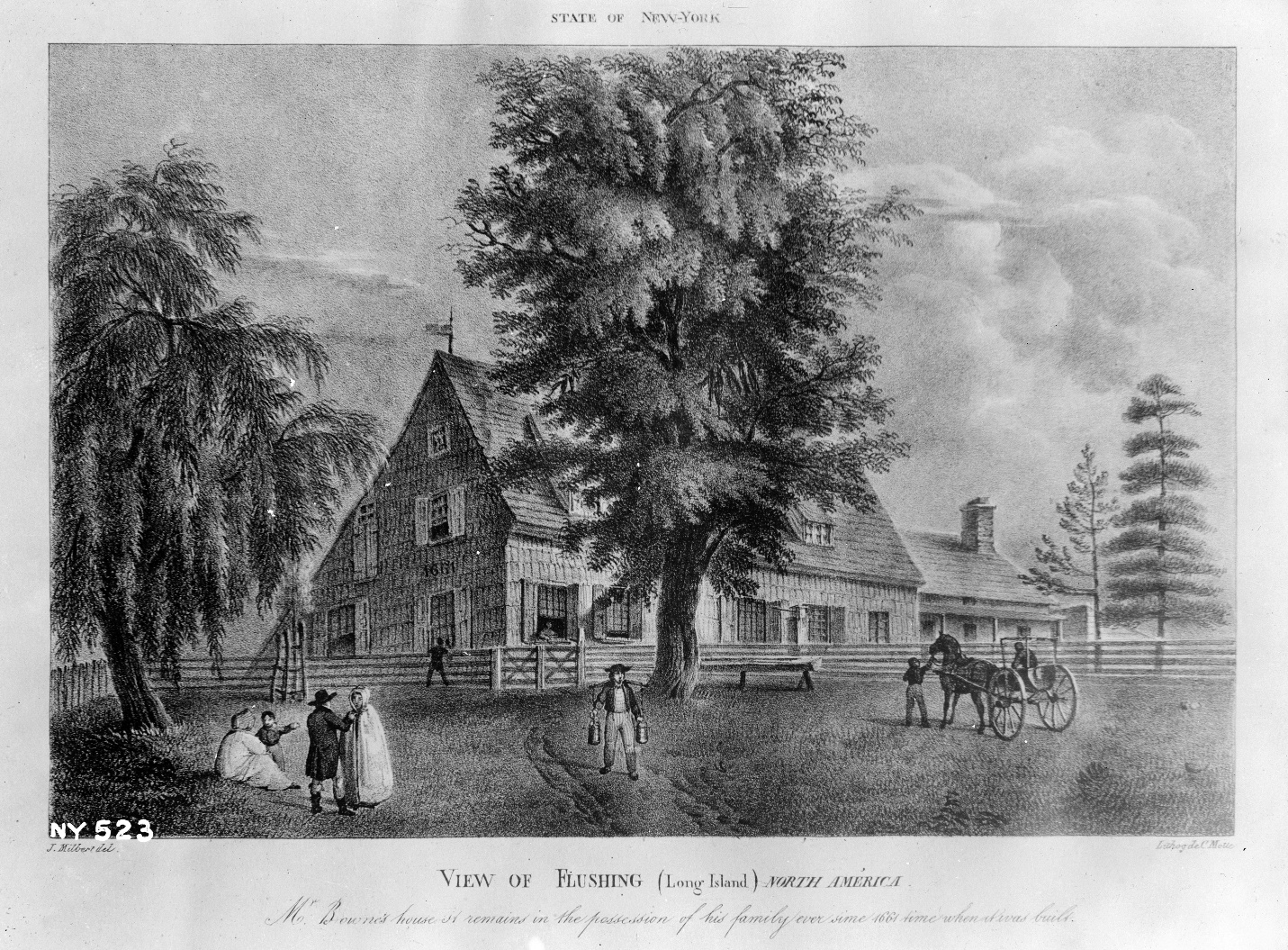
The Bowne House is a wood-frame Anglo-Dutch vernacular saltbox, widely regarded as the best-preserved example of its type in the United States. Its original core was a modest single-room dwelling, laid out according to Dutch spatial conventions but constructed with English framing techniques. The steeply pitched roof, shingle siding, and later dormers reflect practical adaptations to climate and evolving domestic needs. As the Bowne family grew and prospered, the house was expanded in 1669 and 1680, with further alterations over the eighteenth century; its present footprint was largely fixed by 1815, with minor nineteenth-century updates. An 1825 engraving shows the house in its mature form, surrounded by grounds animated by family life.
.
History
The Bowne House is one of the oldest surviving buildings in New York City and the oldest standing structure in the Borough of Queens, distinguished by its continued presence on its original site in Flushing. The house stands within a historically significant area associated with early English settlement and civic life, near the former location of the celebrated Weeping Beech. It was built about 1661 by John Bowne, an English immigrant from Matlock, Derbyshire, who emigrated to Boston in 1649 and settled in Flushing in 1651, when the region was still part of the Dutch colony of New Netherland.
The historical significance of the Bowne House is inseparable from its role in the development of religious liberty in America. In 1662, John Bowne, a recent convert to Quakerism, hosted a Friends’ meeting in the house in defiance of restrictions imposed by Director-General Peter Stuyvesant, who sought to enforce Dutch Reformed religious conformity. Bowne was arrested, fined, imprisoned, and banished to Holland, but he successfully appealed to the Dutch West India Company. In 1663 the company ruled in his favor, affirming liberty of conscience and reinforcing principles first articulated in the Flushing Remonstrance of 1657, principles that later influenced American constitutional protections for freedom of religion, speech, and assembly.
The Bowne House was occupied continuously by nine generations of the Bowne family over more than three hundred years. John Bowne and his wife Hannah Feake Bowne raised eight children there, and later descendants were active in American commercial, civic, and reform movements. John Bowne’s great-grandson Robert Bowne was a co-founder of the New York Manumission Society in 1784, working alongside Alexander Hamilton to promote the abolition of slavery. In the mid-nineteenth century, resident William B. Parsons assisted freedom seekers through the Underground Railroad, a legacy that has led to the house’s inclusion in the National Underground Railroad Network to Freedom.
In 1945 the last family residents, the Parsons sisters, descendants of the Bowne line through the female branch, deeded the property to the Bowne House Historical Society. After restoration and archaeological investigation, the house opened to the public as a museum in 1947. It was designated a New York City Landmark in 1966 and added to the National Register of Historic Places in 1977. Preserved largely as it evolved over centuries, the Bowne House stands today as a rare and tangible record of early colonial architecture, long family continuity, and the historical struggle for civil and religious liberties in America