Bowne Family
Pioneers of Liberty and Commerce
The Bowne family of Flushing, Long Island, ranks among the oldest and most distinguished Quaker families in America. Originating in Derbyshire, England, the Bownes became known from the seventeenth century onward for their steadfast defense of liberty of conscience, their long engagement in commerce and civic life, and their close intermarriage with other leading New York families, including the Lawrences, Murrays, Parsons, and Bogerts.
English Origins and Immigration The family’s earliest known ancestor was Thomas James Bowne (1595–1677) of Matlock, Derbyshire, who emigrated to New England with his son John Bowne in the mid-seventeenth century. They were English Puritans by background, but the younger Bowne soon embraced the tenets of the Society of Friends (Quakers), a radical new movement emphasizing inner light, simplicity, and equality.
Establishment at Flushing By 1661, John Bowne (1627–1696) had settled in Flushing, Long Island, then under Dutch rule. With his wife Hannah Feake, he opened his home for Quaker meetings in defiance of Governor Peter Stuyvesant’s edict against unauthorized religious gatherings. His subsequent arrest, imprisonment, and deportation to Holland led to his celebrated appeal before the directors of the Dutch West India Company in Amsterdam. Their ruling in 1663 ordered that “the consciences of men ought to remain free and unshackled,” effectively establishing freedom of worship in New Netherland.
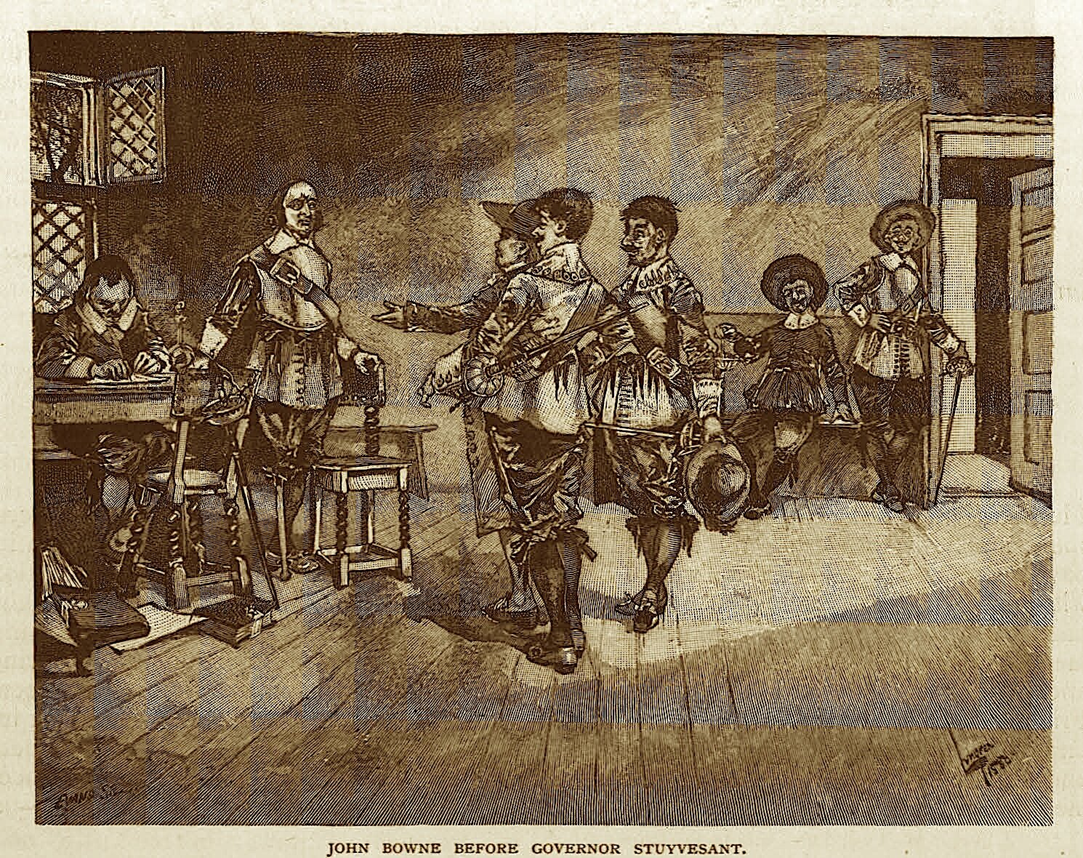
John Bowne before Governor Stuyvesant
This act made John Bowne a foundational figure in the history of American religious liberty. The house he built in Flushing around 1661 still stands as a museum and National Historic Landmark.
Growth and Prominence in the Eighteenth Century John’s descendants continued to live in Flushing and remained faithful members of the Society of Friends. His son Samuel Bowne (1667–1745) became a Quaker minister and was remembered for his hospitality to traveling Friends. The family’s influence extended through Samuel’s sons and grandsons, who intermarried with the Lawrences and other prominent Quaker lines.
During the eighteenth century, the Bownes combined their religious devotion with business enterprise. Robert Bowne (1744–1818), a great-grandson of John I, founded Bowne & Co., printers, in 1775—now the oldest continuously operating commercial firm in New York. He was also a founder of the Bank of New York (1785) and a leader in the New York Manumission Society (1785), which worked for the abolition of slavery and established the African Free School.
Public Service and the Nineteenth Century The family remained active in public and civic life after the Revolution. Walter Bowne (1770–1846), a descendant of Robert’s branch, served as mayor of New York City from 1829 to 1833, guiding the city through the 1832 cholera epidemic and overseeing major municipal improvements. His estate, Bowne Park in Flushing, preserves part of the original family lands.
Other members carried forward the family’s humanitarian traditions. Mary Bowne Parsons (1784–1839) and her husband, Samuel Parsons, were leading Quaker abolitionists, and their children participated in the Underground Railroad. Samuel Bowne Parsons Sr. (1819–1906) and Samuel Bowne Parsons Jr. (1844–1923) developed the Parsons Nursery in Flushing, introducing new ornamental plants and contributing to the design of Central Park and other public landscapes.
Allied Families Through marriage, the Bowne family became intertwined with several other historically significant New York families:
The Lawrences of Flushing and Bayside, with whom they shared Quaker convictions and civic leadership.
The Parsons, prominent horticulturists and abolitionists.
The Bogerts, connected through the Bowne–Lawrence marriages.
The Murrays and Franklins, linked by the eighteenth-century alliance between Catherine Bowne Murray and Robert J. Murray Jr.
These intermarriages reinforced a network of Quaker and reform-minded families who helped shape the social and moral culture of early New York.
Legacy For more than three centuries, the Bownes have represented continuity of principle and public service. From John Bowne’s defense of liberty of conscience in 1662 to the family’s later involvement in education, abolition, and horticulture, the name has stood for a blend of faith, enterprise, and civic responsibility.
The Bowne House in Flushing remains the chief memorial to the family’s enduring influence. It is maintained by the Bowne House Historical Society as a museum of religious freedom and early Quaker life in America.