Willow Bank
Architectural Description
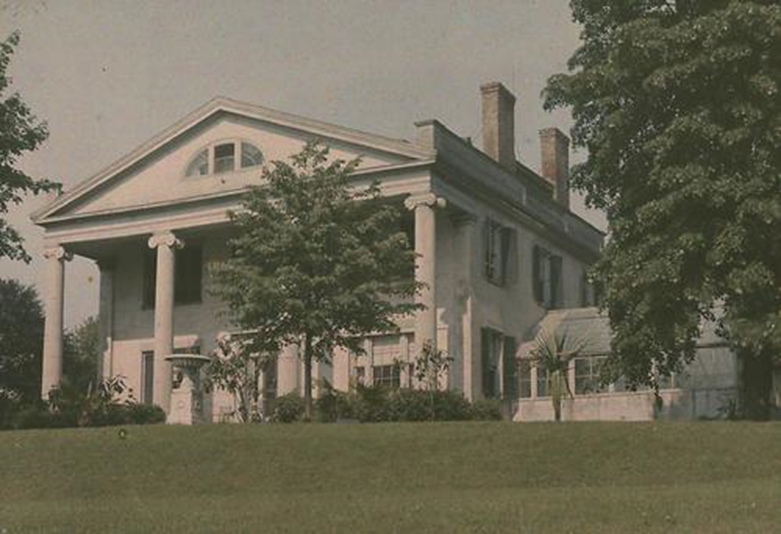
Willow Bank was a substantial early-nineteenth-century country house in the Classical Revival mode, prominently sited on a rise overlooking Flushing Creek. The main block was a rectangular, two-story structure crowned by a low-pitched gabled roof, with a temple-front façade dominated by a full-height portico. Four tall, smooth columns supported an entablature and pediment, the latter pierced by a semi-circular fanlight that illuminated the attic level.
The façade was symmetrically organized, with evenly spaced sash windows and a central entrance approached by a broad flight of steps. The walls appear to have been stuccoed or lightly finished, giving the house a pale, monumental appearance appropriate to its classical detailing. Chimneys rose at either end of the roofline, emphasizing the balanced composition.
To one side stood a large conservatory or greenhouse, a notable feature of the estate, reflecting both horticultural interests and the semi-rural character of Flushing in the nineteenth century. Set amid lawns, mature trees, and water frontage, Willow Bank combined the architectural language of the American Greek Revival with the landscape ideals of a Hudson- and Long Island–area gentleman’s estate.
History of Willow Bank
Willow Bank was a historic estate and mansion in Flushing, Queens, New York, long associated with the Lawrence family, one of the original patentee families of the town. The house stood on the banks of Flushing Creek (also known historically as the Flushing River), on land that traced its ownership back to the mid-seventeenth century.
The land on which Willow Bank later stood was part of the original Flushing patent granted in 1645 by the Dutch governor of New Netherland, William Kieft. Among the patentees was William Lawrence, an early settler who helped incorporate the town of Flushing. The Lawrence family established themselves along Flushing Bay and Flushing Creek, where their holdings extended for generations. By the mid-seventeenth century the family had erected early homesteads nearby, including at what later became known as Lawrence Point, in present-day College Point.
The mansion known as Willow Bank was built in 1836 by John Watson Lawrence (1800–1888), a direct descendant of William Lawrence. An earlier Lawrence house on the site had been destroyed by fire in 1835, prompting the construction of a new and more ambitious residence. John W. Lawrence erected the house on the ancestral estate and named it “Willow Bank” for the numerous willow trees that lined the creek and shaded the grounds.
The new house was a substantial Classical Revival country seat, set within approximately twelve acres of landscaped grounds. It faced Flushing Creek and included a large conservatory or greenhouse, reflecting Lawrence’s interest in horticulture and the influence of nearby nurseries, including the celebrated Prince Nursery of Flushing. Willow Bank quickly became one of the most prominent private residences along the creek.
Throughout the nineteenth century, Willow Bank remained in Lawrence family hands and functioned as a multigenerational family home. John W. Lawrence himself was a prominent civic figure, serving as president of the Village of Flushing, a member of the New York State Assembly, a United States Congressman, and for many years president of the Queens County Savings Bank. Under his ownership and that of his descendants, the estate was known both for its architectural presence and for its carefully maintained grounds.
Later in the century, William Bowie Lawrence added a celebrated feature to the estate: a large duck pond enclosed by a high wire cage. This enclosure housed what contemporary accounts described as the most complete and varied collection of ducks in America, including pairs of nearly every species of American duck and many exotic Oriental varieties. The collection was maintained and expanded by his son, Townsend Lawrence, and became a local point of admiration.
Decline
By the early twentieth century, the character of Flushing Creek had changed dramatically. Once a picturesque tidal waterway, it had become increasingly industrialized, lined with coal docks, lumber yards, factories, railroad sidings, and ash dumps. These encroachments steadily eroded the suitability of Willow Bank as a private residence.
Townsend Lawrence, the last member of the family to live at Willow Bank, and his wife Caroline Bogert Lawrence occupied the house until the mid-1920s, after which they moved to Manhattan. In November 1925 the property was sold to a development company, ending nearly three centuries of continuous Lawrence ownership of the site.
In late 1926, as plans for further industrial development moved forward, the Willow Bank mansion was demolished. Contemporary newspaper accounts described the house wreckers’ work and the burning of unsalvageable lumber in a farewell bonfire as the old year gave way to the new. With its destruction, Willow Bank joined a growing list of Flushing landmarks lost to twentieth-century commercial expansion.
Soon after the demolition, the duck pond was dismantled, the remaining outbuildings were removed, and the grounds were reshaped for industrial and commercial use. The former family landing and boathouse on Flushing Creek disappeared as well. Nothing of the mansion itself survived above ground.