Townsend, Robert (1819–1866)
Commander, U.S. Navy
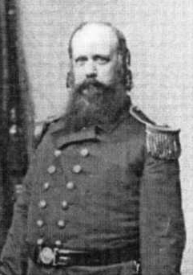
Parents: Isaiah Townsend (1777–1833) and Hannah Townsend (1784–1854). Married: Harriet Munro (1829-1919). Children: Robert Townsend Jr. (1854–1886), Gordon Webster Townsend (1855– ), Mary Walker Townsend (1858–1940), and Elizabeth Munro Townsend (1860– ). Kinship: First cousin five times removed of the post–World War II Smith generation.
Family Background: Robert Townsend was born in Albany, New York, in 1819, into the influential Townsend family whose enterprises had linked Long Island iron manufacture with the commercial and civic life of upstate New York. His father, Isaiah Townsend, was an executive of the Stirling Iron Works, the firm established by their ancestor Peter Townsend, who had forged the Great Chain stretched across the Hudson River at West Point during the American Revolution. His grandfather, Captain Solomon Townsend (1746–1811), had been a merchant sea captain and a legislator in the early Republic. Through this lineage, Robert inherited both a seafaring tradition and a sense of patriotic service.
Education: Townsend received his early education at The Albany Academy and continued his studies at the Rev. Dr. Orville Dewey’s Boarding School in Pittsfield, Massachusetts. He briefly attended Union College in Schenectady but left before completing his degree to serve on the board of survey of the Utica and Schenectady Railroad Company—an early expression of his technical aptitude and interest in transportation.
Naval Career: Early Service and the Mexican War: Townsend entered the United States Navy as a midshipman on August 4, 1837, serving first aboard the frigate John Adams. In 1838 he was posted to the battleship Ohio, and in subsequent years to the sloops Falmouth and Porpoise and the steamship Missouri. Promoted to passed midshipman in 1843, he was assigned to the frigate Raritan and then to the brig Porpoise.
He saw active duty in the Mexican–American War (1846–1847), participating in the naval operations that led to the capture of Vera Cruz. For his conduct he was promoted to lieutenant in 1850. The following year, on April 7, 1851, he resigned from the Navy and entered civilian life for a time.
Civil War Service: When the Civil War began, Townsend reentered the Navy on September 17, 1861, as an acting lieutenant and was soon promoted to commander. His early assignments included service on the side-wheel gunboat Miami under Commander Abram Davis Harrell. The Miami carried one 80-pounder Parrott rifle, a 9-inch smoothbore, and four 24-pounders, with a crew of 134. Operating under Admiral David Farragut as part of the Mortar Flotilla, the Miami took part in the bombardment and reduction of Confederate forts below New Orleans in 1862—actions that opened the Mississippi to Union control. Townsend was promoted to command of the Miami that October.
Command of the Essex: In 1863 Townsend received command of the Essex, a 1,000-ton ironclad gunboat originally built as a Mississippi River ferry. Under Admiral David Dixon Porter’s Mississippi Squadron, Townsend led the Essex during the Siege of Port Hudson (May 21–July 9, 1863). The Essex and the Mortar Flotilla bombarded Confederate fortifications daily until the garrison surrendered, securing Union control of the Mississippi and isolating the trans-Mississippi Confederacy.
Later that summer, on July 9, the Essex engaged Confederate batteries at Donaldsonville, Louisiana. Although damaged in action, the ship remained on station for months. In March 1864, Townsend led her up the Red River and participated in the capture of Fort DeRussy. He relinquished command on November 3, 1864.
Command of the Wachusett and Death in China: After leaving the Essex, Townsend was given command of the steam sloop Wachusett, a 1,032-ton wooden frigate armed with nine guns and manned by 170 sailors. In February 1865 the Wachusett was ordered to the East India Station via the Cape of Good Hope to join the Wyoming and Iroquois in searching for the Confederate commerce raider CSS Shenandoah.
Following the end of the war, the Wachusett remained in East Asian waters protecting American shipping and citizens. In mid-August 1866, while patrolling the Yangtze River in sweltering summer heat, Townsend and many of his crew suffered severe heatstroke. On August 15, 1866, at 1:45 a.m., he died aboard ship. The executive officer, John Woodward (Jack) Philip—later an admiral—assumed command and brought the vessel downriver to Shanghai, where Townsend was buried with full naval honors.
Legacy: Commander Robert Townsend’s naval career spanned the age of sail and the advent of steam power. His service in two wars, his leadership in riverine combat, and his death in distant waters made him a representative figure of the global reach of the post–Civil War U.S. Navy. His life also embodied the Townsend family’s enduring tradition of public service, from forging iron for the Revolution to commanding ships that secured the Union. He was buried in Albany, near the home and city his family had helped to shape.