Townsend Manor Inn
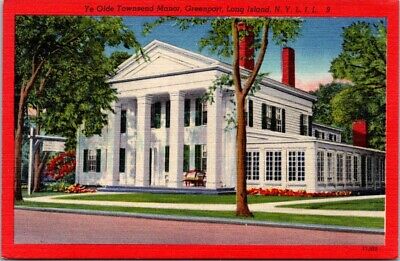
Architectural Description The main building is a substantial early-19th-century residence designed in a Neoclassical/Georgian Revival idiom characteristic of prosperous maritime families during Greenport’s whaling era. The house is distinguished by its symmetrical five-bay façade, monumental two-story portico with classical columns, pedimented gable, and balanced window placement with shutters. Brick chimneys rise from the roofline, and later wings extend to the rear and side, maintaining stylistic harmony while enlarging the structure.
The scale, finish, and classical detailing reflect the wealth and cultural aspirations of Greenport’s whaling captains during the village’s peak period of maritime prosperity in the 1830s and 1840s.
Early History In 1835, the house was constructed by Captain George Cogswell, a successful Greenport whaling captain, during the height of the village’s whaling boom, when as many as fifteen large whaling vessels operated out of Greenport Harbor. The residence served as Cogswell’s family home and stood as a visible marker of his status within the maritime community.
In 1849, drawn by the California Gold Rush, Cogswell sold the property and moved west. Over the next approximately seventy-five years, the house passed through several owners, paralleling Greenport’s gradual transition from a whaling port to a mixed maritime, agricultural, and seasonal resort economy.
Townsend Family Ownership The deeper family association dates to the Townsend family, among the earliest English settlers on Long Island. After arriving in Salem, Massachusetts, in 1638, brothers Henry, John, and Robert Townsend settled in Oyster Bay; Henry later moved to East Williston.
In 1902, Joseph Lawrence Townsend, a descendant of Henry Townsend, sold his farm in East Williston and retired to Greenport. After his death in 1916, his widow, Lillian Cook Townsend, purchased the former Cogswell residence in 1925.
Conversion to an Inn Recognizing the building’s dignified architecture, waterfront setting, and potential as a destination property, Lillian Cook Townsend undertook a careful restoration and adaptive reuse of the house. In 1926 she opened it as Ye Olde Townsend Manor Inn, making modest interior alterations to accommodate guests while preserving the historic fabric and character of the structure.
Lillian actively managed the inn and participated in local civic life until her death in 1945 at the age of seventy. The property remained under Townsend family ownership for nearly three decades, with members of the family—including Joseph Lawrence Townsend III and William Effingham Townsend Jr.—residing there at various times.
Later Ownership and Preservation In 1954, the Gonzalez family acquired the property, beginning a long period of continuous stewardship that continues into the present. Under their ownership, Townsend Manor Inn has been maintained as a historic waterfront inn while being sensitively expanded and modernized.