Townsend, Frederick (1825–1897)
Brigadier General
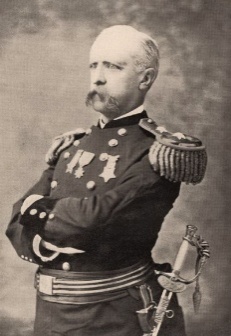
Parents**:** Isaiah Townsend (1777–1833) and Hannah Townsend (1784–1854). Married: Sarah Rathbone (1837-1910). Children: Ann Martin Townsend (1866–1881) and Sarah Rathbone Townsend (1868–1930). Kinship: First cousin five times removed of the post–World War II Smith generation.
Early Life and Ancestry Frederick Townsend was born in Albany, New York, on September 21, 1825, the son of Isaiah and Hannah Townsend. He descended from the early colonial immigrants Henry and John Townsend, who arrived in New Amsterdam from England by 1642, settled briefly in Warwick, Rhode Island, and later at Jamaica and Oyster Bay, Long Island. His grandfather Solomon Townsend had been a ship’s captain in the American Revolution and an iron manufacturer in the Hudson Valley; his great-grandfather Samuel Townsend served in the New York Provincial Congress and on the committee that drafted the first state constitution.
Education and Early Career Townsend attended The Albany Academy and the Bartlett Collegiate School in Poughkeepsie, entering Union College at age fifteen and graduating in 1844. He studied law under John V. L. Pruyn and was admitted to the bar in 1849, beginning a promising legal practice in Albany. That same year, the California gold rush drew his attention westward. Equipped by his grandmother, he set out for the Pacific coast but was long unheard from and believed dead. He eventually returned to Albany with extraordinary tales of capture by Indigenous people, survival of a tornado, and a single gold nugget that he presented to his grandmother, who preserved it as a family relic.
Family and Military Traditions
Frederick married Sarah Rathbone, first cousin to Major Henry Rathbone, who was present in the theater box with President Abraham Lincoln on the night of his assassination.
The Townsend family exhibited strong military inclinations. Frederick’s brother Franklin Townsend served as Adjutant General of New York from 1869 to 1873, while another brother, Robert Townsend, was a U.S. naval commander who died on active duty in China. Their sister Mary Townsend married General William H. T. Walker, a Confederate officer, illustrating how the Civil War divided even closely knit families.
Early Military Service Upon his return from California, Frederick became captain of Company B of the Washington Continentals of Albany. He organized and led the 76th Regiment of Militia and later commanded the Albany Zouave Cadets. His leadership brought him to the attention of Governor John Alsop King, who appointed him Adjutant General of New York in 1857. Townsend ended his law practice to professionalize the state militia, reorganizing its structure, introducing systematic annual reports, improving conditions, and expanding its ranks to 12,000 effective men. His reforms were so well regarded that Governor Edwin D. Morgan reappointed him in 1859.
Civil War Service At the outbreak of the Civil War, Townsend organized the 3rd New York Volunteer Infantry Regiment and was commissioned colonel. He led his men at the Battle of Big Bethel (June 10, 1861), where confusion on the field caused friendly fire from the 7th New York Regiment, wounding twenty-one of his troops. On August 19, 1861, President Lincoln appointed him major in the 18th U.S. Infantry. Townsend served under Generals Don Carlos Buell and William S. Rosecrans, seeing action at Lick Creek, the Siege of Corinth (April 30, 1862), and Perryville, Kentucky (October 8, 1862), one of the war’s bloodiest engagements relative to numbers involved.
At Stones River (December 31, 1862), when all senior officers of the regular brigade were killed or wounded except the commander, Townsend was placed in charge of the left wing. His brigade lost 94 killed, 497 wounded, and 50 missing. For his gallantry he was brevetted lieutenant colonel, colonel, and brigadier general in the regular army.
Postwar Military and Civil Service In 1863 Townsend was assigned as acting assistant provost marshal general at Albany, overseeing enlistment and records. After a leave in Europe, he became acting assistant inspector general of the Department of California, inspecting all U.S. military posts in Arizona. He resigned from the regular army in 1868 and returned to Albany.
Later Career and State Reorganization In 1878 Townsend was appointed brigadier general of the 9th Brigade of the New York State Militia. Two years later Governor Alonzo B. Cornell again made him Adjutant General of New York. As a member of a commission to revise the state’s military code, he undertook a broad reorganization that included disbanding understrength regiments—among them his own former 9th Brigade—and reducing the officer corps. Despite these painful measures, he successfully advocated for the adoption of a standardized state service uniform and the establishment of a permanent state military camp at Peekskill, later named Camp Townsend and eventually Camp Smith.
Legacy: Frederick Townsend exemplified the civic and martial virtues of Albany’s 19th-century elite: disciplined, reform-minded, and devoted to public duty. His contributions to the modernization of the New York militia laid groundwork for the later National Guard structure. The family’s intertwined service—industrial, political, and military—made the Townsends one of the most consequential dynasties in upstate New York history.