Tonetti, François Michel Louis (1864–1920)
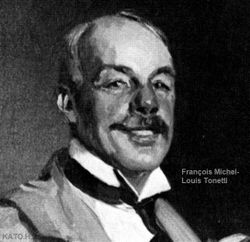
Early Life in France François Michel Louis Tonetti was born in Paris in 1864. His father, Benjamin Tonetti, died when François was about six years old, leaving his mother to support him and his two sisters by taking in laundry. During the Siege of Paris (1870–1871), she and the daughters died of starvation, and François survived only by begging. His grandfather, originally from Genoa, Italy, had opened a marble shop in Paris. He took in the orphaned boy and taught him the craft of stonecutting.
A member of the French Academy, visiting the shop, noticed a small statue François had modeled and was so impressed that he invited the boy to live with his family. In that household, François was introduced to artists, writers, and the cultivated world of late nineteenth-century Paris. When he was old enough, he was sent to the École des Beaux-Arts, where he received a classical training in sculpture.
Apprenticeship and Artistic Development After completing his studies, François became an assistant to the American sculptor Frederick MacMonnies, who had himself trained under Augustus Saint-Gaudens. Through MacMonnies he became familiar with the Beaux-Arts circle that shaped much of the public sculpture in the United States at the turn of the century.
Marriage and Artistic Partnership François met his future wife, Mary Trimble Lawrence, at a ball given by illustrator Charles Dana Gibson. He was described as dark, muscular, and passionate, with an impetuous charm that both intrigued and unsettled the New York social world. When Mary returned to the United States, François persuaded MacMonnies to send him to New York to assist with the completion of sculptures for the Brooklyn Memorial Arch at Grand Army Plaza.
Before leaving Paris, he completed a ten-and-a-half-foot plaster allegorical figure, Art, one of eight statues for the Main Reading Room of the Library of Congress in Washington, D.C. Mary finally agreed to marry him, and Saint-Gaudens, on hearing of their engagement, remarked with amusement, “Mary Lawrence is going to marry Tonetti, half Italian, half French faun who was Mac’s assistant for many years. He is a regular picnic feller and she is a regular picnic girl and I suppose there will be lots of festive children.”
They were married at Grace Church, New York, in 1900—she was thirty-two, he thirty-six—and soon converted the former Murray Hill Presbyterian Church at 135 East 40th Street into a home and studio. The large auditorium space provided an ideal sculptural workshop, and the couple worked both independently and collaboratively on major commissions.
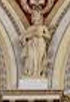
Major Works and Commissions François’ first U.S. assignment was a large plaque (right) of Art for the Library of Congress. He was then selected, along with Chester French, Saint-Gaudens, and other prominent sculptors, to create statuary for the façade of the new U.S. Custom House at Bowling Green, designed by Cass Gilbert. For this project he sculpted The Doge (symbolizing Venice) and Queen Isabella (representing Spain). Family tradition holds that he used his mother-in-law, Mrs. Edward A. Lawrence, as the model for the Doge’s imperious features.
Among other notable commissions, he executed the figure of Victory for the Louisiana Purchase Exposition in St. Louis (1904), a bas-relief for the Connecticut State Library and Supreme Court, and carved the heads in the entry arch of the New York Public Library on Fifth Avenue. He also designed a mantel and overmantel for the library’s director’s room.
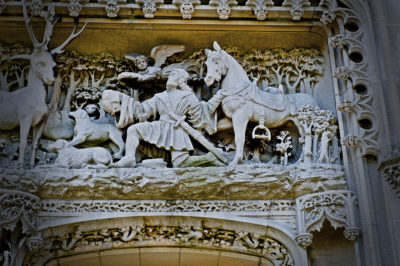
In 1910 he completed the detailed limestone relief of St. Hubert and the Hunt (left) for the Belmont Mausoleum while his family picnicked nearby—a scene later remembered by his children as typical of their father’s mixture of seriousness and play.
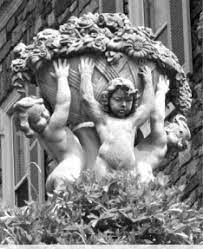
Rockefeller Commissions When John D. Rockefeller Sr.’s estate, Kykuit, was built at Pocantico Hills, Tonetti executed several sculptural pieces for the house and gardens. After later architectural changes in 1913, he designed and carved a pediment spanning the façade and two groups of cherubs holding baskets of flowers (right). His youngest daughter, Alexandra, served as the model for the cherubs. A statue of Silenus, son of Pan, was rejected by Rockefeller as too drunken in appearance—a decision that disappointed Tonetti but amused his artistic friends.
War Service and Death With the outbreak of the First World War, François volunteered as a medical aide in France. He contracted pneumonia during his service and returned home in failing health. He died in 1920 at the age of fifty-six.
Legacy and Lost Works After his death, Mary continued to manage his studio. When she sold the East 40th Street property years later, she secretly removed several of his sculptures to the family estate at Snedens Landing and had them buried there to prevent their destruction or sale. The location of the buried works remains a mystery.
François Tonetti was among the last generation of sculptors to embody the grand Beaux-Arts synthesis of art and architecture. His life and work formed a crucial bridge between European craftsmanship and American monumental art.