Thébaud, Louis Andrew (1859–1939)
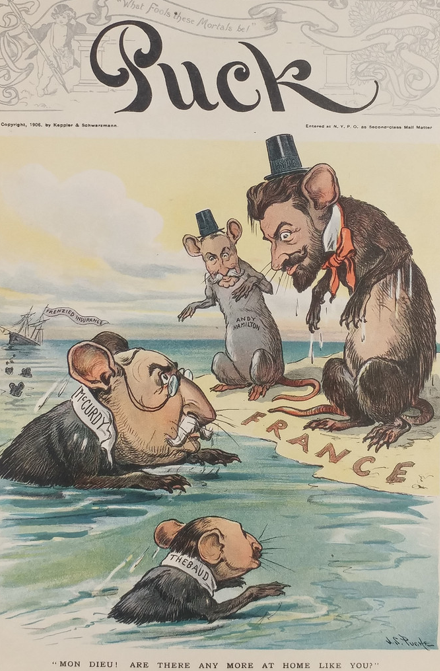
In 1893 Thébaud joined the firm; between 1893 and 1906 he earned commissions totaling nearly a million dollars. In 1905–06, public outrage over Mutual Life’s vast executive payments erupted into what the press called the “Frenzied Insurance” scandal, involving McCurdy, his son, and Thébaud. According to The Homiletic Review, in only two years the three had received about $4.6 million (roughly $145 million in 2025 dollars) in salaries and commissions, while enormous sums were expended on legislative “influence.” The Meriden Daily Journal reported the comic-opera scene of McCurdy’s flight to France on the Amerika, guarded by Thébaud and servants “lest legal papers be served.” Though both men were sued by Mutual Life, neither was ever indicted, and the case quietly settled.
With the ship Frenzied Insurance sinking in the background, McCurdy and Thébaud are shown as taking refuge in France from the investigation of the affairs of Mutual Life (left).
Marriage and Religion: Thébaud’s marriage to Gertrude McCurdy was itself a subject of social note. He was a devout Roman Catholic, while the McCurdys were prominent Episcopalians; the elder McCurdys opposed the union and planned a large Episcopal ceremony. On the eve of the wedding, Louis eloped with Gertrude, marrying her instead in St. Patrick’s Cathedral, New York—a gesture that earned newspaper headlines but also reconciliation with both families.
Philanthropy and Civic Life After his retirement from business, Thébaud turned to philanthropy and sport. During World War I, he and his wife donated generously to the American Field Service in France, and helped endow a girls’ school at Saint-Briac-sur-Mer, Brittany. They gave $200,000 to All Souls Hospital in Morristown, New Jersey (half of it Gertrude’s personal gift) and later donated an ambulance in 1930.
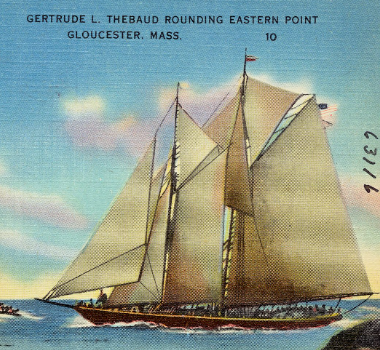
Sport and Kennel Contributions A passionate yachtsman, Thébaud sponsored the famous schooner Gertrude L. Thébaud, built in 1930 and named for his wife. That same year the vessel won the Lipton Trophy, symbolizing American supremacy in Atlantic schooner racing.
An equally avid sportsman on land, Thébaud imported the first griffons and later the first Brittany spaniels into the United States. His dogs—among them Franche de Cosqueron and Genette du Mesnil—were recorded in the Field Dog Stud Book and won honors in early field trials. With Louis de la Flèche, he founded the Brittany Spaniel Club of North America (renamed the American Brittany Club) in 1936 and served as its first president.
Residences Thébaud’s principal estates were Idlewild and later Beauregard in Morristown, New Jersey, where he hosted hunting and sailing acquaintances, among them naval and French diplomatic figures.
Legacy Though shadowed by early controversy, Louis A. Thébaud’s later life embodied the patrician ideal of service through philanthropy, sport, and Franco-American friendship. His name endures through the schooner Gertrude L. Thébaud, still celebrated in maritime history, and through the American Brittany breed that he introduced and championed.