Beauregard
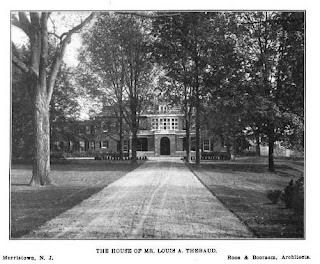
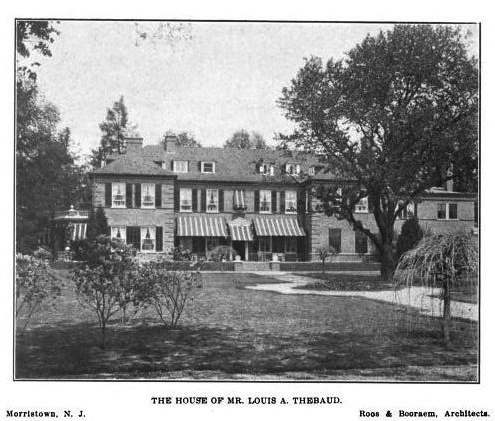
Built: c. 1905–1907
Architects: Roos & Booraem
Architect
Roos & Booraem was a New York City-based architecture firm active in the late 19th and early 20th centuries. The partnership formed in 1899 when Philip W. Roos (a German-born architect who immigrated to the U.S. around the early 1880s, became a citizen in 1883, and started his own practice in 1893) joined forces with Hugh Toler Booraem (sometimes referred to as H. Toler Booraem). The firm operated out of New York, with offices including at 32 Nassau Street and connections to addresses like the Trust Company Building in Morristown. They notably served as the in-house architects for the Mutual Life Insurance Company of New York (MONY) until around 1905, when that relationship ended.
Architectural Description
Beauregard was conceived as a large, symmetrical country house in a restrained classical idiom. The long, brick main façade is articulated by evenly spaced windows and capped by a hipped roof with dormers, lending the house a low, horizontal emphasis appropriate to its expansive grounds. A broad central entrance, approached by a long drive, establishes axial formality, while secondary elevations are softened by porches and terraces that connect the house to its landscaped setting. The overall effect is one of controlled grandeur—imposing in scale but conservative in ornament.
Interior
Hall
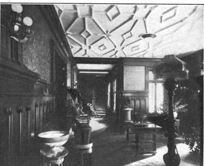
The entrance hall is a long, axial space designed to impress through proportion rather than excess. Paneled walls and a coffered ceiling establish a formal tone, while the hall functions as the organizing spine of the house, connecting principal reception rooms and framing views through to the garden.
Living Room
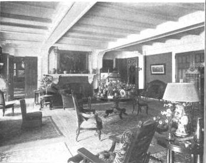
The living room is expansive and horizontally oriented, with a beamed ceiling and large fireplace anchoring the space. Generous windows and French doors admit light and open the room toward the grounds, emphasizing comfort and sociability over ceremonial formality.
Dining Room
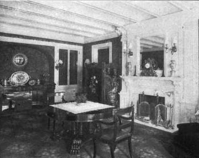
The dining room continues the classical vocabulary with heavy beams, paneled walls, and a prominent mantel. Its scale suggests large formal dinners, while the restrained decorative program reflects the early twentieth-century preference for solidity and permanence rather than ornamented display.
Billiard Room
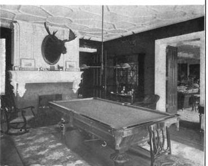
The billiard room is more masculine in character, organized around a central table and fireplace. Darker finishes and a lower ceiling create a sense of enclosure and leisure, marking it as a retreat within the larger house.
Morning Room
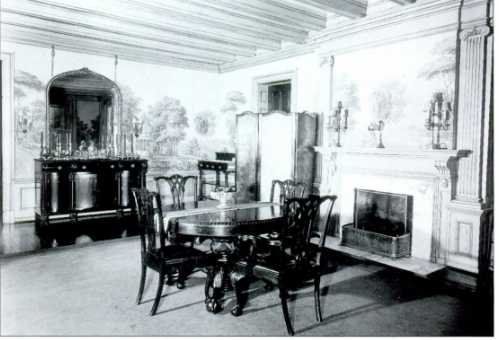
The morning room at Beauregard is an intimate, light-oriented space designed for informal meals and daytime use. Its low beamed ceiling and refined classical fireplace create a sense of enclosure, while painted wall panels with landscape scenes soften the room’s formality and introduce a pastoral note appropriate to a country house. Furnished with a modest dining table and sideboard, the room balances elegance and ease, reflecting its role as a transitional space between the house’s formal reception rooms and the rhythms of daily family life.
History
Beauregard was built for Louis Andrew Thébaud, a member of a socially prominent Franco-American family whose fortunes were transformed by his 1886 marriage to Gertrude Lee McCurdy, daughter of Richard Aldrich McCurdy, longtime president of the Mutual Life Insurance Company of New York. Prior to this marriage, Thébaud’s means were respectable but limited; the McCurdy fortune—derived from vast insurance interests—made possible a level of architectural ambition previously beyond his reach.
After residing at Idlewild in Morris Plains, Thébaud turned to Morristown, where in 1905 McCurdy acquired a 300-acre estate formerly belonging to B. O. Canfield. The existing house was demolished, and Beauregard was erected as a new family seat, designed by Roos & Booraem, architects favored by wealthy New York clients for their assured handling of large Georgian-inspired houses. After Thébaud’s death, the house remained associated with the family; his much younger second wife, Andrée des Étangs, lived at Beauregard until her death in 1983. The estate has since been adapted for institutional use and now forms part of a Care One facility