Schieffelin, George Richard (1836–1910)
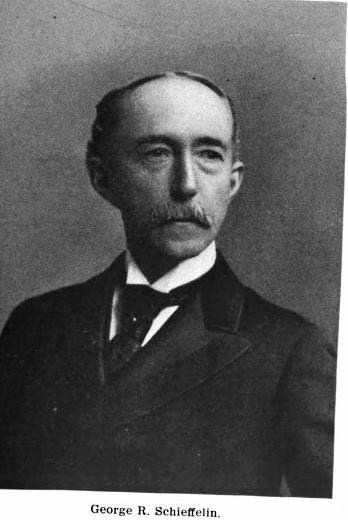
Congres****sman
Parents: Richard Lawrence Schieffelin (1801–1889) and Margaret Helen McKay (1813–1892). Married: Julia Matilda Delaplaine (1851–1915). Children: Julia Florence Schieffelin (1869–1963); Margaret Helen Schieffelin (1870–1948); Matilda Constance Schieffelin (1873–1963); Sara Dorothy Schieffelin (1877–1946); Dorothy Schieffelin (1880– ); George Delaplaine Schieffelin (1884–1950). Kinship: The second cousin four times removed of the post–World War II Smith generation.
Early Life and Education George Richard Schieffelin was born into one of New York’s long-established mercantile and professional families. He graduated from Columbia College in 1854, beginning a career in the law that soon established him among the respected members of the New York bar.
Political Career In 1861 he was elected to the United States House of Representatives. His tenure coincided with the opening months of the Civil War, a turbulent period in national politics. Though not a national figure of the first rank, his service reflected the civic prominence long associated with the Schieffelin family.
Family Connections George and Julia Delaplaine Schieffelin’s children married into families of considerable international and social standing. Their eldest daughter, Julia Florence Schieffelin, married Joseph Bruce Ismay of Liverpool, England, whose brother J. Bruce Ismay served as president of the White Star Line at the time of the Titanic disaster. Their daughter Margaret Helen married Henry Graff Trevor, and Matilda Constance married Charles Bower Ismay, another brother of J. Bruce Ismay, strengthening the family’s ties to the British mercantile and shipping world.
Residences and Social Life The Schieffelins maintained a city residence on East 45th Street near Fifth Avenue and a country home, The Anchorage, in Southampton, Long Island. George Schieffelin belonged to a wide circle of prominent clubs and societies, including the Tuxedo, Union, Knickerbocker, New York Yacht, Riding, and Shinnecock Golf clubs; the St. Nicholas Society; the Century Association; the Downtown Association; and the Society of Colonial Wars, in which he served as deputy governor in 1895.
Later Life Throughout his later years, Schieffelin remained active in legal, social, and civic affairs in New York. He died in 1910, leaving a legacy rooted in both public service and the interwoven networks of New York and Anglo-American society.