Schieffelin Company
Founding and Early Years (18th Century)
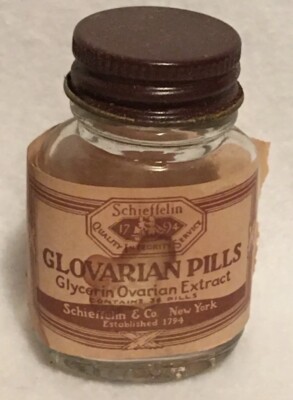
The Schieffelin company traces its origins to colonial America. Jacob Schieffelin (1757–1835), born in Philadelphia to a German immigrant family, was a Loyalist during the American Revolutionary War. He served in the British army, was captured and imprisoned in Virginia in 1779, escaped to British-held New York, and later fled to Canada with retreating forces. In Montreal, he worked as a merchant and importer. After the war, in 1794, he returned to New York and acquired the drug business of his brother-in-law, Effingham Lawrence, which had operated since 1781. Partnering with another brother-in-law, John B. Lawrence, he established Lawrence & Schieffelin as a wholesale drug firm on Pearl Street in lower Manhattan. This marked the beginning of what would become one of the oldest continuously operating companies in the United States.
In its early days, the firm functioned as a wholesaler supplying raw materials, medicines, varnishes, paints, glass, and other goods to druggists. Pharmacy was nascent; physicians often mixed their own remedies, and the first U.S. college of pharmacy opened in Philadelphia in 1821. The company imported drugs, fancy goods, perfumes, and merchandise, while Jacob invested in shipping ventures, yielding significant profits (e.g., $25,000 from one 1795 investment). Amid trade disruptions from the Napoleonic Wars, John B. Lawrence departed in 1799, renaming the firm Jacob Schieffelin. By 1805, Jacob's son Henry Hamilton Schieffelin (1783–1865) joined, forming Jacob Schieffelin & Son.
19th Century Expansion
Jacob retired in 1814 amid the War of 1812's economic challenges, which saw the firm lose ships but persist. Henry took over as H.H. Schieffelin & Co., navigating post-war downturns and relocating multiple times: to Maiden Lane, then John Street in 1841 after the 1837 financial panic. In 1848, it acquired Hoadley, Phelps & Co. Henry retired in 1849, passing control to his sons: Samuel Bradhurst, Sidney Augustus, James Lawrence, and Bradhurst Schieffelin, who renamed it Schieffelin Brothers & Co.
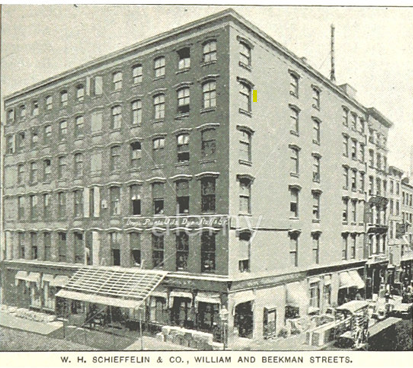
Under Samuel's leadership, the company built a six-story facility in 1854 and expanded into druggists' sundries like mortars and percolators. It adapted to new opportunities, such as shipping petroleum from Titusville, Pennsylvania, after its 1859 discovery. During the Civil War (1861–1865), it lost Southern clients but found alternative revenue streams.
The brothers retired in 1865, and William H. Schieffelin (Samuel's son) led the renamed W.H. Schieffelin & Co., with non-family partners. Growth accelerated: acquisition of A.B. Sands & Co. in 1875, establishment of a leading U.S. pharmaceutical laboratory in 1882, sales offices in Chicago and San Francisco by century's end, European operations in London, and an alliance with Bayer as its U.S. representative.
Early 20th Century: Pharmaceuticals to Alcohol Shift
Entering the 1900s as a top pharmaceutical wholesaler, the firm pioneered quality standards, becoming the first U.S. company in 1906 to file purity proofs with federal regulators, earning Guaranty Number One.
Prohibition (1920–1933), enacted via the 1919 Volstead Act, transformed the business. A loophole allowed "medicinal" alcohol, leading Schieffelin to import items like Hennessy Cognac and Moët & Chandon Champagne for prescriptions. This pivot marked a lasting shift toward wines and spirits.
After repeal in 1933, the company continued in alcohol distribution while maintaining pharmaceuticals. By 1962, it fully exited pharmaceuticals to focus on wine and spirits importation.
Late 20th Century: Acquisitions and Joint Ventures
In 1980, Moët-Hennessy (formed in 1971 from Moët & Chandon and Jas. Hennessy & Co.) acquired Schieffelin & Co.
Somerset's origins trace to 1963, when Canada Dry formed Somerset Distillers. Distillers Company Ltd. acquired it in 1984, and Guinness Plc bought Distillers in 1986 amid a scandal involving stock manipulation.
In 1987, Moët-Hennessy and Guinness merged Schieffelin with Somerset Importers to create Schieffelin & Somerset Co. (S&S) as a 50-50 joint venture, combining over 20 premium brands like Dom Pérignon, Johnnie Walker, Tanqueray, and Grand Marnier. This boosted U.S. sales to about $600 million annually from 3.5 million cases. Moët-Hennessy merged with Louis Vuitton in 1987 to form LVMH, while Guinness merged with Grand Metropolitan in 1997 to create Diageo, making S&S a JV between LVMH and Diageo.
The 1990s saw portfolio adjustments: adding Dewar's and Pinch in 1992, becoming Grand Marnier's exclusive U.S. agent in 1994, divesting Dewar's in 1997, and adding Buchanan's and J&B. Despite 1980s liquor sales dips, S&S thrived in the 1990s, with brands like Johnnie Walker Black Label leading in super-premium Scotch.
21st Century: Restructuring and Current Status
In 2002, Diageo considered dissolving the JV but opted to integrate distributions, appointing joint distributors in key states. By 2004, Diageo assumed management of its brands from S&S in the U.S. The joint venture was fully wound up in 2005, leading to the creation of Moët Hennessy USA (under LVMH) to handle Moët Hennessy products, while Diageo and Moët Hennessy continued joint distribution for select brands.
As of 2024–2026, the original Schieffelin & Somerset entity no longer operates independently. Its legacy persists within Moët Hennessy USA, part of LVMH's Wines and Spirits division, focusing on premium brands like Hennessy, Moët & Chandon, and Dom Pérignon. Diageo retains a 34% stake in Moët Hennessy (unchanged), and the two companies maintain partnerships outside the U.S., such as in France (until a 2024 restructuring where Diageo recovered full distribution of its brands). Recent activities include Diageo's acquisitions in non-alcoholic and spirits categories, but no direct changes to the Schieffelin lineage. The company's evolution from a 18th-century drug wholesaler to a key player in global luxury alcohol exemplifies adaptation to regulatory, economic, and market shifts.