Lawrence, Jeanne Osgood Effingham (Jeanne Nuola) (1840–1934)
Early Life and Education
Jeanne Osgood Effingham Lawrence was born into the Louisiana branch of the Lawrence family and spent her early years at Magnolia Plantation, the family seat on the Mississippi River. Showing early promise in music, she was sent by her father to a convent school in France. There her vocal gifts were recognized and encouraged, and she came under the musical influence of Charles Gounod, who admired her voice and supported her training.
Stage Career
For her musical and theatrical pursuits she adopted the stage name Jeanne Nuola, a creative construction drawn from New Orleans and Louisiana—Nu–O–La. She began her professional career singing with the opera company of Sir Augustus Harris, appearing in the English provincial theatres.
Her career, however, was not without reversals. In 1896 the Infanta Eulalia of Spain engaged her to sing at the opera house in Madrid, but the engagement was abruptly cancelled owing to anti-American sentiment arising from the Cuban conflict and the political estrangement between Spain and the United States.
Performances and Later Career
In 1904, with the assistance of influential friends, she sang at the White House. Her program, entitled “Le Cantori Neapolitana,” consisted of traditional Italian street and gondolier songs, which she performed in Neapolitan costume to considerable effect.
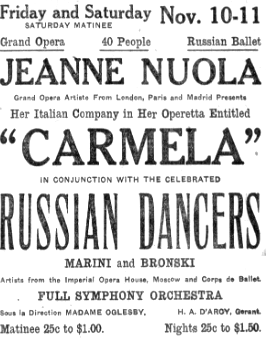
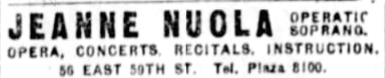
Jeanne later undertook theatrical production herself. She founded a small company to present her operetta “Carmela.” According to the Brooklyn Eagle (2 November 1911), she sang the leading rôle in the first American production in Easton, Pennsylvania. The operetta, which she had already staged in Paris and Madrid, received an enthusiastic reception. It featured Russian dancers, Mlle. Marini and Bronski, and incorporated Italian folk music and costuming. The waltz song in the second act had been composed by Arditti on his eighty-third birthday. A mandolin quartet added to the color of the performance. Jeanne led a modest tour of the operetta to Altoona, Lancaster, South Bend, East Liverpool, Mansfield, and Zanesville, but the production closed before reaching Wheeling. By 1917 she was in New York offering private voice instruction.
Poetry
Jeanne also wrote poetry, sometimes under her stage name. The following poem, published in the Marion Daily Star (Ohio) in 1923, reflects her religious and sentimental style:
IN MEMORIAM. [By Mme. Jeanne Nuola.]
Grieve not brave heart So tried by Fate's decrees That mortal man might Understand—God took thine own— So great in soul, in heart so true— To teach humanity The depth of immortality— All he did undertake Was by divine decree, And in his “weakness,” By the world so called, Was his immortal strength. By love and tenderness, By fellowship for man, He won all hearts to him: Now bowed in grief too deep: To realize the greatness of the man. Grieve not brave heart! A soldier of the cross was he— This valiant man of destiny.
Assessment
Jeanne Nuola’s life illustrates the flowering of artistic talent within the Lawrence family during the late nineteenth and early twentieth centuries. She blended the cultural heritage of New York and New Orleans with European training and experience, and although her career never reached the highest operatic stages, she achieved a measure of distinction as a singer, impresario, and poet. Her work shows a distinctly romantic and devotional temperament, and she stands as a rare example of a Lawrence woman who made her livelihood in the performing arts.