Lawrence, Effingham (1820–1878)
Congressman for a Day
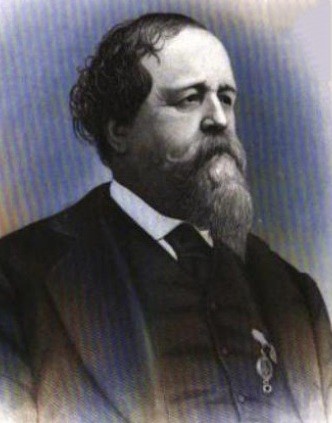
Parents: Judge Effingham Lawrence (1779–1850) and Anne Townsend (1782–1845). Spouse: (1)Jane Lucretia Osgood (1829–1863) in 1847; Gertrude Cammack (1839-1870) Children: With Lucretia Osgood: Annie Townsend Lawrence (1847–1942), Jane Lucretia Lawrence (1847– ), Isaac Osgood Lawrence (1850–1870), Jeannie Osgood Lawrence (1852– ), Adele Lawrence (1853– ), Effingham Lawrence (1856–1899), and Bessie Amelia Lawrence (1858–1937); with Gertrude Cammack Horace Claiborne Lawrence (1867-1874) and Gertrude Lawrence (1869- ). Kinship: Third great-great-granduncle of the post–World War II Smith generation.
Effingham Lawrence was born into a prominent Queens County family and later became a sugar planter and political figure in Louisiana. He served for a term in the state legislature, was a delegate to the Louisiana Secession Convention, and after the Civil War held federal office. His life reflected the social and political transformations of Louisiana in the mid-nineteenth century, including the shift from plantation society through war and Reconstruction.
Early Life and Marriage
Effingham was born in Queens County, New York, the son of Judge Effingham Lawrence of Bayside. In 1847 he married Jane Lucretia Osgood, a Kentucky heiress connected with the Osgood family of Troy, New York. Soon after their marriage, he left New York and settled in Plaquemines Parish, Louisiana. His wife’s family background and resources appear to have facilitated his establishment as a planter on a large scale.
Magnolia Plantation
Effingham purchased Magnolia Plantation in Plaquemines Parish, situated on the Mississippi River about fifty miles below New Orleans.
Effingham served for a term in the Louisiana state legislature in 1854–1855, representing Plaquemines Parish. His participation in local politics and his reputation as a capable planter made him a recognized figure in the parish well before the Civil War.
Toward Secession
As sectional tensions increased in the late 1850s, many Louisiana sugar planters supported separation from the Union. On 27 December 1860, Effingham addressed a meeting of the “Friends of Southern Rights and Separate State Secession” in Plaquemines Parish. He argued that the South had exercised restraint in the face of what he viewed as Northern political pressures, and stated that Louisiana had the right and duty to defend its position. His remarks reflected the prevailing sentiment among planters along the lower Mississippi River at that moment.
Louisiana Secession Convention
Effingham was elected the delegate for Plaquemines Parish to the Louisiana Secession Convention in Baton Rouge. The convention assembled on 23 January 1861, and he took an active role in its proceedings. On 26 January 1861 the convention passed the Ordinance of Secession, and Effingham was among its signatories. He proposed that each signer be presented with a golden pen to commemorate the event. This gesture illustrated the sense, shared by many delegates, that they were participating in a historic and consequential act.
War and Union Occupation
When the Civil War began, Union naval forces gained control of portions of the lower Mississippi River early in the conflict. Plantation operations throughout Plaquemines Parish were disrupted. Effingham remained at Magnolia for much of the period, although he sent his family to New Orleans for safety; his wife died there in March 1863.
Contemporary accounts show that the plantation’s labor system underwent rapid change. Some members of the workforce left the plantation when Union forces arrived in the region, while others returned after encountering uncertainty and hardship in military camps. The Union army was not equipped to sustain the sudden influx of formerly enslaved people, and conditions varied widely. Correspondence from Magnolia indicates tension but not large-scale violence. In mid-1862 the plantation’s overseer sought permission from Union authorities to allow workers to return to their homes, which was granted. By late 1862 Effingham reported difficulty maintaining order and productivity amid the ongoing disruption.
During the occupation, Effingham offered hospitality to Union officers. He served on a levee committee concerned with flood protection, a critical issue for plantations along the river. His stance during this period contrasts with that of some planters who left their properties. The Lawrences had learned that it was wise to imitate the willow, and bend with the wind.
Reconstruction and Public Affairs
After the war, Effingham sought to adapt to the new conditions. Former enslaved workers at Magnolia generally continued to live on the plantation. Some entered wage agreements; others later acquired small parcels of land. Contemporary observers, including two visitors reporting from a Northern perspective, described the arrangements at Magnolia in the mid-1860s as comparatively orderly for the time, with labor compensated by shares of the crop.
Reconstruction politics in Louisiana were turbulent. In 1874 a movement called the White League arose in opposition to the Reconstruction government. It asserted that it opposed corruption and sought to restore local control, but its methods and rhetoric were widely criticized. In August 1874 Effingham published a letter in the New Orleans press rejecting efforts to organize politics along racial lines and warning against attempts to exclude Black citizens from participation in civic life. The New York Times commented that while many in Louisiana privately disagreed with the White League, Effingham was “the only one of large influence” who publicly protested. His stance provoked hostility, and he was threatened and urged to leave the state.
Effingham write a long public letter (Picayune, August 23, 1874) condemning this attempt effectively to disenfranchise blacks..Lawrence admitted that the newly enfranchised black voters had elected corrupt carpetbaggers. The black voters saw the corruption of the white men they had voted for, and were disappointed in their supposed friends; the carpetbaggers then blamed the negro voters for the corruption, thus turning blacks again whites and whites against blacks.
\
Lawrence pointed out that whites also were known to make bad political decisions: “Such lapses in citizenship have occurred among the Anglo–Saxon citizens, and will occur again; but they are not incurable in their character, nor in either the white or black race, such as to lead the patriot to despair of the Republic.”
Lawrence attacked the “scarecrow” of social equality (which seems to have been a code word for miscegenation): “In exceptional cases I have seen white men who, of choice, sought negro association, and negroes who preferred the association of whites; but as the rule, with scarcely an exception, the healthy minded white and colored alike seek domestic affiliations with those of their own race.”
He condemned the attempt to pit white against black: “In my judgment a race organization, political in its character, white or black, is at all times questionable and dangerous. But at this juncture of affairs is evil, only evil, and full of mischief to both races and to the State.”
The New York Times, in recounting Lawrence’s letter, said that it was sure that many responsible Louisianans were ashamed of the White League, but Lawrence was “the only one of large influence who has entered his formal protest against a course which can only end in disaster to the reckless men engaged in it.” Lawrence was insulted, mobbed in the streets, and ordered to leave the state.
The Battle of Liberty Place
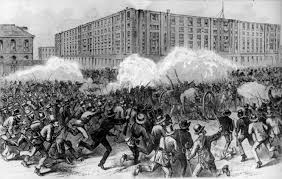
Under former Confederate officers the White League drilled and trained forces until they were better prepared than the police and the state militia. They smuggled in arms, cut telegraph lines to the North, and staged a coup d’état. On September 14, 1874, in heavy street fighting 5,000 members of the League defeated 3,500 police and militia, with 100 casualties (the Battle of Liberty Place). The Republican Governor Kellogg fled for safety to a federal installation. The White League took over all government offices at bayonet point and evicted all incumbents. But President Grant would not tolerate a rebellion; he sent in Federal troops to restore Kellogg.
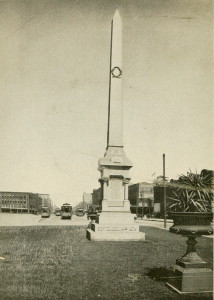
In 1891 New Orleans built a monument to the Battle of Liberty Place.
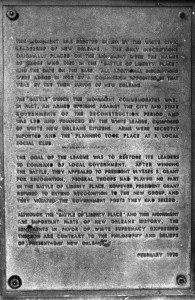
In 1932 a plaque was added:
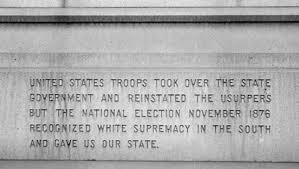
In full it reads: “McEnery and Penn having been elected governor and lieutenant–governor by the white people were duly installed by this overthrow of carpetbag government, ousting the usurpers, Governor Kellogg (white) and Lieutenant–Governor Antoine (colored). United States troops took over the state government and reinstated the usurpers but the national election of November 1876 recognized white supremacy in the South and gave us our state.”
In 1974 the city added a plaque instructing the citizenry to disregard previous plaques: “Although the “Battle of Liberty Place” and this monument are important parts of the New Orleans history, the sentiments in favor of white supremacy expressed thereon are contrary to the philosophy and beliefs of present–day New Orleans.”
The 1993 inscription that covers the 1932 inscription tries to have it both ways.
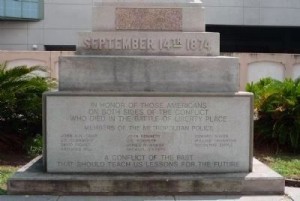
In honor of those Americans on both sides of the conflict who died in the Battle of Liberty Place.
A conflict of the past that should teach us lessons for the future.
But what are the lessons?
The Great Train Journey
In September 1872 Governor Warmoth and Effingham Lawrence went to New York to discuss railroad matters. At 5 PM one evening at the Fifth Avenue Hotel Warmoth unexpectedly ran into his Lieutenant Governor, Pinchback, who said that he was in North giving speeches. The two agreed to meet at 9 PM that evening to make arrangements to return to New Orleans on the same train.
But Pinchback did not show up, and Warmoth went to bed that night with an uneasy feeling. The next morning he went to the hotel and ran into a young man who was travelling with Pinchback, who said that Pinchback hadn’t returned but his luggage was still at the hotel. Warmoth was still uneasy. He ran into Senator Harris, an acquaintance of Pinchback’s, and asked him whether he had seen Pinchback. Harris said that Pinchback had left on the train for Pittsburgh the previous evening. Warmoth immediately spotted Pinchback’s deception and realized he must be up to something.
He and Lawrence opened telegraphic connections all along the route to New Orleans and took the lightning train south. Pinchback had a twelve–hour lead. At Louisville Warmoth and Lawrence learned what Pinchback was up to.
What Pinchback had been doing in New York was conspiring with the Grant faction at achieve a coup d’état in Louisiana to make sure the state delivered its electoral votes to Grant. Pinchback’s supporters in the legislature were waiting for him at Amite, just inside the Louisiana line. There they would “impeach the Governor, Auditor, and some other officers, overturn the city government, reorganize the police, remove all of Warmoth’s appointees throughout the State, especially the registrar of voters, sign the new bills, and continue in session until January next.” They had prepared “plenty of troops to call to protect the coup d’état and maintain by force the raw regime.”
The matter was urgent. Warmoth and Lawrence chartered a special train to meet them at Humboldt: the best locomotive of the Mississippi Central and one car. They telegraphed ahead for the track to be cleared the whole distance south. They told the engineer to open the throttle, but he insisted that Lawrence first sign a bond to be responsible for any damages. Meanwhile Warmoth and Lawrence arranged a little trick of their own.
Pinchback was on the train as it stopped in Canton, Mississippi. A man boarded and asked whether there was a Mr. Pinchback aboard. Pinchback identified himself, and was told there was a telegram at the station office for him but it was to be put direct into the hands of Pinchback and no one else. Pinchback went to the station; thee stationmaster said he needed positive identification. Pinchback rounded up some people who knew him, and then the stationmaster said he had misplaced the telegram and had to search for it. He finally gave it to Pinchback who tore it open only to discover a blank piece of paper. He then realized what had happened and tried to get out but the door was locked. He tried the window and that was locked. He yelled and finally got someone outside to unlock the door. But then he saw the train two hundred yards down the track on the way to New Orleans. It did not stop as he waved his handkerchief and yelled. He was told there would be another train in the morning, so he spent the night in the town.
At dawn he went to the platform and saw a train approaching. “The tall figure of Governor Warmoth is seen on the platform, and his strong voice is heard shouting–‘Hurra! Hulloa! Pinch, is that you? Thought you were with your baggage at the Fifth Avenue. Get aboard and we will take you to the city.’”
Warmoth and Lawrence then unfolded the whole counterplot. Pinchback admitted “you have won another race, and I’ll be d—d if it isn’t the biggest one you ever did or ever will win.”
As their train passed Amite, Louisiana, they saw on the platform the Grant politicians. Pinchback pointed to Warmoth and said, “Captured! Captured!” Warmoth “rose and affectionately and gracefully waved his handkerchief toward the foiled and disgusted conspirators.”
Warmoth and Effingham held court in the St. Charles hotel to receive congratulations in their success on thwarting the Grantites–but, of course, that was not the last move in the game.
Congressman for One Day
In the disputed 1872 congressional election, Jacob Hale Sypher (Republican) was initially declared the victor over Effingham (Democrat). Effingham contested the result before the U.S. House of Representatives. Near the end of the congressional session, the House ruled in his favor. Effingham was sworn in on 3 March 1875, the final day of the session, and served through its adjournment that evening. Although brief, his seating marked the first time since the Civil War that a Democrat from Louisiana’s 1st District had been recognized in Congress. President Rutherford B. Hayes later appointed him Collector of Customs for the Port of New Orleans.
Effingham died at Magnolia on 9 December 1878. He was buried in Greenwood Cemetery, New Orleans.
Context Box
Magnolia Plantation, south of New Orleans, passed into the Warmoth family after Effingham’s death. Economic pressures and changes in the sugar market in the late nineteenth century contributed to its decline. The Lawrence townhouse at 68 St. Louis Street in New Orleans was sold, and the Lawrence children appear to have returned to the North. Mark Twain visited Magnolia in 1893 when it was owned by Warmoth and wrote about the estate’s machinery and setting.