Keene, James Robert (1838–1913)
The Born Speculator
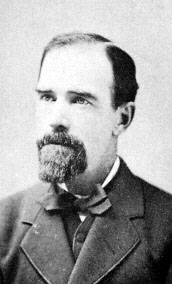
Parents: James Keene (1810–1894) and Selina Hicken (1808–1863). Married: Sarah Joy Daingerfield (1830–1916). Children: Jessica Harwar Keene (1867–1938) and Foxhall Parker Keene (1867–1941). Kinship: Father-in-law of Mary Lawrence, the great-grandaunt of the post–World War II Smith generation.
Early Life and Marriage
James Robert Keene was born in England into the family of a prosperous merchant whose bankruptcy cut short his education. As a teenager, he emigrated with his family to Shasta, California, to rebuild their fortunes. He worked at any task that offered a wage—editing a newspaper, peddling milk, and even tending livestock at Fort Reading. The savings from these labors allowed him to purchase a miner’s outfit and head for the California and Nevada diggings, where he achieved modest success.
He returned to California and married Sarah Joy Daingerfield, daughter of Colonel Leroy Daingerfield of Virginia and sister of Federal Judge William Parker Daingerfield of California. The couple lived in style until James’s speculative ventures failed. Senator Reuben Fenton secured him a seat on the San Francisco Stock Exchange, allowing Keene to pay for it later. His skill as a trader soon earned him the presidency of the Exchange and a governorship of the Bank of California.
The Bonanza Fortune and Early Speculation
Keene’s first great triumph came in the Nevada Comstock Lode, where he made $6,000,000—a fortune equivalent to roughly $150,000,000 in modern value. In 1876 he left California intending to travel to Europe for his health, but Wall Street diverted his path.
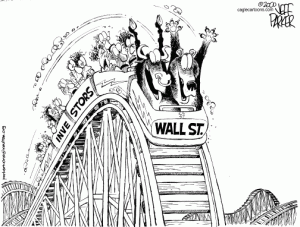
There he met his nemesis, Jay Gould, the most ruthless of the robber barons. Gould reportedly said, “Keene arrived in New York by private railroad car, and I’ll send him home to California in a boxcar.” Gould succeeded: Keene lost his fortune, and when his Newport mansion burned down, he lost nearly everything, including his prized Rosa Bonheur painting Sheep. When a visitor later saw the painting in Gould’s home, Gould allegedly sneered, “There hangs the scalp of James R. Keene.”
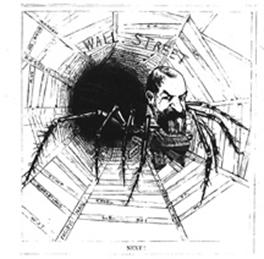
Jay Gould as seen by small investors
Rise, Fall, and Return on Wall Street
Undeterred, Keene began again. He made and lost fortunes repeatedly. In 1879–1880 he attempted to corner the wheat market but failed, losing another $3,000,000. Yet his brilliance as a market operator made him indispensable to the most powerful men in finance. He managed the affairs of Henry Havemeyer’s Sugar Trust and served J. P. Morgan’s syndicate during the battle for control of the Northern Pacific Railroad.
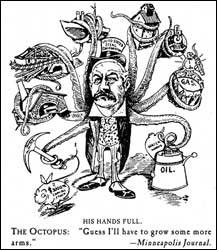
When Morgan created United States Steel in 1901, he secretly employed Keene to inflate its stock price before the offering. Keene worked through his son-in-law Talbot J. Taylor’s brokerage firm to disguise the connection. As Keene bought heavily, smaller investors rushed to follow him, believing he had insider knowledge. The stock soared from 39 to 55 before collapsing to 8¾ by 1904. Morgan and Keene profited handsomely; the public was ruined. Such “pool operations” are now strictly illegal.
Despite the ruthlessness of his methods, Keene astonished contemporaries by his sense of honor. According to his son Foxhall, when his father’s finances recovered, “his first thought was to settle up. He gave a large dinner to all his creditors. Every man found on his plate a check for the full amount owed him.”
The Psychology of the Speculator
When asked why he persisted in risky ventures, Keene replied with characteristic imagery: “Why does a dog pursue its thousandth rabbit? He’ll chase it as though his life depended on it, and once caught, he’ll cast it aside and begin again. When you tell me why that dog wants another rabbit, I’ll tell you why I want more money.”
Keene viewed speculation as the natural expression of human creativity and daring:
“All life is a speculation. The spirit of speculation is born with man. Providence has impressed upon him the betting instinct. Without speculation, initiative would cease, business would decay, values decline, and the country would go back twenty years in less than one.”
His Wall Street contemporaries admired him as “a sportsman who found in manipulating stocks and bonds the same excitement that other sportsmen found in poker or the roulette wheel.”
The Turf and Castleton Farm
Keene’s passion for risk extended to the racetrack. He began buying racehorses in 1879, starting with the great Spendthrift. He soon acquired Kingston (1884–1912), who won eighty-nine races, the most in the history of American thoroughbred racing, and Foxhall (1878–1904), named for his son, who won the Grand Prix de Paris and England’s Cesarewitch and Cambridgeshire in 1881.
Other champions followed: Domino (1891–1897), whose epitaph reads “the fleetest runner the American turf has ever known”; Sysonby (1902–1906), unbeaten in nine consecutive races and named 1905 Horse of the Year; and Colin (1905–1932), undefeated in fifteen starts and regarded as one of the greatest horses in American racing history.
In 1890 Keene purchased Castleton Farm near Lexington, Kentucky, the former estate of the Breckinridge and Castleman families. He expanded it to over a thousand acres and transformed it into one of the premier breeding establishments in the world. Between 1905 and 1910 Castleton horses won more than $1,200,000 in purses (about $30,000,000 today). The London Sportsman in 1908 declared that Keene possessed “the greatest lot of racehorses ever owned by one man.”
After Keene’s death, his son Foxhall inherited Castleton, selling it in 1913. Through successive owners—including Frances Dodge Johnson and Frederick Van Lennep—it remained one of the most storied farms in Kentucky. It was later restored by Tony Ryan, founder of Ryanair, and renamed Castleton Lyons.
Death and Estate
James R. Keene died on January 3, 1913, leaving an estate valued at $15,000,000—equivalent to nearly $400,000,000 in 2025 dollars.. His life, alternating between triumph and ruin, epitomized the volatile energy of the Gilded Age. To admirers and critics alike, he represented both the genius and the peril of American capitalism: the born speculator who could never stop chasing his next rabbit.