Jones, Sir John Thomas, 1st Baronet (1783–1843)
Early Life and Education John Thomas Jones was born at Landguard Fort, Felixstowe, Suffolk, on 25 March 1783, the eldest of five sons of John Jones, Esq., general superintendent at Landguard Fort and of Cranmer Hall, Fakenham, Norfolk. He was educated at the grammar school at Ipswich and entered the Royal Military Academy, Woolwich, in 1797.
Military Career Jones was commissioned second lieutenant in the Royal Engineers on 30 August 1798 and stationed at Gibraltar, where he worked on the north front defenses and the celebrated galleries, earning promotion to lieutenant in 1800. After returning to England in 1803, he designed coastal defenses against Napoleon’s threatened invasion.
In 1805 he sailed with Sir James Craig’s expedition, serving at Malta, Naples, and Sicily. At Messina and Milazzo he supervised fortifications and produced a report on Sicilian defenses that earned the praise of Sir John Moore. He fought at the Battle of Maida (1806) and directed the siege of Scylla Castle, which he regarded as his greatest professional achievement.
During the Peninsular War, Jones served under Sir John Leith and later under the Duke of Wellington. He distinguished himself at the sieges of Ciudad Rodrigo and Badajoz, saving Captain Holloway’s life during the latter engagement and earning promotion to brevet lieutenant-colonel. He was severely wounded at Burgos in 1812 and returned to England after prolonged suffering.
While recovering, he published Journal of Sieges carried on by the Allies in Spain (1814), a detailed critique of the engineer service that, though critical of the Board of Ordnance, won Wellington’s respect for its accuracy and candor.
Service under Wellington In 1815 Wellington appointed Jones to the Defense Commission for the Netherlands, later naming him inspector of fortifications with full powers over construction and expenditure. The two men formed a close working relationship, Jones accompanying Wellington on numerous inspection tours.
He was promoted lieutenant-colonel in 1816, aide-de-camp to the king in 1825, and major-general in 1837. During the Belgian revolt of 1830, Jones was sent to the Netherlands as Wellington’s special envoy, where his reports influenced British strategy. For his services he was created a baronet on 30 September 1831, at Wellington’s recommendation.
Later Work and Honors Jones later directed fortification work in the Ionian Islands (1823–1825) and drafted comprehensive schemes for the defense of British coasts and colonies. In 1840 he oversaw improvements to the defenses of Gibraltar, where Jones’s Battery was named in his honor.
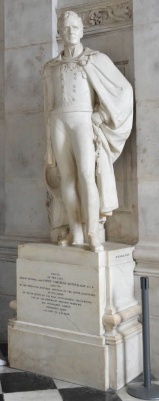
He was made a Companion of the Bath (C.B.) in 1815 and a Knight Commander of the Bath (K.C.B.) in 1838. A statue in his memory was erected in the south transept of St. Paul’s Cathedral by the officers of the Royal Engineers.
Other Interests Jones was also an amateur cricketer, chiefly associated with Middlesex, and appeared in six first-class matches between 1814 and 1819.
Death Sir John Thomas Jones died in 1843 and was succeeded by his son Sir Lawrence Jones, 2nd Baronet.