Jones, later Lawrence-Jones, Family
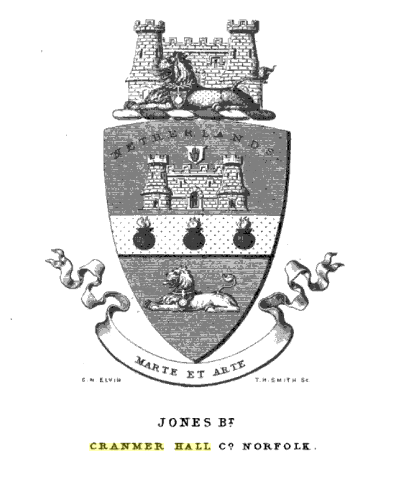
Title
The Baronetcy of Cranmer Hall, in the County of Norfolk, was created on 30 September 1831 in the Baronetage of the United Kingdom for Major-General Sir John Thomas Jones, K.C.B., who had distinguished himself in the Peninsular War and in the service of the Duke of Wellington.
Origins Sir John married Catherine Maria Lawrence (1786–1859), daughter of Effingham Erasmus Lawrence (1735–1806), a native of Flushing, Queens County, New York, who had returned to England after the American Revolution and became active in trans-Atlantic mercantile and shipping circles. Through this union the Cranmer Hall family became connected to the extensive Lawrence lineage of New York and Long Island.
Succession of the Baronets • Sir John Thomas Jones, 1st Baronet, K.C.B. (1783–1843) • Sir Lawrence Jones, 2nd Baronet (1817–1845), murdered by brigands near Macri, Turkey • Sir Willoughby Jones, 3rd Baronet (1820–1884), High Sheriff of Norfolk and Member of Parliament for Cheltenham • Sir Lawrence John Jones, 4th Baronet (1857–1954), President of the Society for Psychical Research, 1928–1929 • Sir Lawrence Evelyn Jones, M.C., 5th Baronet (1885–1969), author and Fellow of the Royal Society of Literature • Sir Christopher Lawrence-Jones, 6th Baronet (born 1940), physician and Fellow of the Royal College of Physicians
The heir apparent is the present holder’s son, Mark Christopher Lawrence-Jones (born 1968).
Name and Family Identity The family’s assumption of the additional surname Lawrence by the sixth Baronet formalized a connection long reflected in their recurrent use of Lawrence as a given name. The choice recognized the historic importance of the American Lawrences and perhaps also of the Tasmanian branch, but the name Effingham—popular among the New York Lawrences—was never adopted at Cranmer Hall. In England, where the lack of any genuine link to the Earls of Effingham was clearly understood, its use would have been regarded as presumptuous or discourteous.
Family Character and Continuity Across six generations the Lawrence-Jones family combined military distinction, landownership, and intellectual curiosity. The first baronet represented the engineer-soldier ideal of the Napoleonic period; his descendants included parliamentarians, clerics, psychical researchers, and authors. Their repeated engagement with public service, scholarship, and science preserved the character of a Norfolk gentry line conscious both of its English and its American antecedents.