Gugler, Eric (1889–1974)
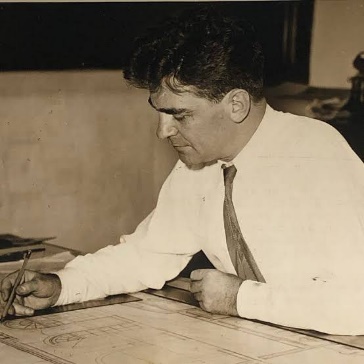
Early Life and Family Background Eric Gugler was born in Milwaukee, Wisconsin, in 1889, into a family distinguished in printing and the arts. His grandfather, Henry Gugler Sr. (1816–1880), was a German-born engraver for the U.S. Bureau of Engraving and Printing during the Civil War, noted for his life-sized engraving of Abraham Lincoln. Later, Henry and his son Julius founded H. Gugler & Son Lithographing Company in Milwaukee. Julius Gugler was both a printer and a poet, and his daughter Frida Gugler (1874–1966) became a painter who studied with William Merritt Chase. Eric inherited this blend of technical skill and artistic sensibility.
Education and Early Career Gugler studied at the Armour Institute (now Illinois Institute of Technology) and at the School of the Art Institute of Chicago. He earned his B.A. from Columbia University in 1911 and studied for three years at the American Academy in Rome. While in Rome, he designed a monumental plan for a new approach to St. Peter’s Basilica—a tree-lined boulevard of reflecting pools leading from Bernini’s piazza to the Tiber. His classical training and sense of proportion remained central to his later work.
World War I and Camouflage Design From October 1917 to December 1918, Gugler served in the U.S. military, designing camouflage for ships to protect them from submarine attack. His work included experimental structural alterations to funnels and masts to distort enemy rangefinding. These innovations placed him at the intersection of engineering and art, and he was later cited in Camoupedia as a pioneer in applied camouflage design.
Architectural Career in New York After the war, Gugler opened an office in New York City at 101 Park Avenue, sharing space with McKim, Mead & White. In 1929 he won first prize for the design of a Chicago War Memorial, a vast, unbuilt monument on an island at the end of Congress Street. His career flourished in the 1920s and 1930s, combining classical discipline with a modern monumental sensibility.
Marriage to Anne Tonetti Gugler rented a house across from sculptor Mary Lawrence Tonetti’s home and studio on West 40th Street. There he met Mary’s daughter, Anne Elizabeth Tonetti, whom he married in 1932. Their wedding, witnessed by Justice Benjamin Cardozo, united two families active in New York’s artistic world.
Forum Auditorium, Harrisburg In the early Depression years, Gugler and his associate Richard Brooks designed the interior of the Forum Auditorium in the Pennsylvania State Education Building, Harrisburg. They conceived the ceiling as a celestial map, painted on canvas panels with gold constellations, silver planetary orbits, and more than a thousand stars—365 of them crystal. The architects described their intent as a tribute to the grandeur of the heavens and the patient curiosity of humankind. At the center was a great silver sunburst concealing the auditorium’s ventilator, incorporating symbolic diagrams of the major theories of the solar system. The building remains a celebrated work of Art Deco and astronomical imagination.
White House and the West Wing In 1933 Franklin D. Roosevelt commissioned Gugler to rebuild the West Wing of the White House. Roosevelt wanted easier access from his living quarters and an office that would subtly accommodate his physical limitations. Gugler excavated a full basement, added subterranean offices under the lawn, and extended the building eastward to create a new Cabinet Room and Oval Office.
The new Oval Office, completed in 1934, was an elegant blend of Georgian and Art Moderne styles, with bookcases set in niches, cove lighting hidden in the cornice, and a ceiling medallion bearing the Presidential Seal. The twin armchairs before the fireplace—one for the president and one for guests—were arranged so that Roosevelt could meet others at eye level while seated. The design remains in place to this day.
Other Architectural and Preservation Work Gugler designed the White House’s 1938 Steinway piano, decorated with gilt figures of American folk musicians and dancers by Denbar Beck, with sculptural eagles by Albert Stewart. He also supervised the restoration of the Sub-Treasury Building on Wall Street, later Federal Hall, and worked with civic leaders to save Castle Clinton from demolition. His advocacy, supported by Eleanor Roosevelt and Felix Frankfurter, helped persuade President Truman to establish Castle Clinton National Monument in 1946.
Collaborations and Memorials Gugler’s long collaboration with sculptor Paul Manship began in the 1920s and produced several major works. They designed the Hutchins Memorial Bench in Central Park (1932), featuring carvings by the Piccirilli Brothers and a sundial by Albert Stewart. Together they also created the Theodore Roosevelt Memorial on Roosevelt Island (1963–1967), a vast granite plaza encircled by inscriptions and a 17-foot bronze statue by Manship.
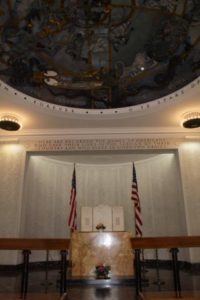
His work extended to memorials across the country: the Mayo Memorial Amphitheater, the Harvey Firestone Memorial in Akron, and the American Military Cemetery at Anzio, Italy. The ceiling of the Anzio chapel (right) reprises his celestial motif, with zodiacal constellations and planets placed in their positions on January 22, 1944, the day of the Allied landing.
Val-Kill and Arthurdale Gugler worked closely with Eleanor Roosevelt on her Hyde Park cottage, Val-Kill, and later on the Arthurdale subsistence-homesteading project in West Virginia. Although the project became mired in bureaucratic inefficiency and overspending, Gugler’s redesigns of the prefabricated cottages were structurally sound and humane in scale.
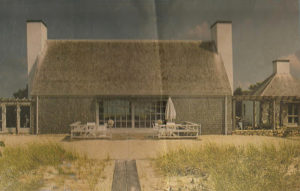
Later Projects Gugler’s later works include Chip Chop, the beach house of actress Katharine Cornell on Martha’s Vineyard, completed in 1957, and the Armillary Sphere for the 1964 New York World’s Fair, again with Paul Manship. He also proposed an immense open-air temple, “The Hall of Our History,” for Warm Springs, Georgia, an unrealized project intended to house the nation’s founding documents.
Eleanor Roosevelt and Helen Keller at Chip Chop
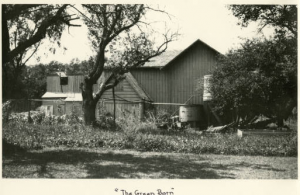
Retirement and Death Eric and Anne Gugler retired to The Green Barn at Snedens Landing, New York, long associated with the Tonetti family and their artistic circle. Gugler died there on May 16, 1974. Anne survived him until 1990.
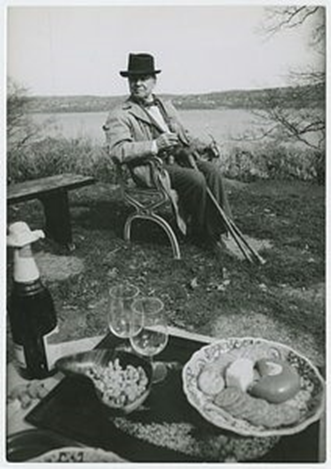
Eric Gugler in retirement (left)
Green Barn (below)
Legacy Eric Gugler’s work spanned architecture, art, and civic design. From ship camouflage to celestial ceilings, from the Oval Office to national memorials, he combined technical discipline with imaginative symbolism. His lifelong fascination with the harmony of the cosmos shaped spaces that sought to reconcile human order with the vastness of creation.
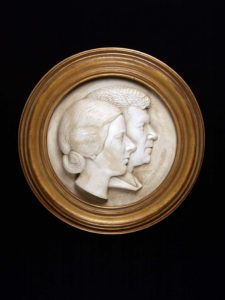
Anne and Eric Gugler by Paul Manship
Top of Form
Bottom of Form
11`