Breese, James Lawrence II (1884–1959)
Education and Early Life
James Lawrence Breese II, often called “Jim,” inherited both the technical aptitude and the flair for adventure of his father, the society photographer James Lawrence Breese. He attended Groton, where he was a schoolmate of Franklin Delano Roosevelt, and graduated from Princeton University in 1909. His education and connections later proved significant when Roosevelt, as Assistant Secretary of the Navy, helped secure Breese’s participation in a pioneering aviation event.
The Aviator
In 1919 Breese served as engineering officer and co-pilot of the NC-4, the Curtiss flying boat that completed the first successful transatlantic flight—from New York to Lisbon—years before Charles Lindbergh’s solo crossing.
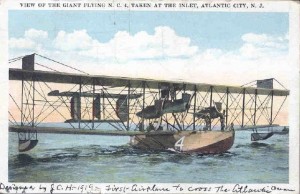
The NC-4, one of four Navy Curtiss flying boats built for long-distance experimentation, departed from Naval Air Station Rockaway on May 8, 1919, stopping at Halifax and Newfoundland before attempting the longest leg of the journey to the Azores. Escorted by a line of Navy destroyers lighting the night sea with searchlights, the NC-4 reached Horta, Faial Island, after fifteen hours in the air. It was the only one of the three planes to survive the entire crossing; NC-1 sank after damage at sea, and NC-3 was forced down by fog and mechanical problems.
After repairs in the Azores, the NC-4 continued to Lisbon on May 27, completing the first flight ever made across any ocean—a historic milestone in aviation. The crew was celebrated worldwide, and Breese received the Navy Cross and the Congressional Gold Medal for his role. His daughter Mary NC Breese was named for the aircraft that had carried him into history.
The Inventor
After the war, Breese’s interests turned toward engineering and invention. Having learned mechanics from his father and aviation from the Navy, he initially joined a firm that produced experimental steam automobiles. From his work on the steam car’s oil burner, he developed an idea that revolutionized domestic heating.
Studying the combustion of a candle flame, he designed a burner that maintained a steady temperature without producing smoke. Adapting this principle, he invented the first thermostatically controlled oil burner for home furnaces—the “Breese Burner.” Manufactured worldwide, it became one of the most widely distributed heating units of the mid-twentieth century, with over three million sold by 1954. The U.S. Army used Breese Burners to heat barracks during wartime.
Santa Fe Years
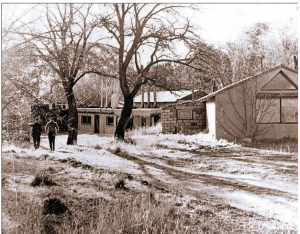
Breese’s first encounter with Santa Fe was accidental. While piloting a Ford Trimotor to Winslow, Arizona, he ran low on fuel and followed an arrow painted on a rooftop that guided him to a small landing strip outside Santa Fe. Captivated by the landscape, he bought property on Upper Canyon Road and built a house. There he continued to refine and test the Breese Burner while overseeing manufacturing partnerships around the country.
The factory building on Upper Canyon Road later became part of Santa Fe Preparatory School. Breese became a well-known local figure, equally at home among engineers, pilots, and the artists and architects who frequented Santa Fe’s growing cultural circle. During World War II he served in the Civil Air Patrol.
Personal Life
Breese’s first marriage to Marjorie Howard Gorges produced four children—Frances, Anne, Mary NC, and James III—but ended in divorce. In 1935, he married Sarah Spencer Morgan Gardner, a widow and granddaughter of financier J.P. Morgan; this marriage also ended in divorce. In 1940, he married Irene Rich (born Anna Josefa Irine Sobczyk), a nurse; they divorced in 1948. His final marriage was to the journalist and editor Florence Welch Wagner, widow of writer Robert Wagner, founder of Rob Wagner’s Script, the literary magazine that first published the young Ray Bradbury.
Later Life and Legacy
Breese’s later years were divided between New Mexico and California. In San Diego, where he died on April 1, 1959, he remained active as an inventor and aviation enthusiast.
His career spanned the age of steam, flight, and postwar industrial expansion. From pioneering transatlantic aviation to revolutionizing home heating, James Lawrence Breese II exemplified the inventive, adventurous spirit of early-twentieth-century American engineering.