Breese, Ann (1924–2019)
Early Life and Artistic Influences
Ann Breese was born on May 27, 1924. She began drawing and painting at an early age, her artistic life shaped by growing up in Santa Fe amid the city’s flourishing early-twentieth-century art colony. Family friends and neighbors included Randall Davey, who introduced her to polo and painting, and Andrew Dasburg, the American modernist. She admired the work of the printmaker Gustave Baumann, a family friend whose daughter Ann was her close childhood companion. Through these connections she was acquainted with many Santa Fe and Taos artists, including Mabel Dodge Luhan and her husband, Tony, to whom she once taught the jitterbug.
She recalled that Santa Fe artist Will Shuster designed the Breese family’s Christmas cards, and that as a teenager she occasionally encountered Georgia O’Keeffe painting near Abiquiú—O’Keeffe’s brusque attempt to shoo her away with a candy bar left an indelible memory rather than a discouragement.
Life at Los Vientos and Santa Fe Society
In later recollections, Ann vividly described her childhood at Los Vientos, the family’s ranch on Upper Canyon Road, and her friendships with other Santa Fe families such as the Packs of Ghost Ranch. Her account of early Santa Fe life captured the world of artists, architects, and eccentrics—John Gaw Meem, whose Pueblo Revival architecture helped define the city’s appearance; Faith Weight and Charles Mintun, who ran experimental schools; and colorful figures like Brian Behru Dunne, the self-made town character and newspaper columnist.
She remembered her family’s casual exchanges of art for their own inventions—“a Breese Burner in exchange for a painting”—and the camaraderie of artists like the Baumanns, whose marionette plays she recalled with affection.
Education and Study with Diego Rivera
Ann experienced progressive education at a school run by Charles Mintun ("Uncle Charlie") and Faith Weight on Palace Avenue. The curriculum emphasized "learning by doing" over rote academics: making pottery, learning steps from Indian dances (her specialty was the Eagle dance), and visiting nearby pueblos. This lack of formal schooling was balanced by deep exposure to indigenous culture. As she later reflected:
"I don't think I would have had as much appreciation for pueblo cultures if there had not been that early exposure... All the dances are a fascinating integration of the native American religions and the Christian teachings brought by the Spanish missionaries."
Faith was an early health food enthusiast, and our meals were mainly fresh fruit, vegetables, nuts, granola, and whatever else she considered wholesome. Desserts were for bidden. There seemed to be no schedule. When they were tired after supper, boarders were asked what room they felt like sleeping in that night. Boys sometimes shared quarters with girls, and no one seemed to think it odd.”
Ann attended the Sandia School in Albuquerque, designed by Meem and founded by Ruth Hanna McCormick Simms, where she studied art with Raymond Jonson, one of the New Mexico Transcendentalists, and Kenneth Adams, artist-in-residence at the University of New Mexico.
She then entered Bennington College in Vermont in 1943, drawn to its modern educational philosophy that integrated studio art with liberal studies. Under the guidance of Paul Feeley, she explored abstract painting and nonrepresentational form. During her Non-Resident Term she studied with Diego Rivera in Mexico City, assisting in his studio on a mural depicting burros in the desert and meeting Frida Kahlo, whose fragile health made a lasting impression.
Marriage, Travel, and Artistic Development
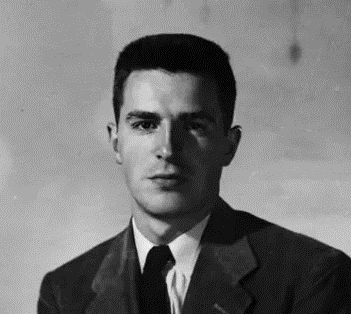
After graduating from Bennington in 1947, Ann returned to Santa Fe, where she met the young architect Charles Sink (right), a Harvard graduate who had studied under Walter Gropius alongside I. M. Pei. They married and lived in Caracas, Venezuela, where he opened the city’s first architectural office, and she pursued painting.
Returning to the United States, they settled in Denver, and for a time in New York, where Charles worked with I. M. Pei and William Zeckendorf. Exposure to New York’s Abstract Expressionist scene deeply influenced her artistic development; she knew family friend Adolph Gottlieb and viewed major exhibitions of the movement.
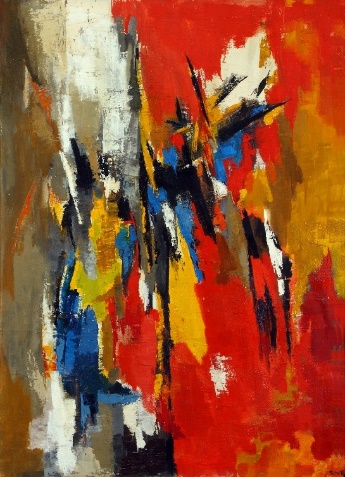
In the latter 1950s, along with raising her young family in Denver, Ann began painting oils on canvas and board in the styles of pure and referential abstraction. While she and her family lived in New York, she saw Abstract Expressionism in the exhibitions of its artists, including family friend Adolf Gottlieb. Her firsthand contact with the movement informed her striking and large untitled canvas in the late 1950s. Other pure abstracts from the 1960s show her attachment to Color Field painting. At the same time, she applied referential abstraction to other paintings basing their imagery on New Mexico landscape and the large Native American pueblo in Taos, which she visited while growing up in Santa Fe. The cubistic structure of the several-storied adobe pueblo appealed to her and was a very familiar subject. She likewise applied referential abstraction to still lifes, a subject close at hand, whose bright palettes recall those of Arthur B. Carles.
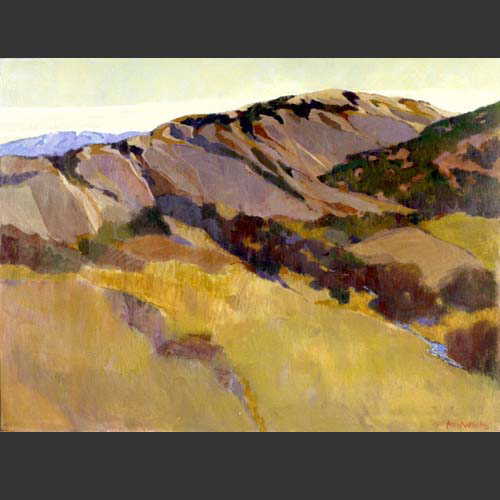
By the early 1960s she began painting acrylics which had become commercially available and used by a number of New York-based Abstract Expressionists. She increasingly preferred them to oils because they dried quickly and were practically odorless.
Providing limitless expression and creativity, they allowed artists to achieve different textures, consistencies and color depths. Ann applied the medium to modernist landscapes on canvas and paper of Colorado, New Mexico, Arizona and Montana, as well as of Mexico, Greece, and other locales she visited with her second husband, Ed White. Some of these same places appear in her watercolors and watercolors combined with pastel.
Artistic Work and Exhibitions
With her husband she co-founded the Alliance for Contemporary Art in Denver, under the auspices of the Denver Art Museum, to promote modern and abstract art in the region. She later received the museum’s Cile Bach Award and its Fifty-Year Award for her service.
Active in civic causes, she joined the Colorado Coalition for the Prevention of Nuclear War and painted Peace March at Nevada Test Site after joining a protest in 1987. She exhibited in Denver galleries and regional shows and was a founding member of The Nine, an independent association of women artists active from 1963 to 2000. A signature member of the Colorado Watercolor Society, she exhibited regularly in juried shows.
Teaching and Later Career
Ann earned a teaching certificate in art education at the University of Denver in 1969 and taught in summer programs, museums, and schools throughout the city. In the 1970s she managed the Scholastic Art Awards in Denver and served as a regional editorial consultant in design and architecture for national publishers.
After her divorce from Charles Sink, she married architect Edward White of Denver, a preservationist who helped found the Denver Landmark Preservation Commission and restored many of the city’s historic buildings. His civic legacy was honored with major preservation awards.
Retrospective and Legacy
In 2000 her son, the photographer Mark Sink, organized a fifty-year retrospective, Ann White, 1950–2000, at Gallery Sink in Denver, which surveyed her abstract and representational works—distinguished by clarity of structure, expressive color, and a lifelong dialogue between modernism and the New Mexican landscape.