Woodlands (or Woodland) Plantation
Location: Plaquemines Parish Louisiana
Built: c 1840
Architectural Description
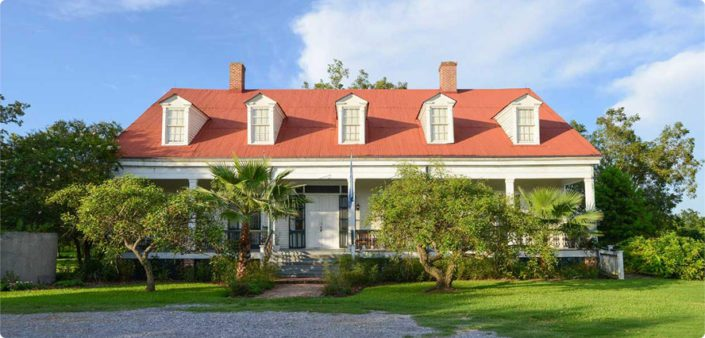
Woodland Plantation (historically spelled both Woodland and Woodlands) is a raised Greek Revival–Creole plantation house dating from the mid-nineteenth century, prominently sited along the west bank of the Mississippi River in Plaquemines Parish, Louisiana. The main house is a long, rectangular, one-and-a-half–story structure set on a raised brick foundation, a practical response to flooding and heat in the lower Mississippi Delta.
The principal façade is defined by a broad, full-width gallery sheltered beneath the main roofline and supported by a row of simple classical columns, most closely aligned with the Doric order. The gallery functions as both circulation space and climatic buffer, a characteristic feature of Creole plantation architecture. Access to the house is via a central stair rising to the gallery, reinforcing the building’s axial symmetry.
The roof is a steeply pitched hipped form clad in red metal, punctuated by a regular series of dormers with classical surrounds, providing light and ventilation to the upper level. Tall interior chimneys rise above the roofline, originally serving multiple fireplaces. Fenestration consists of evenly spaced French doors and multi-paned windows opening onto the gallery, allowing cross-ventilation and visual continuity between interior rooms and the surrounding landscape.
While fundamentally Greek Revival in its symmetry and classical vocabulary, Woodland also incorporates Italianate and Creole elements in its proportions, roof form, and emphasis on shaded outdoor living space. The overall effect is restrained rather than monumental, reflecting the vernacular adaptation of national architectural styles to the specific environmental and cultural conditions of the Louisiana river parishes.
History
Woodland Plantation was developed in the 1830s by Captain William Johnson, one of the earliest chief river pilots on the Mississippi River. Johnson, who had navigated waters from Nova Scotia to the Gulf of Mexico, settled in the Deep Delta after working under the Spanish river pilot Juan Ronquillo. Local tradition and later accounts associate Johnson and his partner, George Bradish, with the orbit of Jean Lafitte, reflecting the blurred boundary between legitimate river commerce, smuggling, and piracy in the late eighteenth and early nineteenth centuries.
Before building Woodland, Johnson and Bradish jointly developed Magnolia Plantation, located several miles downstream, where both families lived for decades. After selling his interest in Magnolia, Johnson established Woodland as a separate sugar plantation. The main house appears to have been constructed between circa 1834 and 1855, replacing earlier plantation buildings on the site.
Woodland functioned as a large-scale sugar plantation dependent on enslaved labor. By 1850, Johnson’s son George Washington Johnson, who inherited the property after William Johnson’s death in 1849, had 181 slaves. Their forced labor underpinned the plantation’s sugar production and the family’s wealth. Contemporary accounts indicate that the plantation included substantial slave quarters and industrial facilities, including a modern sugar mill for its time.
During the Civil War, Woodland became the subject of federal scrutiny. In 1863, the Union Army’s Office of Negro Labor investigated conditions on the plantation and reported severe discontent among the enslaved population, who requested permission to enlist in the Union Army and complained of curtailed rations and abuse by the overseer. These reports provide rare documentary insight into plantation life during wartime occupation.
That same year, Johnson brought a legal claim against Union General Neal S. Dow, alleging that Union troops had seized sugar and looted personal property from the plantation. Although Johnson initially won damages, the case ultimately reached the U.S. Supreme Court as Johnson v. Dow (1876). The Court ruled against Johnson, holding that property in enemy territory during wartime was subject to military seizure. The case became widely cited during the contested Tilden–Hayes presidential election, as Americans debated the legal status of the former Confederate states.
The plantation later passed to Bradish Johnson, William Johnson’s third son, who owned Woodland until his death in 1897. His heirs sold the property to the Wilkinson family, who retained it for most of the twentieth century. By the late 1990s, the house had fallen into serious disrepair.
In 1997, the property was purchased at public auction by Claire and Jacques Creppel and their son Foster, who undertook a comprehensive restoration between 1997 and 1998. Woodland reopened in 1999 as a country inn and event venue, later incorporating the adjacent former church as Spirits Hall, a restaurant. The plantation was listed on the National Register of Historic Places in 1998
It is also memorialized on the label of Southern Comfort
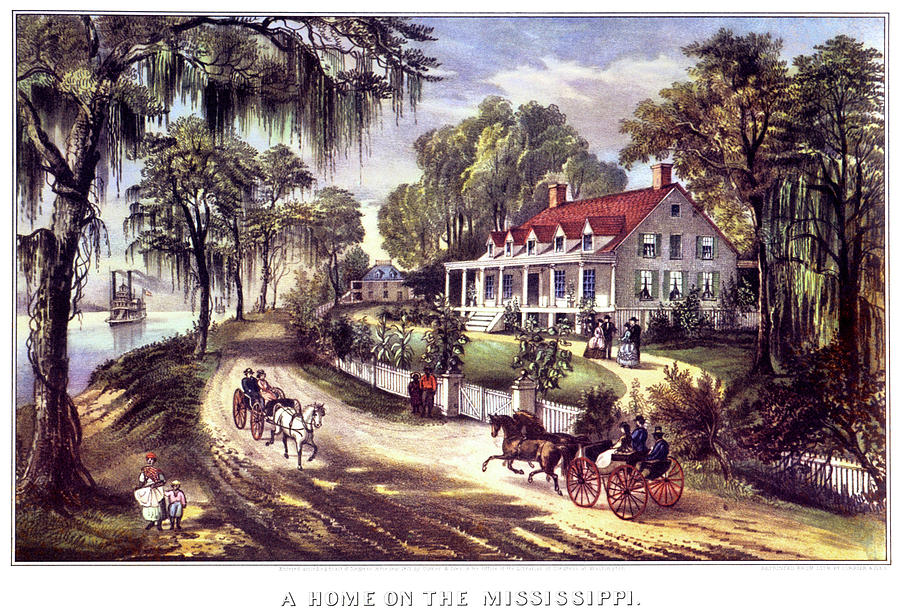
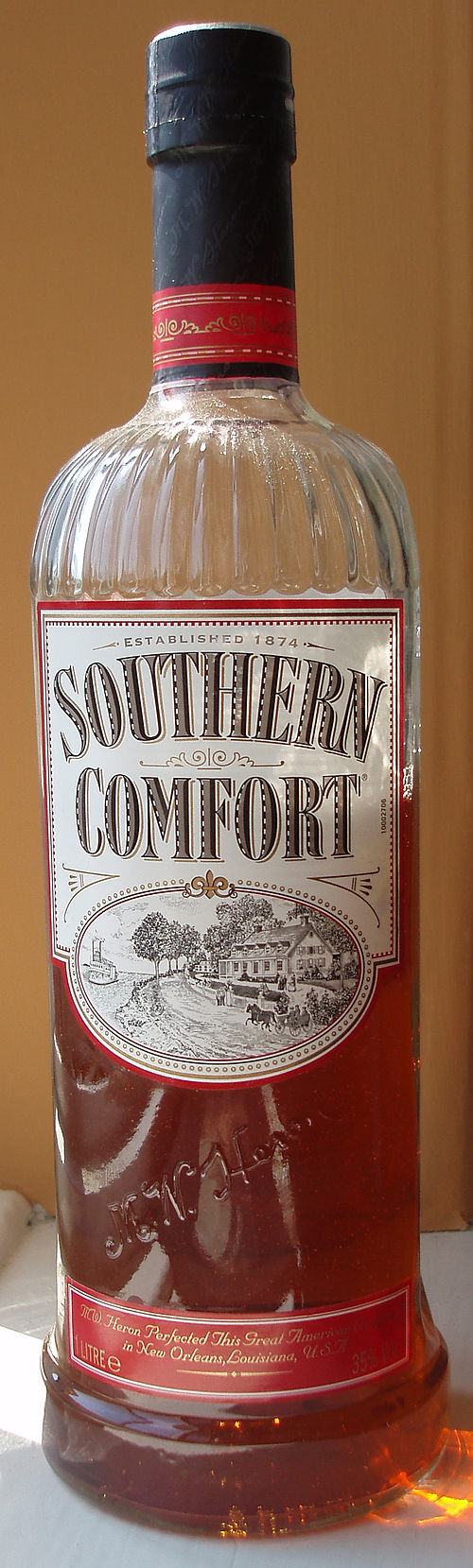
The image of Woodland Plantation ended up on the label of Southern Comfort through a licensing arrangement after the end of Prohibition in 1933. The iconic depiction is based on the 1871 Currier & Ives lithograph titled A Home on the Mississippi (also known as Home on the Mississippi), a hand-colored print created from a drawing by artist Alfred Waud. This artwork was originally commissioned as part of a U.S. government documentary effort on the Mississippi River and shows the antebellum mansion with its grounds, a horse-drawn carriage, and a steamboat on the water—evoking a romanticized vision of Southern life along the river.
In 1934, the makers of Southern Comfort (a New Orleans-originated whiskey-based liqueur created in 1874 by Martin Wilkes Heron) licensed and adapted this public-domain Currier & Ives image for their bottle label, as it perfectly captured the brand's "Southern comfort" theme tied to Louisiana heritage. The plantation house was not chosen for any direct connection to the brand's history but because its classic Greek Revival style and riverside setting symbolized the idealized antebellum South. The image remained a prominent feature on the front label for about 75 years (from the 1930s until 2009–2010), when the brand underwent a major rebranding under new ownership (Brown-Forman, and later Sazerac), dropping the plantation artwork in favor of a more modern design—partly amid evolving cultural sensitivities around such imagery.