Winn, James Julius (1907–1990)
Early Life and Education
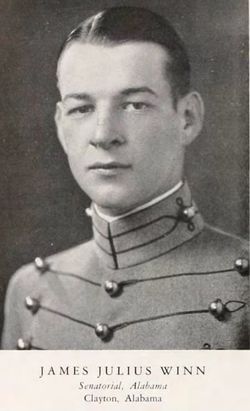
James Julius Winn was born in 1907, the son of Guy Westmoreland Winn and Ellene Glenn, families of long Virginia and North Carolina lineage. He attended Marion Military Institute in Marion, Alabama, graduating in 1925, and was appointed to the United States Military Academy at West Point, where he graduated in 1929. His early education reflected the traditional Southern emphasis on military discipline and civic duty, qualities that would define his long Army career.
Early Military Career and Association with the Marshalls
After graduation from West Point, Winn was assigned to the Field Artillery and attended the Infantry School at Fort Benning, Georgia. While stationed there in 1929, he became acquainted with General George C. Marshall and his first wife, Katherine Tupper Brown Marshall. Winn later recalled attending a social event given by Mrs. Marshall for her daughter Molly in 1930 or 1931, an occasion that marked the beginning of an enduring family connection.
Winn’s talent and reliability brought him early to national attention. He was appointed as a military aide to President Franklin D. Roosevelt, serving in the White House in the early 1930s. His duties required discretion and tact, qualities for which he became known throughout his career. By 1937, he was stationed at Fort Myer, Virginia, and was still there when General and Mrs. Marshall moved into Quarters Number One in 1939 upon his appointment as Chief of Staff of the Army.
The Winns and the Marshalls shared close quarters at Fort Myer, and the friendship deepened. The marriage of Winn to Molly Pender Brown, the daughter of Katherine Tupper Brown and the stepdaughter of General Marshall, took place in the Oval Dining Room of Quarters Number One, linking the two families in both affection and service.
World War II Service
When the United States entered World War II, Winn was serving with the 1st Army Artillery. After the Allied landings in Normandy, he was ordered to the European Theater and arrived on June 30, 1944. He took part in the campaigns across northern France and was at Le Bourget Airfield near Paris at the time of the liberation of the city in August 1944.
His service in Europe extended through the final months of the war, as the 1st Army advanced toward Germany. His duties included coordination of artillery fire and logistics, a vital but often underrecognized element of the Allied victory. His professional competence and calm leadership earned the respect of his fellow officers.
Later Career and Retirement
After the war, Winn continued his service as a career officer in the Regular Army. His assignments included posts in artillery training and organizational planning during the early Cold War years. He rose through the ranks with steady distinction, maintaining the quiet professionalism that characterized his generation of West Point officers.
After more than thirty years of active duty, he retired from military service but remained active in veterans’ organizations and West Point alumni affairs. He and Molly maintained their ties to the Marshall family and frequently participated in events honoring the general’s legacy.
Family and Legacy
James and Molly Winn had three children: James Jr., Katherine, and Ellene. Their youngest, Ellene Westmoreland Winn, later took part in the unveiling of the statue of General George C. Marshall at the Virginia Military Institute in 1979, a symbolic continuation of the family’s connection to the general’s memory and ideals.
James Julius Winn’s life reflects the continuity of duty and personal integrity that defined the professional Army officer corps of his era. From Fort Benning and Fort Myer to the fields of France, his service spanned the pivotal decades in which the United States became a global power. His career, family life, and enduring connection to the Marshall family illustrate the interweaving of private loyalty and public service that marked his generation.