Webb, Alexander Stewart (1835–1911)
Early Life and Education
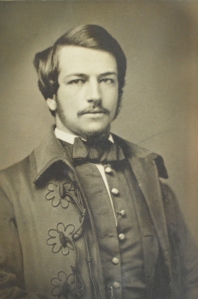
Alexander Stewart Webb was born in New York City into one of the most prominent families of the early American republic. His father, James Watson Webb, was a leading newspaper editor, diplomat, and later a Union general during the Civil War, while his mother, Helen Lispenard Stewart, was descended from the old Lispenard and Stewart families of colonial New York.
He entered the United States Military Academy at West Point, graduating thirteenth in the class of 1855. Webb excelled in mathematics and in drawing, studying under Robert Walter Weir of the Hudson River School and befriending James McNeill Whistler, whose irreverent caricature of a chemistry professor caused his expulsion. A fading Whistler sketch made at that time is preserved by Webb’s descendants.
Anna Remsen, whom Webb married in 1857, came from a family distinguished in early American finance and government. Her ancestor Henry Rutgers Remsen had been private secretary to Thomas Jefferson during Jefferson’s service as Secretary of State and later a leading New York banker.
Early Military Career
After graduating, Webb was assigned to Florida during the Third Seminole War, where he gained his first experience of field command. He later returned to West Point as an instructor of mathematics, combining his technical skills with an aptitude for leadership that would soon prove essential.
The Civil War
When the Civil War began in 1861, Webb volunteered for active service. He participated in the defense of Fort Pickens, was present at First Manassas, and soon became assistant to General William F. Barry, Chief of Artillery for the Army of the Potomac. During the Peninsula Campaign he served as Barry’s acting inspector general and then as chief of staff to General Fitz John Porter’s V Corps during the Maryland Campaign.
In June 1863, a few days before the Battle of Gettysburg, he was promoted to brigadier general and given command of the Philadelphia Brigade of the II Corps. At Gettysburg, his four regiments held the Union center at the clump of trees that became the focus of Pickett’s Charge. Despite losing nearly half his command, Webb stood calmly in the open, smoking a cigar and encouraging his men during the artillery bombardment. He was wounded in the thigh during the fighting but refused to leave the field.
At Spotsylvania in 1864, a bullet entered near his right eye and exited by his ear, leaving a visible scar. He returned to duty the following year and served as chief of staff to General George G. Meade until the war’s end. For his gallantry at Gettysburg, he received the Medal of Honor in 1891.
Academic and Civic Leadership
After the war, Webb remained in the regular army, teaching mathematics at West Point until 1870. That year he became president of the City College of New York, where he upheld a rigorous classical curriculum and guided the institution for more than thirty years. His leadership helped to establish the college’s enduring reputation for academic excellence and public service.
Webb also served as the first president of the Westminster Kennel Club, reflecting his lifelong interest in breeding and sporting pursuits. In 1881 he published The Peninsula: McClellan’s Campaign of 1862, a careful study of the campaign in which he had taken part.
Family and Character
Alexander and Anna Webb lived in a large home overlooking the Hudson River in Riverdale, New York, where they entertained family and former comrades. Their grandchildren affectionately called them “Cuckoo” and “Grandmoo.” Letters from Julia Grant, wife of General Ulysses S. Grant, urged Anna to accompany her husband as near to the front as possible, advice she often followed.
Webb’s composure and intelligence, whether under fire or in academic life, earned him enduring respect. His contemporaries saw him as the model of the soldier-scholar, precise in mind, courageous in action, and modest in manner.
Death and Legacy
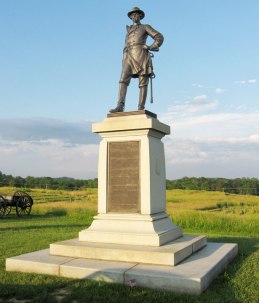
Alexander Stewart Webb died in Riverdale on February 12, 1911, and was buried at West Point Cemetery. Monuments to him stand at Gettysburg—near the Angle, where Pickett’s Charge was repelled—and on the campus of the City College of New York.
Through his daughter Helen’s marriage to John Ernest Alexandre, Webb’s descendants became linked to the Alexandre and Lawrence families, extending the family’s legacy of public service and achievement into later generations.