Townsend, Robert (1753–1837)
George Washington’s Chief Spy
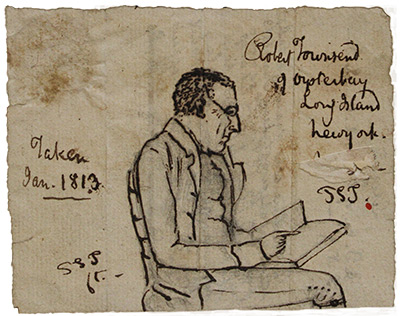
Parents: Samuel Townsend (1717–1790) and Sarah Stoddard (1720–1800). Children: None, but he gave his name to Robert Townsend Jr., the illegitimate son of his brother William Townsend and Mary Banvard, his Irish housekeeper. Kinship: Fourth great-granduncle of the post–World War II Smith generation.
Early Life and Family Background: Robert Townsend was the third son of Samuel and Sarah Townsend of Oyster Bay, New York. His father was a prosperous merchant and Whig politician; his mother, an Episcopalian, came from an established Long Island family. Samuel Townsend combined commercial success with a liberal Quaker heritage, though his evolving religious views led him at different times to identify with the Baptists as well. The family home in Oyster Bay became a center of both business and political activity and later, during the Revolution, a British military headquarters.
Little is known about Robert’s youth, though records suggest he was quiet, studious, and reflective. As a teenager, he was apprenticed to the New York merchant firm of Templeton and Stewart, where he lived and worked in the bustling, seamy district of “Holy Ground,” near what is now the Financial District. The experience exposed him to the urban underworld, to British soldiers stationed in New York, and to the complex loyalties of the city’s diverse inhabitants.
Intellectual and Political Formation: Townsend’s turn toward the revolutionary cause was influenced by several forces: the publication of Thomas Paine’s Common Sense in 1776, the mistreatment of his family by occupying British troops, and his friendship with Abraham Woodhull of Setauket. Though shaped by Quaker ideals of pacifism, Townsend’s conscience drove him to act against what he perceived as corruption and tyranny. His solution was to serve the Revolution not by combat, but through intelligence work.
The Culper Spy Ring: In 1779 Abraham Woodhull—Washington’s trusted operative under the code name “Samuel Culper”—recruited Townsend to join a new espionage network directed by Major Benjamin Tallmadge. Townsend agreed, adopting the alias “Samuel Culper Jr.” (code number 723). His role was to collect intelligence in British-occupied New York and relay it, through intermediaries, to Washington’s headquarters. Even Washington did not know his real identity.
Townsend’s information proved vital. Through contacts in mercantile and military circles, he provided detailed reports on troop movements, naval construction, planned raids, and political developments. His dispatches were among the most accurate Washington ever received. He worked largely alone, relying on couriers—among them his nephew James Townsend—and on the invisible-ink correspondence system devised by Tallmadge. The risk was constant; arrest meant hanging.
Dangers and Difficulties: The hazards of espionage were vividly illustrated when Townsend’s nephew James, serving as courier, was arrested after arousing suspicion while posing as a Loyalist recruiter. Washington himself intervened to secure his release, but the experience deeply shook Townsend, who thereafter avoided committing sensitive details to writing.
He also witnessed the fate of other spies: Nathan Hale’s execution early in the war, and later the exposure of Benedict Arnold’s treachery and the capture of Major John André. The André episode touched Townsend personally: André had visited Colonel John Graves Simcoe at the Townsend home in Oyster Bay, which British troops had used as headquarters during their occupation. Townsend’s father was forced to host Simcoe and his men, who devastated the family’s orchard to build fortifications. The British presence left emotional scars but also created the circumstances that made the Townsend home a center of intrigue.
Decline of the Ring and Final Report: As the war neared its end, the Culper Ring’s operations diminished. In 1782, when Washington again requested intelligence from New York, Townsend sent what appears to have been his final report on September 19 of that year, confirming that Britain was preparing to recognize American independence and evacuate New York. His quiet, meticulous work had contributed significantly to the American victory, though it remained unknown for nearly 150 years.
Abolitionism and the Case of Elizabeth (“Liss”): In later life, Townsend’s moral convictions found expression in his membership in the New York Manumission Society, founded in 1785 by John Jay and others. His involvement was not merely theoretical. He became personally entangled in the life of an enslaved woman, Elizabeth (“Liss”), once owned by his father. When British Colonel Simcoe—an abolitionist—removed Elizabeth to safety during the occupation, Townsend maintained contact with her, providing money and small gifts.
After the war, when Elizabeth reappeared in New York pregnant and destitute, Townsend took her into his home, purchased her freedom from his father for seventy dollars, and ensured she was cared for after giving birth to her son Harry in 1783. Later, under financial strain and seeking stability for her, he arranged her sale to a widow with an agreement that she would not be resold. When that agreement was violated and Elizabeth was trafficked to Charleston, South Carolina, Townsend went into debt to repurchase her, working through intermediaries.
The case posed a legal dilemma: New York had banned the importation of enslaved persons, yet Townsend was determined to bring Elizabeth home. He succeeded, likely smuggling her aboard a ship to Oyster Bay in 1787, and later found a way to document her freedom through a family Bible entry that erased evidence of her prior bondage. By the 1790 census she appeared as “Free Elizabeth,” living and working independently in Oyster Bay.
Later Years: Robert Townsend never married. He lived quietly with his sister Sarah (“Sally”) in their family home, suffering periods of melancholy and withdrawal. Family letters depict him as gentle, intellectual, and deeply introspective—a man haunted by war, secrecy, and moral compromise. He expressed sorrow at the execution of Major André, whom he may have met during the occupation, and reportedly said that he had “never felt more sensibly for the death of a person.”
He never revealed his espionage role to anyone. It was not until 1929 that historian Morton Pennypacker, comparing handwriting samples, proved that the anonymous operative “Samuel Culper Jr.” was Robert Townsend. The revelation transformed understanding of Washington’s intelligence network and restored Townsend’s place among the most effective American spies of the Revolution.
Character and Legacy: Robert Townsend’s life was marked by contradiction: a Quaker merchant turned spy, a reluctant participant in slavery who risked his fortune to rescue an enslaved woman, a patriot who concealed his service for half a century. His restraint, secrecy, and moral seriousness distinguished him from the reckless amateurism of earlier agents and exemplified Washington’s new professional approach to intelligence.
He died in 1837, largely forgotten, and was buried in the family plot in Oyster Bay. His reputation was restored only in the twentieth century, when his code name “Culper Jr.” became a symbol of quiet heroism and integrity in service to both country and conscience.
(Based on the research of Claire Bellerjeau and Tiffany Yecke Brooks, Espionage and Enslavement in the Revolution: The True Story of Robert Townsend and Elizabeth [Lyons Press, 2021].)