Townsend, Peter Sr. (1736–1787)
Early Life and Family Peter Townsend was born in 1736, the son of Henry B. Townsend and Elizabeth Titus of Oyster Bay, Long Island. He descended from the original Townsend brothers who had settled Oyster Bay in the seventeenth century, part of a family that combined Quaker traditions with mercantile enterprise. Peter married Hannah Hawkhurst, uniting two of Long Island’s most prominent Quaker families.
Iron Manufacturing and Industrial Innovation In the mid-eighteenth century, Townsend became associated with Noble, Townsend & Company, founded in 1751 by William and Abel Noble. The firm was among the first in the American colonies to export iron to England, competing successfully with Swedish and Russian iron. By the 1770s, Peter Townsend had become sole owner of the enterprise, operating the Stirling Iron Works near Tuxedo, New York. There he produced anchors, tools, bar iron, sleigh rails, and axles, and in 1776 he made the first steel produced in New York State, initially from pig iron and later from refined bar iron.
The American Iron Industry in the Revolution During the Revolutionary War, the United States produced an astonishing fourteen percent of the world’s iron—approximately 30,000 tons per year. With seventy-two cold-blast furnaces and countless smaller forges, colonial iron output exceeded that of England and Wales combined. The process was laborious and destructive of timber, consuming an acre of forest per day per furnace. Yet these resources enabled the colonies to supply their armies and fortifications with iron weapons, tools, and defenses.
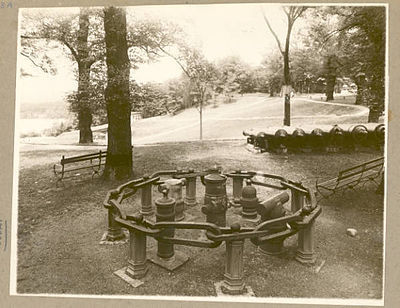
The Great Chain Across the Hudson Peter Townsend’s greatest contribution came when General George Washington commissioned him to forge a massive chain to be stretched across the Hudson River at West Point, designed to prevent British ships from sailing north to join their Canadian forces. Townsend completed the project in an extraordinary six weeks. On May 1, 1778, the Great Chain—1,200 links weighing a total of sixty-five tons and extending 1,700 feet—was installed across the river. It represented a technical and logistical feat of the first order. Fortifications on the cliffs above, designed by Thaddeus Kościuszko, guarded the chain and the narrow bend of the river. By the end of 1779, West Point had become the most formidable American stronghold, due in large part to Townsend’s ironwork.
The Arnold–André Conspiracy The British recognized that breaching or neutralizing the Great Chain was crucial to their strategy. Their hopes turned to treason within the American ranks. General Benedict Arnold, trusted by Washington and placed in command of West Point, secretly conspired with the British. In September 1780, he met with Major John André, the British intelligence officer who had previously conferred with Colonel Simcoe at the Townsend family home in Oyster Bay. André carried concealed plans for West Point in his boots when he was captured by American militiamen. The exposure of Arnold’s plot led to André’s arrest, trial, and execution. Arnold fled down the Hudson to HMS Vulture, escaping to New York, where he was rewarded by the British with a commission and £20,000.
Myths and Family Legends Later local lore claimed that Peter Townsend’s cousin, Sarah “Sally” Townsend—sister of Robert Townsend, the Culper spy—had intercepted correspondence between Arnold and André at the Townsend home in Oyster Bay, allegedly revealing a plan to weaken the chain’s defenses. No evidence supports this story, and it appears to be a nineteenth-century embellishment designed to romanticize the Townsend family’s role in espionage. The genuine historical record, however, firmly establishes Peter Townsend’s decisive contribution to the war through his ironworks and the forging of the Great Chain.
Legacy Peter Townsend’s technical skill and patriotic labor placed him among the great industrial contributors to the American Revolution. His Stirling Iron Works supplied the Continental Army and produced the hardware that defended the Hudson Valley, one of the war’s most strategic theaters. The Great Chain remains an enduring symbol of American ingenuity and resistance, and links from it are preserved today at the United States Military Academy at West Point. Townsend died in 1787, leaving a legacy that joined the industrial might of early America to its fight for independence.