Townley Estate Fraud (Lawrence-Townley Estate Fraud)
Historical Genealogical Claims and Fabrication
The genealogical work The Historical Genealogy of the Lawrence Family by Thomas Lawrence (1858) advanced the claim that the Townley and Lawrence families were connected by marriage and that the Townley estate was “of many millions, in Lancashire, in Chancery.”
One version of the romance: a Protestant Lawrence married Mary Townley, daughter of Sir Richard Townley of Lancashire, was disinherited by her Catholic father, emigrated to America, but the father later left his estate to her albeit unable to locate her. This version, while colorful, is entirely fabric.
A detailed background paper notes the Towneley family of Lancashire was real and well documented (with a daughter Mary Anne Dorothy Towneley) but there is no credible link to a Joseph or John Lawrence of New England or Long Island in the period claimed.
The Fraudulent Mechanism and Exposure
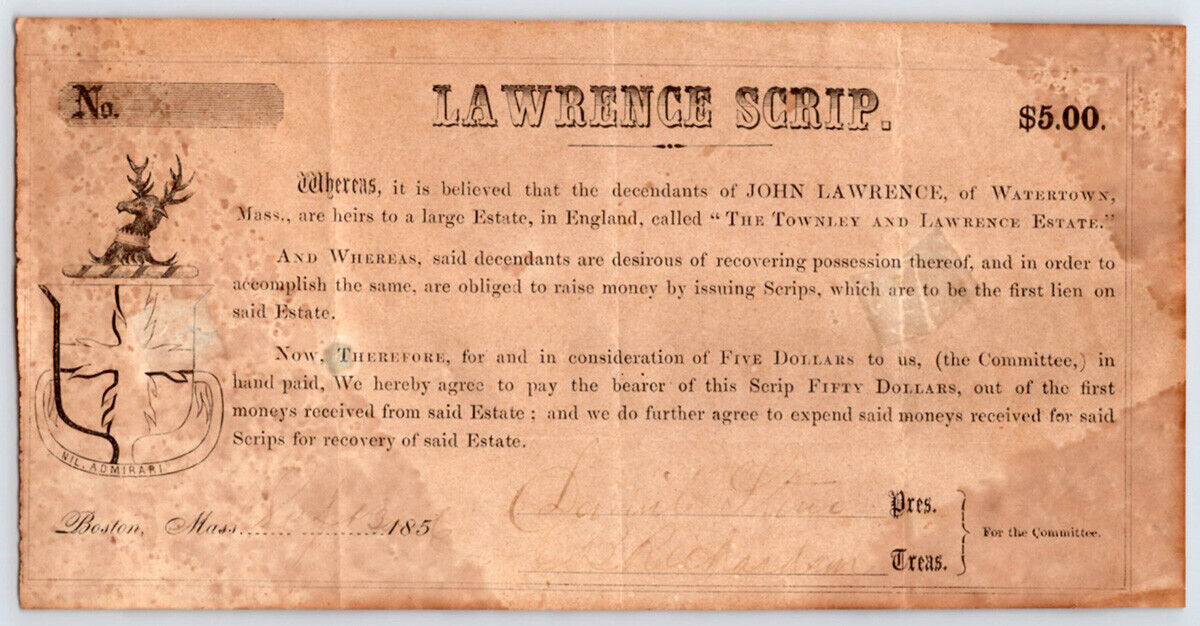
Scammers formed associations of “claimants,” issued scrip or bonds promising large returns from the estate in England, and solicited money to prosecute claims or to secure the merits of the genealogical case.
In England, solicitors such as Howell Thomas, acting for American claimants, pursued actions in the Chancery and High Court — all of which were dismissed as “frivolous and vexatious.” The case was ultimately rejected by the House of Lords.
One of the main promoters, James F. Jacquess, admitted at a hearing that he had received around £10,000 from American dupes between 1876–1885 (and perhaps £22,000 more thereafter) in claims-by-bond schemes. In July 1894 Thomas was convicted of obtaining money by false pretenses; Jacquess was later convicted of conspiracy.
Impact and Relevance to the Lawrence Family
Many members of the American Lawrence family (and allied families) were approached and some apparently invested in the claim. The story appealed to social ambitions (aristocratic connections), romantic genealogies, and the lure of an easy inheritance.
The scandal is used as a cautionary lesson in genealogical research: just because a surname and a story match does not mean the pedigree or claim is valid. The Towneley family pedigree was meticulously recorded in Lancashire and did not support the alleged American Lawrence connection.
Why It Matters
This scam exemplifies the era’s fascination with genealogy, lost fortunes, and the idea of “American heirs” to British aristocratic estates. It shows how genealogical enthusiasm combined with social aspiration could render otherwise sensible people vulnerable to fraud. The case remains relevant to historians of genealogy, inheritance law, and the social history of American elites.