Sunnybank
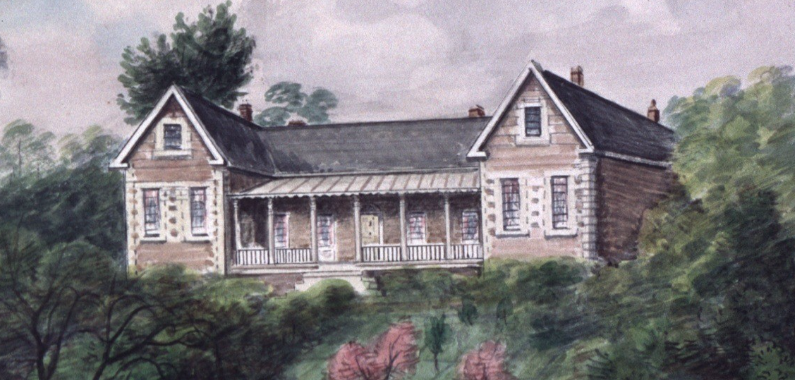
Architectural Description Sunnybank is a modest but historically important early colonial residence. Constructed of stone, it presents as a low, symmetrical house with gabled end sections and a central verandah, typical of early settler adaptations to climate and available materials. While occasionally described in secondary accounts as an “opulent stone homestead,” its significance lies less in architectural grandeur than in age, survival, and association. The building exemplifies the restrained domestic architecture of the first generation of free settlers rather than the later, more monumental colonial houses of the 1830s and 1840s.
Early History
Sunnybank was built about 1824 by William Effingham Lawrence (1781–1841), an English merchant and among the earliest prosperous free settlers in northern Van Diemen’s Land. Sunnybank served as William Effingham Lawrence’s initial residence in Launceston following his arrival in Tasmania in 1823. Lawrence came to the colony seeking improved health and economic opportunity, and he quickly established himself as a substantial landowner and figure of consequence in the fledgling northern settlement. At the time Sunnybank was built, Launceston was still a small and precarious town, and the house stood among the earliest permanent residences erected by wealthy free settlers.
William Effingham Lawrence Lawrence was educated, cultivated, and well connected in England, with intellectual ties that reportedly included Jeremy Bentham. Although he migrated partly for reasons of health, he became active and influential in the early colonial economy of Tasmania. Beyond Sunnybank, he acquired extensive land grants and developed several properties, including Formosa near Cressy (where an earlier log dwelling was destroyed by bushrangers in 1826 and subsequently replaced), Vermont on the North Esk River, and land known as Lawrence’s Paddock. His activities place him squarely within the small elite that shaped the social and economic foundations of northern Tasmania in the 1820s.
Later History and Survival Sunnybank’s continued survival is exceptional. As Launceston expanded and many early structures were demolished or altered beyond recognition, Sunnybank remained standing and recognizable as an early colonial dwelling. Its endurance has led to its frequent identification as Launceston’s oldest surviving residence, a designation that underscores both its antiquity and its rarity.