Strawberry House, also The Homestead and Roadside
Description
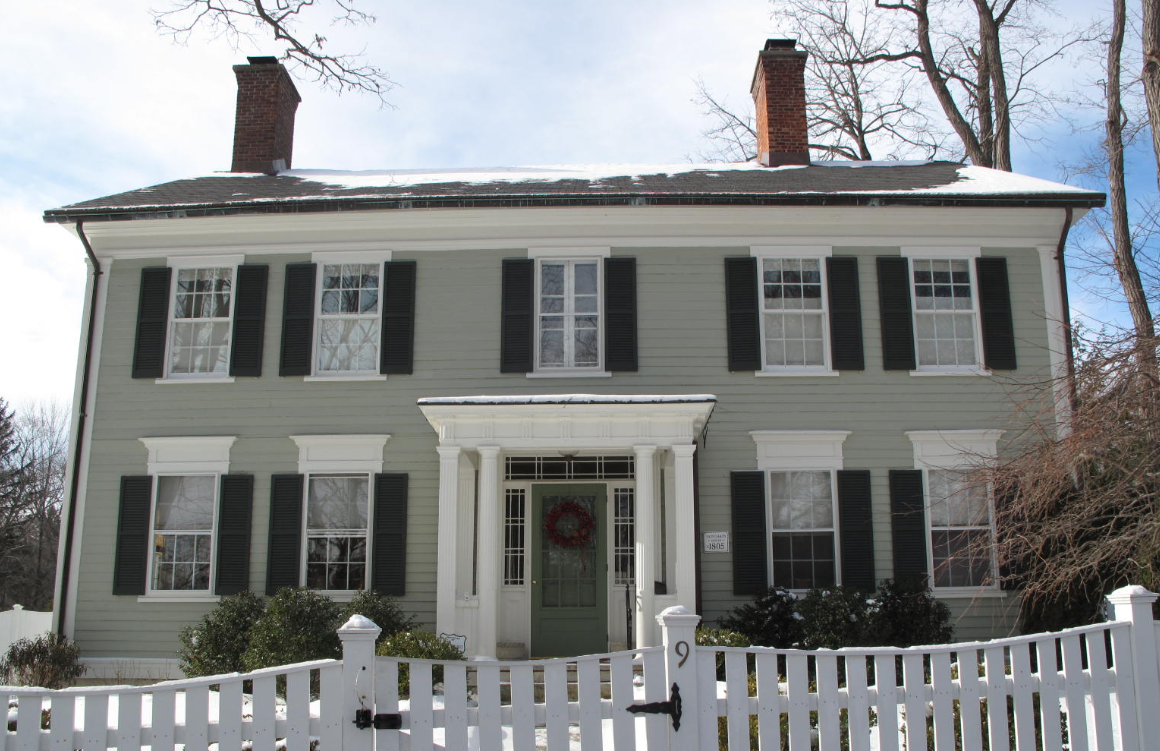
Strawberry House is a well-preserved Federal-style residence of two stories with an asphalt shingle roof. The main block is a five-bay, wood-framed structure with a central entrance and clapboard siding, resting on a stone foundation. Windows are six-over-six sash, with paneled headers and cornices on the first-floor windows. Exterior detailing includes corner boards and an entrance pavilion with fluted Doric columns and pilasters, a frieze articulated with triglyphs and metopes, and a front door surround featuring a leaded (plaid-paned) transom and half-length sidelights.
A two-story, cross-gabled rear ell extends from the main block. The presence of one end chimney and one interior chimney suggests that the original structure was a three-bay house, later enlarged by a two-story addition on the right. A wood picket fence with scalloped panels between posts survives at the front of the property.
Strawberry House is one of the few Federal-period houses remaining in Lenox Village. Documentary and architectural evidence suggests that many more houses of this period once existed, but most were demolished during the second half of the nineteenth century.
History
Calvin Burnham constructed the house around 1805 and lived there with his family. He was likely a brother of Julia Ann Burnham, who migrated from Vermont to Lenox to marry Colonel Charles Mattoon. Burnham and Mattoon were closely connected through numerous documented business transactions, reflected in surviving deeds.
An unusual deed of 1814 granted Burnham’s daughter, Anna Burnham, a lease to occupy her own room in her father’s house in exchange for the nominal rent of one peppercorn. Upon her father’s death, Anna Burnham inherited the property. In 1822, she sold the house to the American Board of Commissioners for Foreign Missions for $500, “and also in consideration of the love and regard which I have for the missionary cause.”
In 1825 the house was purchased from the Board by John Hotchkin, shortly after his return to Lenox from Andover Theological Seminary. Hotchkin succeeded Levi Glezen as principal of Lenox Academy. A graduate of the Academy himself, he served as principal until 1848 and continued teaching until his death in 1862.
After 1876, Hotchkin’s descendants sold the house to Anna B. Shaw. The Shaw family used the property as a summer residence, during which period it was known as The Homestead (not to be confused with another property of the same name at Cliffwood and Greenwood Streets). The house was later called Roadside.
In 1955, the property was purchased by Anna Remsen Alexandre, who renamed it Strawberry House, the name by which it has since been known. There she entertained numerous relatives, including the family of David Huxley, the governor of Bermuda. Her next-door neighbor, Jacob Bean, the curator of drawings at the Metropolitan Museum of Art, used to sunbathe in the nude; Anna found that. reprehensible.