Schieffelin, Edward Lawrence (1847–1897)
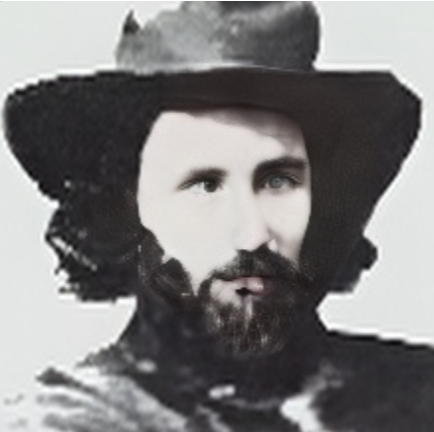
Early Life Edward Lawrence “Ed” Schieffelin was born in western Pennsylvania, where his family lived for a short time before moving to the Rogue Valley of the Oregon Territory. Growing up on the far western frontier, he displayed from an early age a strong independence and fascination with mining, geology, and wilderness life. At seventeen he set out alone as a prospector and spent the next decade crisscrossing the West in search of precious metals. He looked for deposits in California, Death Valley, the Grand Canyon region, and parts of Nevada and Arizona, living the hard, itinerant life of a solitary prospector.
Character and Appearance In 1876, David P. Lansing of Phoenix described Schieffelin as “about the strangest specimen of human flesh I ever saw.” He was exceptionally tall at six feet two, with hair hanging below his shoulders, an untrimmed beard matted into knots, and clothing patched from deer hide, corduroy, and flannel. His hat had been so repaired with rabbit skin that almost none of the original felt remained. The description became part of the legend that grew around him.
Search for Ore and Apache Frontier Years of wandering produced nothing of value. In 1877, still seeking opportunity, Schieffelin enlisted as an Army scout during the Army’s struggle against the Apache. He prospected while scouting in the dangerous country along the San Pedro River, only a few miles from Geronimo’s band. A German miner in the area had already been murdered, the first of many killings in that deadly frontier region—yet Schieffelin kept searching for a vein he believed must be there.
Origin of the Name “Tombstone” The naming of Tombstone became part of frontier folklore. One version holds that fellow scout Al Sieber warned him, “The only rock you’ll find out there will be your own tombstone.” Another said, “Better take your coffin; you’ll find your tombstone and nothing else.” A third held that he was told to take along a chisel so he could carve his name on a rock before dying in the mountains. Still another story attributes the name to a granite formation resembling a gravestone that appeared near his first promising vein.
Discovery and the Struggle for Recognition Schieffelin eventually located what he believed was silver ore and filed a claim, naming it “Tombstone.” But there was no assay office in Tucson, and everyone he showed his samples to dismissed them as worthless. He searched hundreds of miles for his brother Al, nearly penniless, at one point having to work weeks at a mine to earn enough to continue.
When he reached his brother in early 1878, experts at the McCracken Mine also dismissed his samples as lead. Frustrated, he threw most of them out of the cabin door—but kept three. Only after finding an expert assayer, Richard Gird, did he finally receive a true valuation. Gird determined that one sample was worth $2,000 a ton. On the spot, Schieffelin, his brother Al, and Gird formed a partnership.
The Tombstone Boom The three men created the Tombstone Gold and Silver Mining Company. Gird built a crude assay furnace in a cabin fireplace and confirmed that Schieffelin’s ore was valuable. When the initial vein pinched out after three feet, morale faltered, but Ed refused discouragement and continued prospecting until he found new “float ore.” His exuberance prompted Al to call him a “lucky cuss,” and the name stuck for one of the richest claims in the district. Another immensely rich lode, the “Tough Nut,” soon followed.
On June 17, 1879, Schieffelin drove into Tucson with his first wagonload of bullion, valued at $18,744—about $474,000 in today’s dollars. The Tombstone mines ultimately produced the equivalent of about a billion dollars in modern currency.
Town of Tombstone A boomtown rose to support the mines. When Cochise County was created in 1891, Tombstone became its seat. In 1881, Edward’s brother Al built Schieffelin Hall as a theater and civic center, the largest adobe structure in the Southwest. Tombstone soon became famous as the site of the gunfight at the O.K. Corral on October 26, 1881. (Edward’s great-niece, Mary Schieffelin Brady, later restored the hall in 1964.)
Later Life and Alaska Expedition Though he sold portions of his mining interests, Schieffelin remained wealthy. Convinced that mineral riches extended in a great band from Alaska to the Andes, he financed an expedition to Alaska. The brutal cold eventually drove him back to California. In 1883 he married Mary Elizabeth Brown and settled for a time in Los Angeles. Later he returned to Oregon and purchased a ranch near his brothers Effingham (“Eff”) and Jacob (“Jay”).
He continued prospecting until the end of his life.
Death and Legend On May 12, 1897, Schieffelin was found dead of a heart attack in his cabin, reportedly leaning over ore samples later valued at more than $2,000 a ton. The last line in his journal read, “Struck it rich again, by God.”
His will specified a prospector’s burial: “I wish to be buried in the garb of a prospector, my old pick and canteen with me, on top of the granite hills about three miles westerly from the city of Tombstone, and that a monument such as prospectors build when locating a mining claim be built over my grave… Under no circumstances do I want to be buried in a cemetery or graveyard.”
A monument of stones, as he requested, marks his grave to this day.