Saportas, William Francis (1871–1941)
Parents: Edouard Saportas (1816–1885) and Isabel Jones Maxwell (1831–1908) . Spouse: Frances Goode Cabanne (1872–1959), widow of Sylvester Henry Scovel (1869–1905).
Children: None recorded. Kinship: Uncle of Regina Matilde Saportas, the wife of Frederick Francis Alexandre, the granduncle of the post–World War II Smith generation.
William, known as “Billy,” was a quintessential adventurer.
In the Klondike gold rush he befriended the notorious Soapy Smith and barely escaped the vigilante justice that ended Smith’s life in Skagway in 1898. After deportation to Seattle and a brief flirtation with scandal, he enlisted in the U.S. Army, rose through the ranks to captain, and served honorably across the country. He married Frances Scovel—the widow he had once rescued from the Yukon—in Hawaii in 1917 and lived a steady military life thereafter.
Like his brother Edouard, William went to Alaska to seek his fortune, a decision made necessary by the financial difficulties of his father. William’s first adventure involved a reporter, Sylvester Scovel, and his wife, Frances Goode Cabanne of St. Louis.
Scovel had gotten to a great deal of trouble with Spanish officials and achieved much fame by going to Cuba and overing the revolution there.
He returned to the United States and on April 5, 1897, married Frances Goode Cabanne of St. Louis. She was a direct descendant of one of the founders of the city.
Four months later Sylvester was sent to Alaska. to cover the Klondike gold rush; he took his new wife with him on an unusual honeymoon.
In Skagway, Sylvester met two men, whom he put in touch with each other: William Francis “Billy” Saportas and Soapy Smith. Sylvester’s friendship with Billy Saportas helped Saportas land a job at the Daily Alaskan, which developed into a friendship with Soapy Smith. Scovel said of Soapy, “Smith may be a grafter, but he is one of the most generous, kind-hearted men I ever met in my life. He is always ready to help those in distress and he loves his family. To know Smith is to like him.” Not everyone agreed.
A connoisseur of Alaskan history, Jeff Smith, recounted these events in :
“Of the many schemes to get rich, Sylvester Scovel's was unique. Scovel was a reporter for the New York World, but he also brought two tons of blasting powder to Skagway in Sept 1897 for White Pass Trail construction. He arrived in Skagway with his wife, Frances Cabanne and went over the Chilkoot Pass with his provisions. When he and Frances reached Lake Bennett, they had intended to float up to Dawson, but when he heard that only three mail deliveries would make it to Dawson that winter, Scovel came up with an idea. Why not organize a regular dog team mail delivery service from Skagway to Dawson and thus deliver the New York World to miners who would happily pay for news? He told Frances that they would certainly get rich.
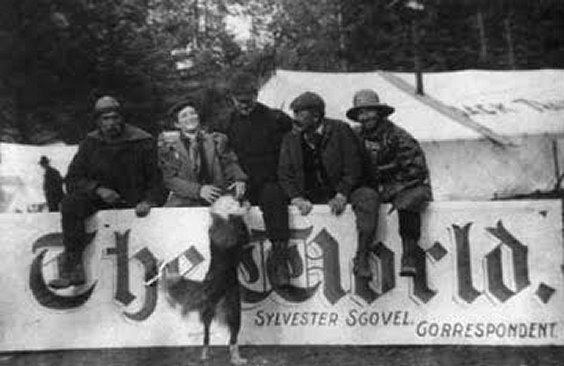
Frances second from left
“He left Frances in a tent at Lake Bennett while he took a boat down to Seattle to wire his employers for support in this venture. The World took three days to respond and then turned him down flatly and ordered him back to New York immediately. He wrote to Frances to return to Skagway and take the first boat down to Seattle as he was returning to New York. He also wrote to William Saportas, an acquaintance and fellow reporter in Skagway (also friend of Soapy) to please go find the "madame" in Lake Bennett and take her down south. Meanwhile poor Frances had not heard from her husband yet and so related in a letter to her mother that Bennett was "awful, awful without him and in this hole - it is death."
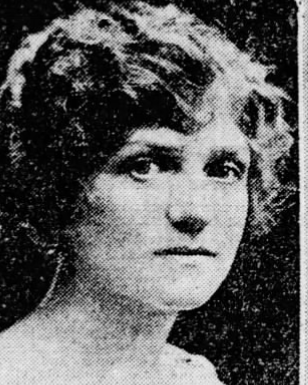
Billy rescued Frances and she made her way south to her husband Sylvester. They were in a café in Havana harbor when the Maidie exploded. Sylvester rowed out to the battleship while its ordnance was still exploding and became even more famous. But he died of complications of malaria and his widow returned to St. Louis.
There she worked at the society editor for the St. Louis Post Dispatch.
Meanwhile a strong dislike of Soapy Smith and all his works and pomps and all his associates was growing in Skagway, and these associates included Billy Saportas. Jefferson Randolph "Soapy" Smith II (1860 – July 8) was an American con artist and gangster in the American frontier.
Jeff Smith continued his account:
“Smith operated confidence schemes across the Western United States, and had a large hand in organized criminal operations in both Colorado and the District of Alaska. Smith gained notoriety through his ‘prize soap racket,’ in which he would sell bars of soap with prize money hidden in some of the bars' packaging in order to increase sales. However, through sleight-of-hand, he would ensure that only members of his gang purchased ‘prize’ soap. The racket led to his sobriquet of ‘Soapy.’
The success of his soap racket and other scams helped him finance three successive criminal empires in Denver and Creede, both in Colorado, and in Skagway, Alaska.
On the evening of July 8, 1898, about 9 p.m., Soapy Smith was inside Smith's Parlor drinking when William ‘Bill’ Saportas, a reporter for the Daily Alaskan and a member of the Soap Gang, came to Smith and gave him a note that read, ’the crowd is angry, if you want to do anything do it quick’' ... [signed] 'S'. Smith stuffed the note into his pocket, grabbed a rifle and revolver and decided to attend the vigilante meeting.
He was killed in the shootout on Juneau Wharf in Skagway, on July 8, 1898.”
His associates, including William Francis Saportas, who protested he was innocent of any involvement, were all deported to Seattle to be dealt with by the law.
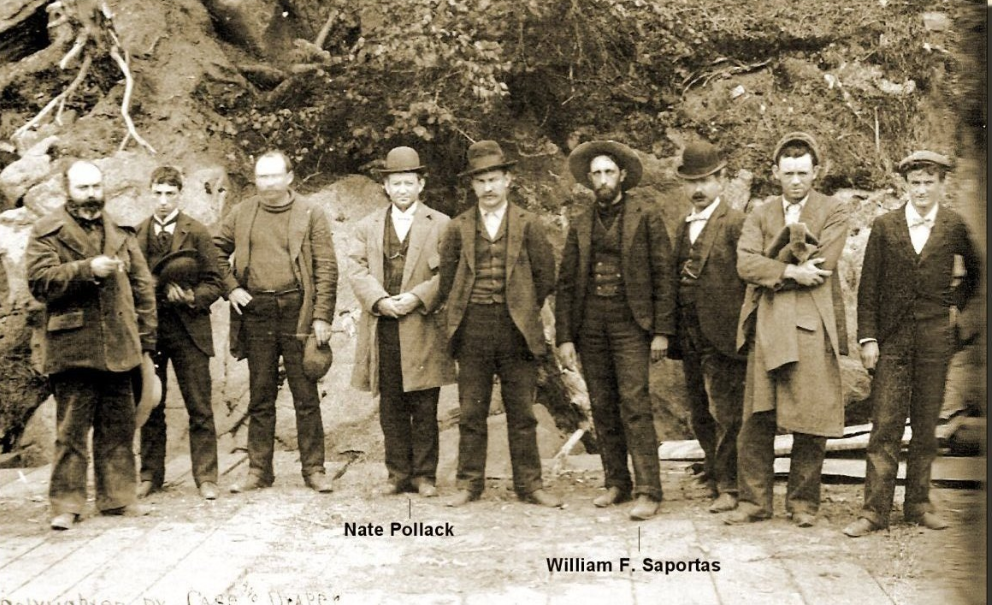
The newspaper reported that “W. F. Saportas will return [to Skaguay] on the next steamer. He says he came out to look after some business matters. He thinks that Soapy Smith wanted to commit suicide when he went down to the wharf. He thinks that the matter might have ended very differently had not Soapy ran up against the nervy Reid. He agrees with the prevailing opinion in the north that Skaguay will be a much better town now that Smith is dead.”
No one believed Saportas. But nothing happened to the deportees in Seattle.
As for Saportas, he resorted to what some have done in romantic movies when in trouble: join the French Foreign Legion. William, though, who was not that romantic, did not go so far. At the Presidio in San Francisco on October 4, 1898, at the age of 26 years, 8½ months, he joined the U.S. Army. He was made a clerk, served his enlistment, enlisted again and continued enlisting. He received good-to-excellent reviews, rose to sergeant, sergeant major, and into the officer ranks to captain. Saportas received postings all over the country, and apparently in his travels, he met again the wife of Sylvester Scovel, whom he had rescued from Bennett and who had become Scovel’s widow. He married her in Hawaii in 1917 in a service conducted by Father Fealey, the Catholic chaplain of the First Field Artillery.